Traditional Client Portals vs. Engagement Platforms: A Complete Comparison
12 min Read
A client portal. You probably have one. Your clients probably ignore it.
If you’re like most advisors, you’ve seen the pattern: excited client onboarding, initial login, maybe a second visit to check their balance after a volatile market day, and then… silence. Crickets. The portal sits there, while you continue communicating with clients the old-fashioned way: through quarterly meetings and the occasional phone call.
Here’s the uncomfortable truth: the average client portal achieves about 10% regular engagement. That means 90% of your clients are M.I.A. They’re experiencing mostly silence from you. And in that silence, they’re hearing from everyone else: CNBC, their neighbor’s crypto stories, that TikTok finance influencer their kids are following.
Here’s the good news: A different category of technology is emerging in our industry: engagement platforms. And the results are dramatically different. Advisors using true engagement platforms are seeing 70-90% monthly client engagement. Not one-time logins. Regular, ongoing engagement.
What’s the difference? Let’s break it down.
The Fundamental Difference: Passive vs. Proactive
Traditional client portals are passive. They sit and wait, hoping your clients will remember to log in. It’s like setting up a beautiful office and hoping clients will randomly stop by to visit. Some will. Most won’t.
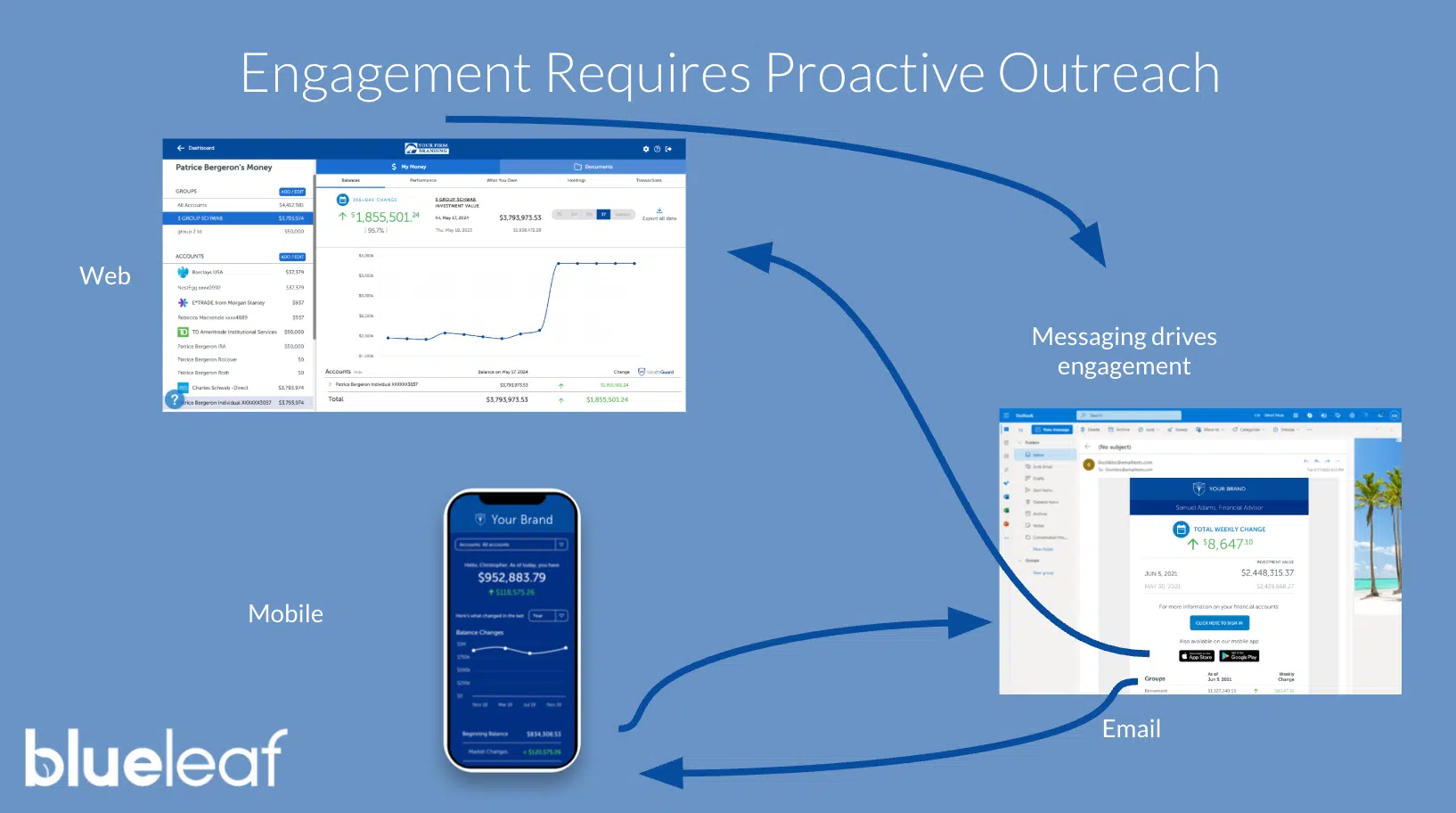
Engagement platforms are proactive. They reach out to clients where they already are: on their phones, in their email, on the web. They deliver timely, relevant information that keeps your brand and value top of mind. It’s less like waiting for clients to visit your office and more like the way Netflix or Amazon stays connected with you. When did you last wonder whether Netflix was still there for you? Never. Because they remind you constantly with personalized recommendations and new release notices.
This isn’t just a philosophical difference. It’s a business model with measurable results.
Feature-by-Feature Breakdown
Communication Channels
Traditional Portals:
- Single channel: web-based or mobile portal access
- Client must remember to log in
- Information lives behind a login wall
- Communication is one-way: advisor uploads, client (maybe) views
Engagement Platforms:
- Multi-channel delivery: mobile apps, web, email, push notifications
- Content reaches clients automatically
- Information flows to clients where they already are
- Two-way interaction: clients can engage, comment, and respond
Why it matters: Your clients check their phones 96 times per day on average. They check their financial advisor’s portal maybe once or twice a year, if you’re lucky. Meeting clients where they are isn’t a nice-to-have anymore. It’s table stakes.
Content Delivery Model
Traditional Portals:
- Static document library
- Quarterly performance reports (that no one reads)
- Account statements and tax documents
Engagement Platforms:
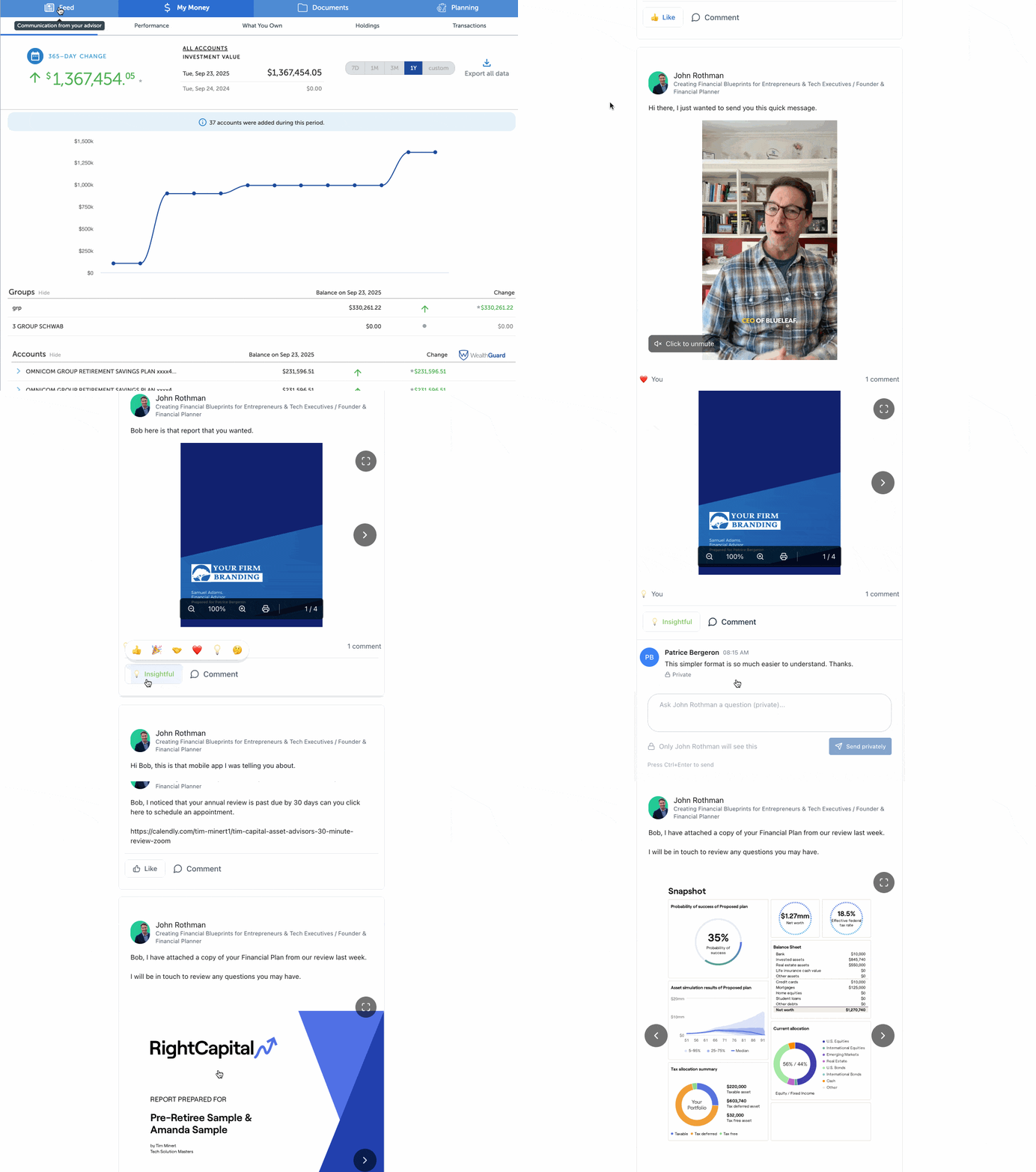
- Social media-style feed with dynamic content
- Proactive outreach to deliver value to clients
- Multi-channel delivery (mobile, web, email, push notifications)
- Automated reports and messaging with personalized insights
- Analytics that track what clients actually engage with
- Compliance workflows and auditing are built in
- Multiple content types: video, articles, quick updates, visual data
When I talk to advisors who’ve made this switch, they tell me the same story. One advisor said,
“I used to spend hours creating this gorgeous 50-page quarterly report. Maybe 2% of my clients actually read it. Now I send weekly 90-second updates on what’s happening with their money. Almost everyone engages with it.”
Engagement Tracking
Traditional Portals:
- Limited metrics
- May not even show logins
- No insight into actual engagement or activity
- Often completely hidden
Engagement Platforms:
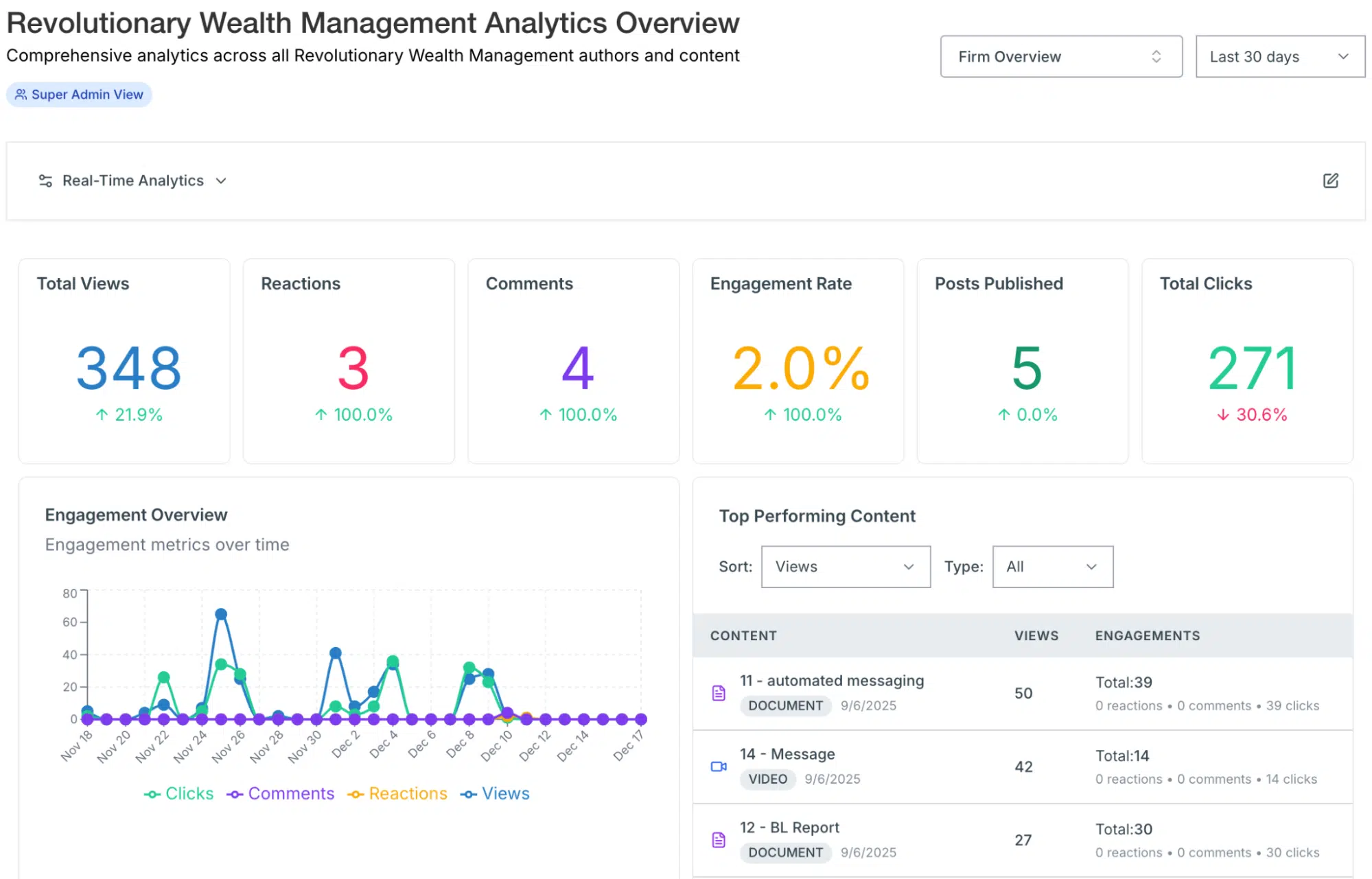
- Real-time activity monitoring dashboard
- Content performance analytics
- Client behavior patterns
- Engagement scoring across all touchpoints
- ROI measurement tools
This matters more than you might think. If you don’t know what clients are engaging with, you’re flying blind. You’re guessing about what communication works, what timing is right, what format resonates. Engagement platforms give you data to optimize everything.
Mobile Experience
Traditional Portals:
- Companion mobile apps or mobile-only experiences
- Client must open the app to see updates
- May include messaging but no automation
- Each channel operates independently (email, web, and mobile are separate experiences)
- A mobile app is just another destination to remember to visit
Engagement Platforms:
- Native mobile apps with mobile-optimized experiences
- Push notifications bring updates to clients automatically
- Content flows intelligently across channels – email opens to mobile OR web
- Unified experience regardless of entry point
- Mobile isn’t just another app to open – it’s part of a seamless multi-channel system that meets clients where they are
Remember: 72% of people over 70 now use online banking, and they’re doing it on their phones. Your grandparent clients aren’t intimidated by mobile anymore. They expect it.
Automation Capabilities
Traditional Portals:
- Manual report creation and/or uploads
- Advisor-initiated communication only
- Limited workflow automation
- Heavy lifting is required for each client touchpoint
Engagement Platforms:
- Automated micro-reports
- Workflow automation for content creation and distribution
- Integration with CRM for user segmentation
- Scheduled content publication
Jason Wenk, who founded Altruist, was one of the first to crack this code. He realized that automation was essential to reach an impactful number of client touches per year. For him that was about 150. You can’t do that manually. There aren’t enough hours in the day…
Integration and Data
Traditional Portals:
- Often part of another platform built to lock you in.
- May have integrations, but limited to a few systems
- Aggregation capabilities are often an afterthought
- Siloed by design – built for their ecosystem, not yours
Engagement Platforms:
- Platform-agnostic – works alongside your existing technology (Blueleaf, Orion, BlackDiamond, Addepar, etc.)
- Can easily incorporate content from any source, not just pre-built integrations
- Changing other systems doesn’t disrupt client experience
- Direct data aggregation capabilities reduce third-party dependencies
- Enhances what you already have rather than replacing it
One critical distinction: the best engagement platforms don’t require you to rip out your existing technology stack. They enhance it. If you’re already using Blueleaf, Orion, BlackDiamond, or Addepar for portfolio management, you don’t need to switch. The engagement layer sits on top, making everything work better.
The 10% vs. 90% Engagement Mystery Solved
So why the massive difference in engagement rates? Let’s break down what’s really happening.
Why Traditional Portals Get ~10% Engagement:
- No Trigger: Nothing prompts them to engage between meetings
- Cognitive Load: Clients must remember another login, another password, another website to check
- Static Content: Same view every time, unless markets move dramatically
- Desktop-Oriented: Most aren’t optimized for mobile use
- One-Way Street: Clients can only consume, not interact
- Buried Value: The good stuff is hidden behind login walls and navigation menus
Why Engagement Platforms Achieve 70-90% Engagement:
- Automated outreach: Content comes to clients via email, mobile push, or one-tap app access
- Regular Touchpoints: Weekly or even daily micro-interactions keep your brand present
- Dynamic Content: Something new every time they engage
- Multi-channel: Designed for how people actually use technology today
- Two-Way Interaction: Clients can respond, react, and engage
- Obvious Value: Every touchpoint delivers clear, immediate value
I’ve seen this transformation firsthand. One advisor told me,
“My clients used to call me panicked during every market dip. Now they don’t, because they’re seeing regular updates that put everything in context. They’ve been gradually educated to understand that their diversified portfolio moves differently than the S&P 500 headlines.”
That’s the power of consistent, automated engagement. It’s not just about keeping clients happy. It’s about helping them make better decisions and behave in ways that serve their long-term interests.
Cost-Benefit Analysis
Let’s talk money. At the end of the day, this is a business decision.
Here’s the thing: most traditional portals are free. They’re bundled with your custodian or portfolio management platform. Engagement platforms cost real money – Blueleaf Engage runs about $100 per advisor per month for an enterprise, or roughly $1 per client per month.
So the question isn’t “which is cheaper?” Obviously, free is cheaper. The question is: “Is it worth paying for dramatically better engagement?”
Let’s run the numbers for a business with 60 advisors and $10B AUM:
Traditional Portal Scenario:
- Portal cost: $0/year (bundled with custodian or other software provider)
- Referrals per year: 400 new clients
- Revenue from new clients: $2,000,000 (at $500K average AUM, 1% fee)
- Time spent on panic calls during volatility: ~4,000 hours/year across the team
Engagement Platform Scenario:
- Platform cost: $72,000/year
- Referrals per year: 800 new clients (engaged clients refer 2x more)
- Revenue from new clients: $4,000,000
- Time spent on panicked calls: ~1,000 hours/year
The Real ROI Math:
Year one impact:
- Additional revenue from 400 more referrals: $2,000,000
- Platform cost: -$72,000
- Net benefit: ~$1,928,000
- Time saved: 3,000+ hours per year
Return: Over 25x ROI in year one
And this compounds. Those 400 additional clients will refer others. Within three years, you’re looking at 1,200+ additional clients from the referral multiplier effect and $6M+ in additional annual revenue.
The Practice Value Premium
This is something most advisors don’t think about, but practice valuations are tied to growth rates, not just revenue or profitability.
An individual practice growing at 30% per year commands a dramatically higher multiple than one growing at 10%. Industry data shows that high-growth practices (25%+ annual growth) can command 6-8x revenue multiples, while moderate-growth practices settle for 2-3x. On a $10M revenue practice, that difference is $30M-$50M in sale value.
And here’s the kicker: most deals include earnouts. The buyer pays you over 3-5 years based on client retention. Engaged clients stick around. Disengaged clients drift away during transitions.
One advisor who recently sold told me:
“The buyer specifically asked about our client engagement metrics. When I showed them our 85% monthly engagement rate and our 25% annual growth from referrals, they offered an 8x multiple instead of their standard 3x. On our $10M revenue, that was an extra $50M. And because our clients were so engaged, we hit every earnout milestone. The return? Literally $50M more at sale.”
Think about that math:
- Platform cost over 10 years: $12,000-24,000 per individual practice
- Additional practice value from higher growth multiple: $30M-$50M
- Additional earnout payments from engaged clients sticking around: $5M-$10M
The question isn’t whether you can afford an engagement platform. It’s whether you can afford to leave tens of millions on the table when you eventually sell.
Free is expensive when it costs you growth rate, practice value, and earnout payments.
Implementation Complexity Comparison
One concern I hear constantly: “This sounds great, but what does implementation actually look like?”
Fair question. Let’s be honest about what’s involved with each approach.
Traditional Portal Implementation:
- Technical setup: 1-2 days (usually handled by your platform vendor)
- Client rollout: 2-6 months, depending on your approach
- Client training and adoption efforts are required
- Ongoing manual processes for uploading content and reports
- Already integrated with your existing platform (that’s the whole point)
Engagement Platform Implementation:
- Technical setup: 1-2 weeks for core functionality
- No migration required – works alongside your existing technology
- Client rollout: 1-3 months for full adoption
- Client adoption requires no training
- Content setup: Mix of automated and manual
- Automated: financial updates, account summaries, planning, and risk updates
- Manual: your custom content management
- One-time content strategy setup, then ongoing management
The Key Difference:
Traditional portals are simple to implement because they’re already part of your tech stack. The challenge is getting clients to use them. Let’s face it. You’re asking them to remember another login and proactively check in.
Engagement platforms require a slightly different upfront setup. The client adoption is easier because the content comes to them. More importantly, they don’t need to remember to log in.
One advisor described it this way:
“Setting up our portal took a few days. Getting clients to use it took a year, and we never got more than 15% regular usage. Setting up Blueleaf took about the same amount of time. Within three months, we had 75% of clients engaging because they were getting valuable updates automatically.”
The real work with either approach isn’t the technology setup; It’s the client rollout and adoption. The difference is whether you’re hoping clients come to you (traditional portal) or bringing value to them where they already are (engagement platform).
Making the Decision: What You Really Need to Consider
After talking with hundreds of advisors about this decision, here’s what matters most:
Choose a Traditional Portal if:
- You’re comfortable with 10% engagement rates
- You have all the referrals you can handle
- You’re not looking to grow
- You have time and staff to create all your client communications manually
Choose an Engagement Platform if:
- You want 70-90% client engagement
- You’re tired of panicked calls during market dips
- You compete with platforms that have better digital experiences
- Referrals are critical to your growth strategy
- You want to scale great advice efficiently
- You need to demonstrate ongoing value to justify your fees
- Your clients expect modern experiences
The Bottom Line
The gap between traditional portals and engagement platforms isn’t just about features. It’s about philosophy.
Traditional portals were built when digital was an afterthought. They’re passive, desktop-oriented, and assume clients will seek you out.
Engagement platforms were built for the world we live in now. They’re proactive, mobile-web integrated, and they reach out to clients where they already are.
The results speak for themselves: 10% engagement vs. 70-90% engagement. That’s not a marginal improvement. That’s a different category of client experience.
I started Blueleaf because I saw this problem coming. In 2008, during the financial crisis, I got hundreds of panicked calls from advisors who couldn’t see all their clients’ assets in one place. But the deeper problem wasn’t just data aggregation. It was client engagement. Advisors were only connecting with clients a handful of times per year. The rest of the time? Silence. And into that silence came fear, anxiety, and bad decision-making.
The advisors who are thriving today aren’t the ones with the best portfolios or the most sophisticated strategies. They’re the ones who’ve mastered consistent, valuable, engaging client communication. They’re present in their clients’ lives 150 times per year, not 4 times. They’re using technology to make themselves more human, not less.
The choice isn’t really between a traditional portal and an engagement platform. It’s between the advisor you are today and the advisor you need to become to thrive in this new era. Digital engagement isn’t a nice-to-have feature. It’s how you demonstrate value, build loyalty, and grow your practice.
Your portal is waiting for your clients to visit. Your clients are waiting for you to show up in their lives in meaningful, consistent ways.
Which world do you want to live in?