If Your Advisors Switched TAMPs, Would Their Clients Notice?
7 min Read
TAMPs compete on performance, price, and platform. The advisors who stay longest are often the ones whose clients would feel the change.
Most TAMP leaders know the honest answer. For many advisors, the clients would notice very little.
A move would change the back office. It would change the models and the reporting behind the scenes. But the client would keep hearing from the same advisor, in the same way, about the same things.
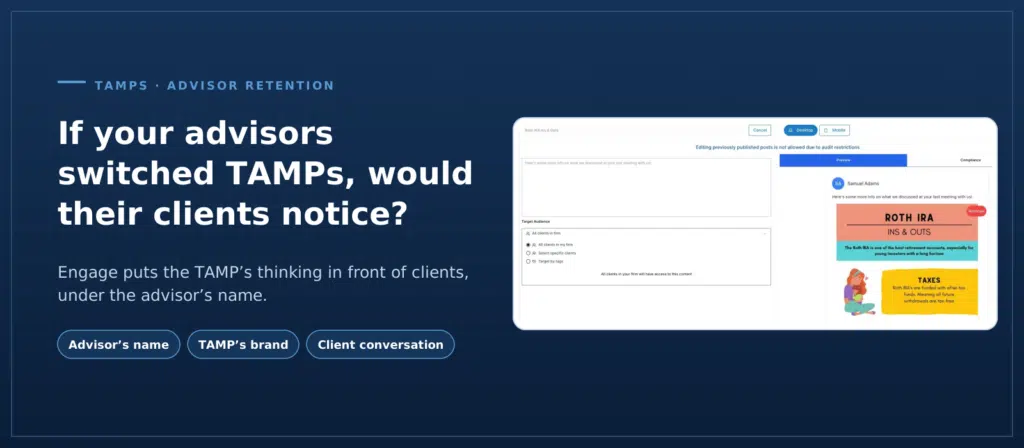
That is the retention problem in one question. The TAMP’s best thinking rarely reaches the people whose money it manages.
It can. And when it does, the answer to the headline changes.
Three Pressures on Every TAMP
TAMP leaders face three pressures at once. Each one makes the others harder.
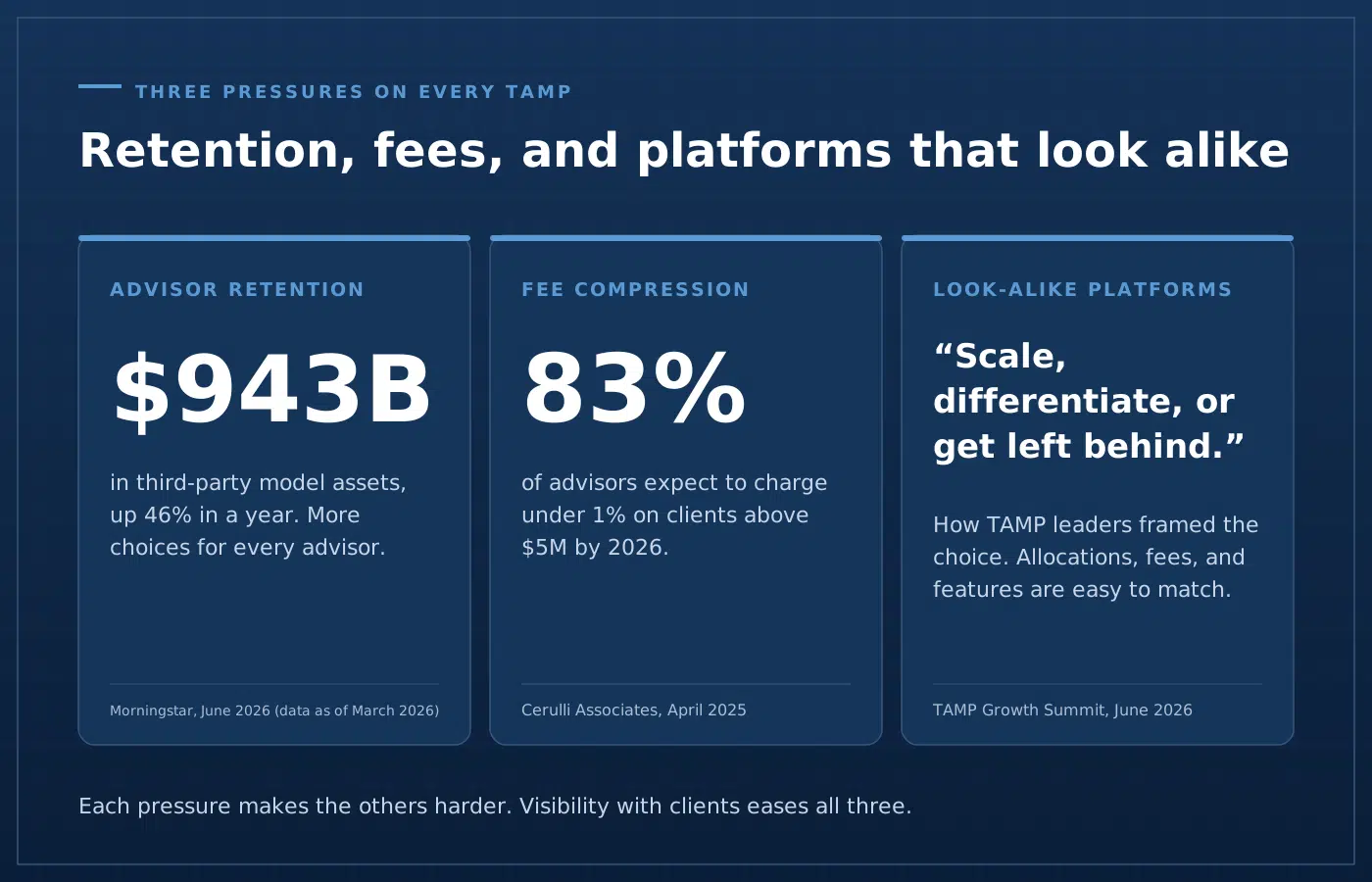
The first is advisor retention. Advisors have more choices than ever. Morningstar’s 2026 U.S. Model Portfolio Landscape, released in June 2026, put third-party model assets at $943 billion as of March 2026. That was up 46% in a year. Custom models alone held $258 billion.
$943B in third-party model portfolio assets, up 46% in a year (Morningstar, data as of March 2026)
The second is fee compression. Advisors are feeling it in their own pricing. Cerulli Associates surveyed advisors on pricing in April 2025. By 2026, 83% expect to charge less than 1% on clients with more than $5 million. Clients want more service for lower fees.
When an advisor’s own margin tightens, every basis point paid to a platform gets a harder look.
The third is platforms that look alike. At the June 2026 TAMP Growth Summit, leaders from Envestnet, AssetMark, SEI, Orion, and others framed the choice plainly. Scale, differentiate, or get left behind.
Differentiation is the hard part. Allocations can be matched. Fees can be matched. Platform features get copied within a cycle or two.
What Advisors Want From Their Providers
Cerulli asked advisors what support they value most from asset managers. The answers appeared in “U.S. Intermediary Distribution 2026,” released in August 2026.
Client engagement strategies ranked first, at 37%. Financial plan implementation came next, at 29%. Behavioral finance tools for client meetings followed, at 27%.
The same study found a gap. Fifty-two percent of distribution professionals thought advisors wanted business consulting and growth guidance. Only 16% of advisors said so.
Advisors aren’t asking providers to run their practices. They’re asking for help reaching their clients.
Two other findings point the same way. Eighty-four percent of advisors rated thought leadership content as important. Seventy-six percent said the quality of the digital experience matters to their decisions.
Advisors value the provider’s thinking. They want help putting it in front of clients.
The Work Clients Never See
Outsourcing frees advisors for other work. Cerulli measured it in November 2025. Advisors who outsource portfolio construction spend about 10.6% of their time on investment management.
That is the point of a TAMP. It also means much of the TAMP’s work happens out of the client’s view.
Consider where a TAMP’s best material goes today. Quarterly commentary goes to advisors. Rebalancing rationale goes to advisors. Market notes after a volatile week go to advisors, who may or may not pass them on.
| TAMP asset | Where it goes today | Who sees it |
|---|---|---|
| Quarterly market commentary | PDF or advisor site | Some advisors |
| Rebalancing rationale | Advisor communications | The advisor |
| Model explainers | Sales materials | Prospective advisors |
| Market-event notes | Advisor email | The advisor, and clients if forwarded |
Most of a TAMP’s thinking reaches the client only if the advisor carries it there.
Work the client never sees is easy to replace. Switching TAMPs changes little the client would notice.
Your Platform Is the Base
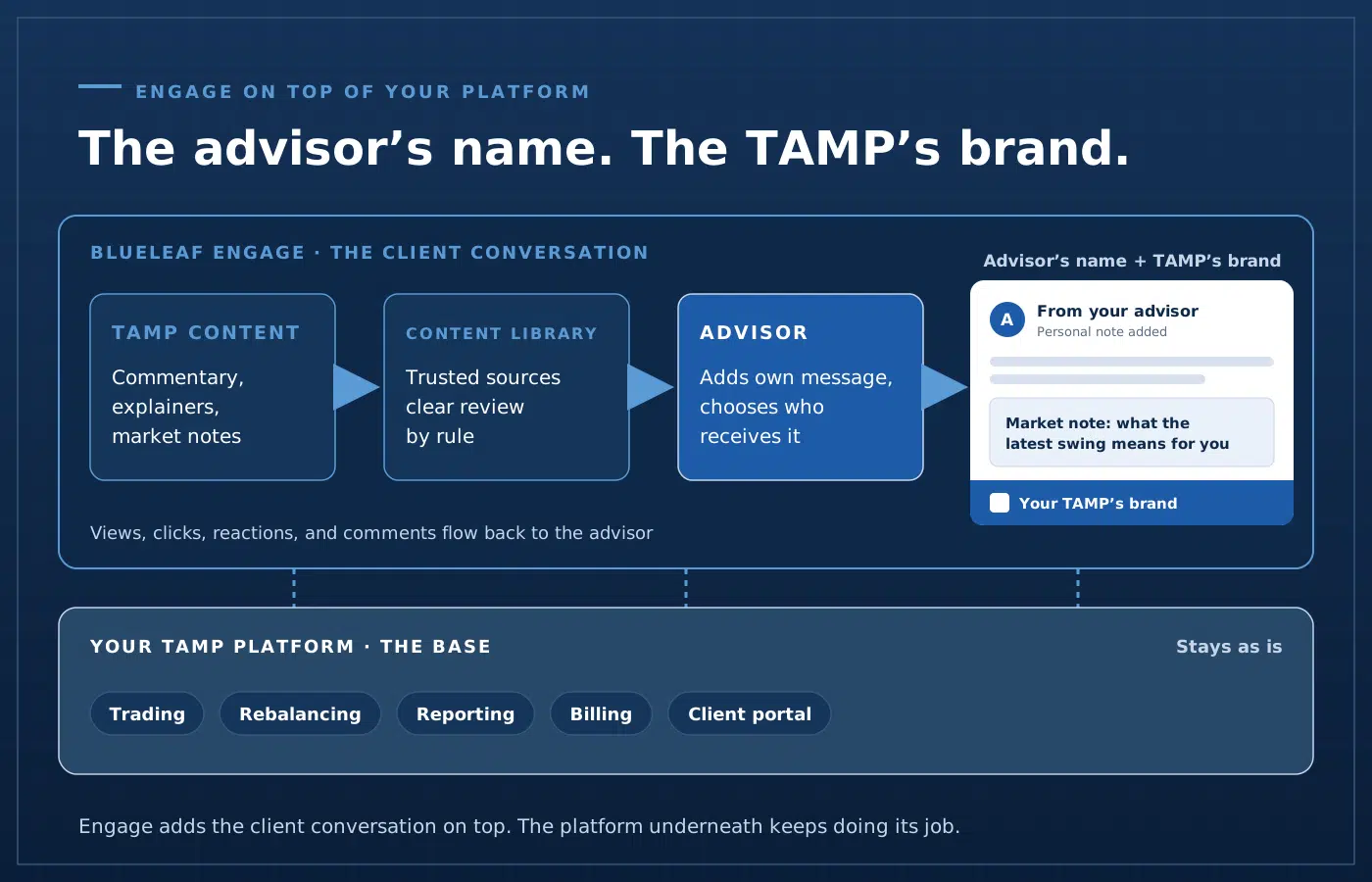
The TAMP owns the platform. Trading, rebalancing, reporting, billing, and the client portal run there. It is the system of record, and it does that job well.
Advisors chose it for good reasons. Nothing about that needs to change.
Blueleaf Engage does not replace any of it. It sits on top of the TAMP’s platform and adds one thing: the client conversation.
What Engage Adds on Top
With Engage, a TAMP’s thinking can travel all the way to the client.
- TAMP content in the advisor’s library. Commentary, explainers, and infographics can be published to a central content library. Content from sources a firm marks as trusted can clear review by rule. That rule is set by the firm, not by AI.
- Shared in the advisor’s own voice. Advisors choose what to send and add their own message.
- Branded on every post. Posts go out under the advisor’s name and carry the TAMP’s brand.
- Sent to the right clients. Advisors can target the whole book, specific clients, or segments by tag, such as retirees or plan participants.
- Signals back from clients. Views, clicks, reactions, and comments flow back to the advisor. Analytics show which content gets read and which falls flat.
The Advisor’s Name and the TAMP’s Brand
Branding answers two questions at once.
The TAMP asks: will clients ever know this came from us? Yes. The TAMP’s brand travels with every post the advisor sends.
The advisor asks: will the TAMP start talking to my clients? No. The advisor decides what to send, adds their own words, and chooses who receives it. Every post goes out under the advisor’s name.
The client hears from the advisor they trust. They also see who stands behind the advice. That makes the advisor look better informed, more often.
The advisor’s name on every post. The TAMP’s brand on every post. One conversation, two relationships strengthened.
How Visibility Becomes Retention
Lasting retention rarely comes from contracts. It comes from being hard to replace.
A TAMP whose commentary reaches clients every month becomes part of the client experience. Clients come to expect the note after a market swing. They notice when it stops.
Advisors notice too. Their clients engage. Their meetings start from a shared understanding. Replacing the TAMP now means replacing a voice and a brand the clients know.
It also changes the fee conversation. A TAMP the client sees every month is easier to justify than a line item the client never notices.
TAMPs already connect engagement to advisor results. At the June 2026 summit, AssetMark said its most engaged advisors reach low-double-digit organic growth. That is AssetMark’s own figure, but the direction is telling.
Five Questions for Your Distribution Team
Heads of Distribution should be able to answer these before the next advisor review.
- What share of our commentary ever reaches an end client?
- How many steps does an advisor take to share our market note with clients?
- Could our content clear an advisor’s review by rule, or does it need review every time?
- Where does our brand appear in what clients see each month?
- If an advisor switched TAMPs tomorrow, would their clients notice?
Competing on More Than Price and Platform
TAMPs will keep competing on performance, price, and features. That race does not end, and it rarely produces a lasting lead.
The advisors who stay longest want something harder to copy. They want help keeping clients informed, engaged, and confident.
A TAMP that helps them do it becomes part of how their clients experience advice. Then the answer to the question changes. Yes, the clients would notice.
See how TAMP content reaches clients through Blueleaf Engage. [Request a Demo]