Multi-Channel Magic: How One Piece of Content Reaches Clients Everywhere
11 min Read
Here’s a scenario I bet you’ve lived through: You spend two hours crafting the perfect client newsletter or market commentary. You write it, edit it, and get it compliance-approved. Then you copy-paste it into your email system, manually format it for your website, and try to figure out how to make it look decent on mobile. You wonder if you should post it to your portal.
By the time you’re done, it’s taken half your day, and you’re pretty sure most of your clients will never see it anyway.
There has to be a better way …
The Fragmentation Problem Nobody Talks About
Most advisors today are managing what I call “the channel circus.” You have email over here. Your client portal is over there. Maybe a mobile app somewhere else. Text messages for urgent stuff. And none of them talks to each other.
So you’re constantly asking yourself: Should I send this as an email? Should I put it in the portal? Will my clients even check the portal? Maybe I should text them that there’s something new in the portal? But I don’t want to annoy them…
It’s enough to make you give up on client communication altogether. And many advisors do just that, falling back to quarterly meetings and hoping that’s enough.
Spoiler alert: it’s not.
In our research calls with advisors, we hear this pain point constantly. They know they should be communicating more frequently. They’ve read the studies about client engagement. They understand that staying top-of-mind matters. But the mechanics of actually doing it across multiple channels? That’s where they get stuck.
What Multi-Channel Actually Means (And Why Most Platforms Get It Wrong)
Let me be clear about what I mean by “multi-channel” because there’s a lot of confusion in the industry.
Multi-channel is NOT:
- Sending the same email to everyone and hoping they read it
- Having both a website and a portal (that nobody logs into)
- Posting to LinkedIn and calling it a day
- Having a mobile app that’s just your website in a wrapper
Real multi-channel means your content flows seamlessly across every touchpoint your clients use (mobile, web, email, messaging) without you having to manually manage each one. It means each channel is optimized for how clients actually use that channel.
Think about how Netflix does this. You start watching a show on your phone during your commute. You pick it up on your TV when you get home. You get an email when the next season drops. You see a notification on your iPad that there’s a new episode. It’s all the same content, but it’s delivered in the way that makes sense for each platform.
That’s what your client communication should feel like. But for most advisors, it feels more like a three-ring circus where you’re the one doing all the juggling.
Behind the Curtain: How Content Actually Flows
Let me walk you through how this works in Blueleaf Engage, because understanding the mechanics helps explain why this approach drives 60-90% monthly client engagement versus the industry standard of around 10%.
Step 1: You Create Once
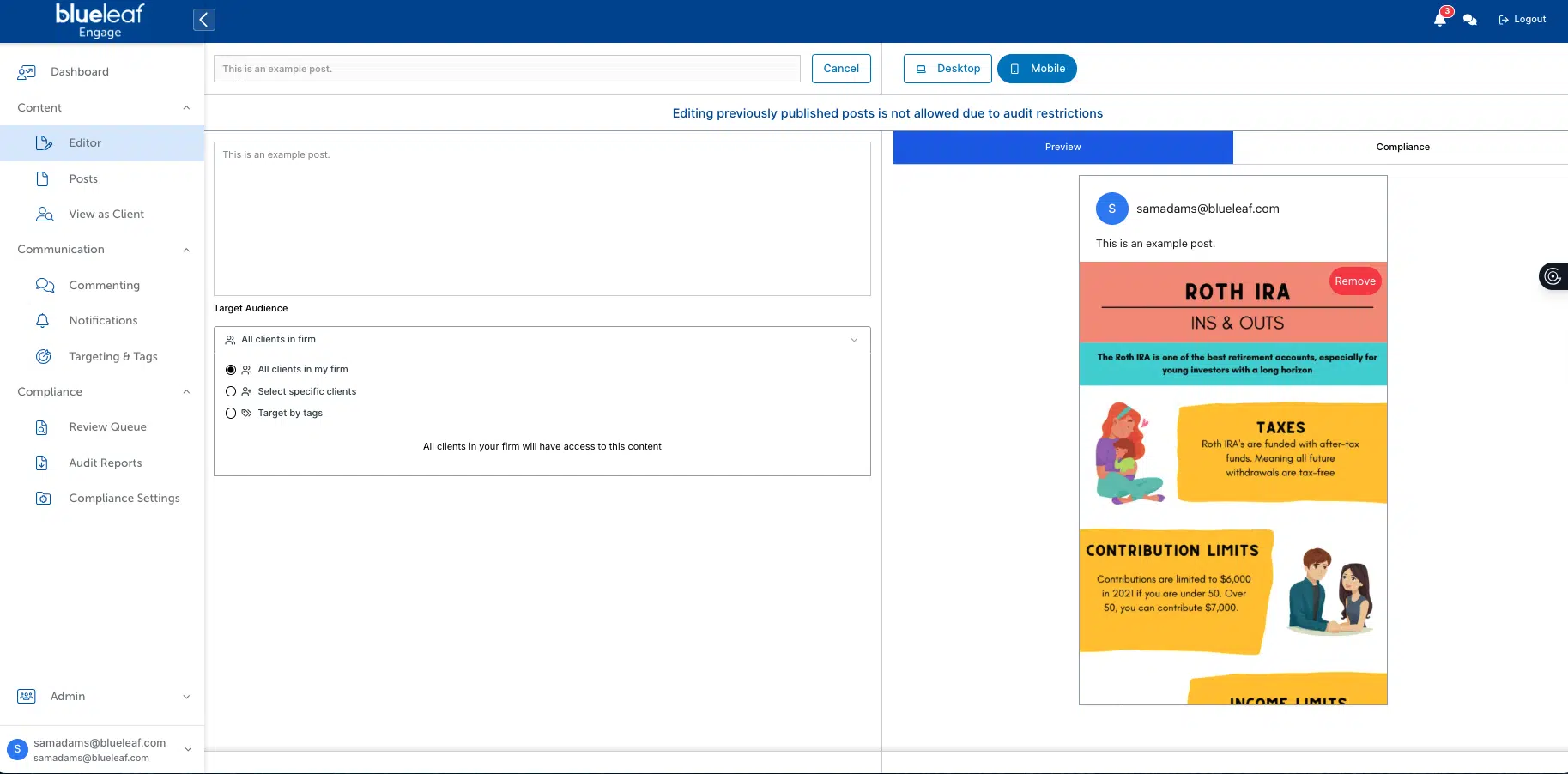
You write your content in our visual editor. Market update. Planning insight. Service announcement. Whatever it is. You can add any images, documents, or videos you want to include. You target it to the right client segments.
That’s it. One time. In one place.
Step 2: The Distribution Engine Takes Over
Here’s where the magic happens. The moment you publish, our system automatically:
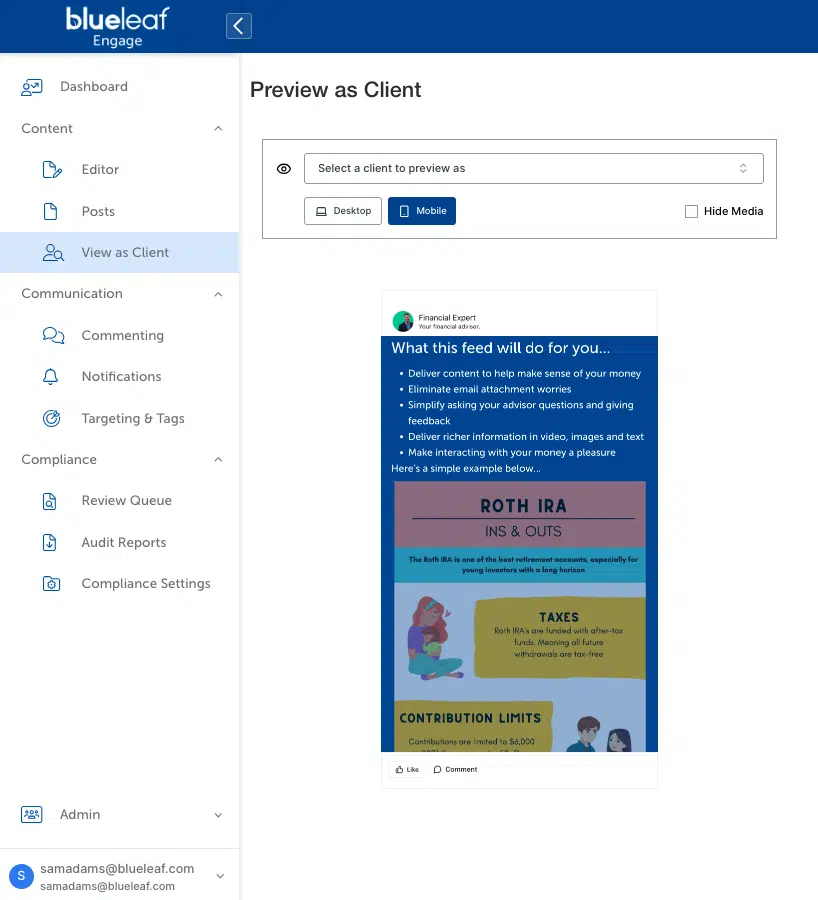
Delivers to Mobile: Your content appears in your clients’ mobile app feed. They see it the next time they open the app, or they get a notification if they’ve enabled them. The formatting is perfect for mobile: images resize, text is readable, videos play inline. No pinching or zooming required.
Displays on Web: The same content appears in the web portal, but it’s not just copied and pasted. It’s formatted for the larger screen. Tables display properly. Multi-column layouts work. Everything is optimized for desktop viewing.
Sends via Email: An email summary goes out automatically. But it’s not just a link saying “go check the portal.” It makes it clear exactly what the content is and why it’s valuable, and even includes the media. And if they do click? They go directly to that specific content item, not some generic portal homepage.
Enables Messaging: Clients can comment or message you directly about any content. Those messages flow into your advisor dashboard, where you can respond. The conversation stays threaded and connected to the original content.
All of this happens automatically. You published once. The system handled the rest.
The Automatic Formatting That Clients Never See (But Always Notice)
I learned something fascinating in our user testing. When we ask clients why they like using Blueleaf Engage, they rarely mention “formatting.” But when we dig deeper into what makes them feel good about the experience, design comes up constantly, just not in those words.
They say things like:
- “It just works on my phone.”
- “I can actually read everything.”
- “It’s not clunky like other financial stuff.”
- “It feels modern.”
That’s all design and formatting. But it’s invisible when it’s done right.
Here’s what happens behind the scenes that clients never see:
Image Intelligence: Upload a high-res photo, and the system automatically creates multiple versions. There’s one optimized for mobile (smaller file, faster loading, right dimensions). Another for desktop (higher quality, better resolution). The system serves the right version to the right device. Clients just see “it looks good.”
Text Reflow: Your paragraphs automatically adjust for screen size. On mobile, line length is optimized for readability. On a desktop, it uses the full width effectively. Clients don’t consciously notice this, but their brains do. It’s why they can read your content without fatigue.
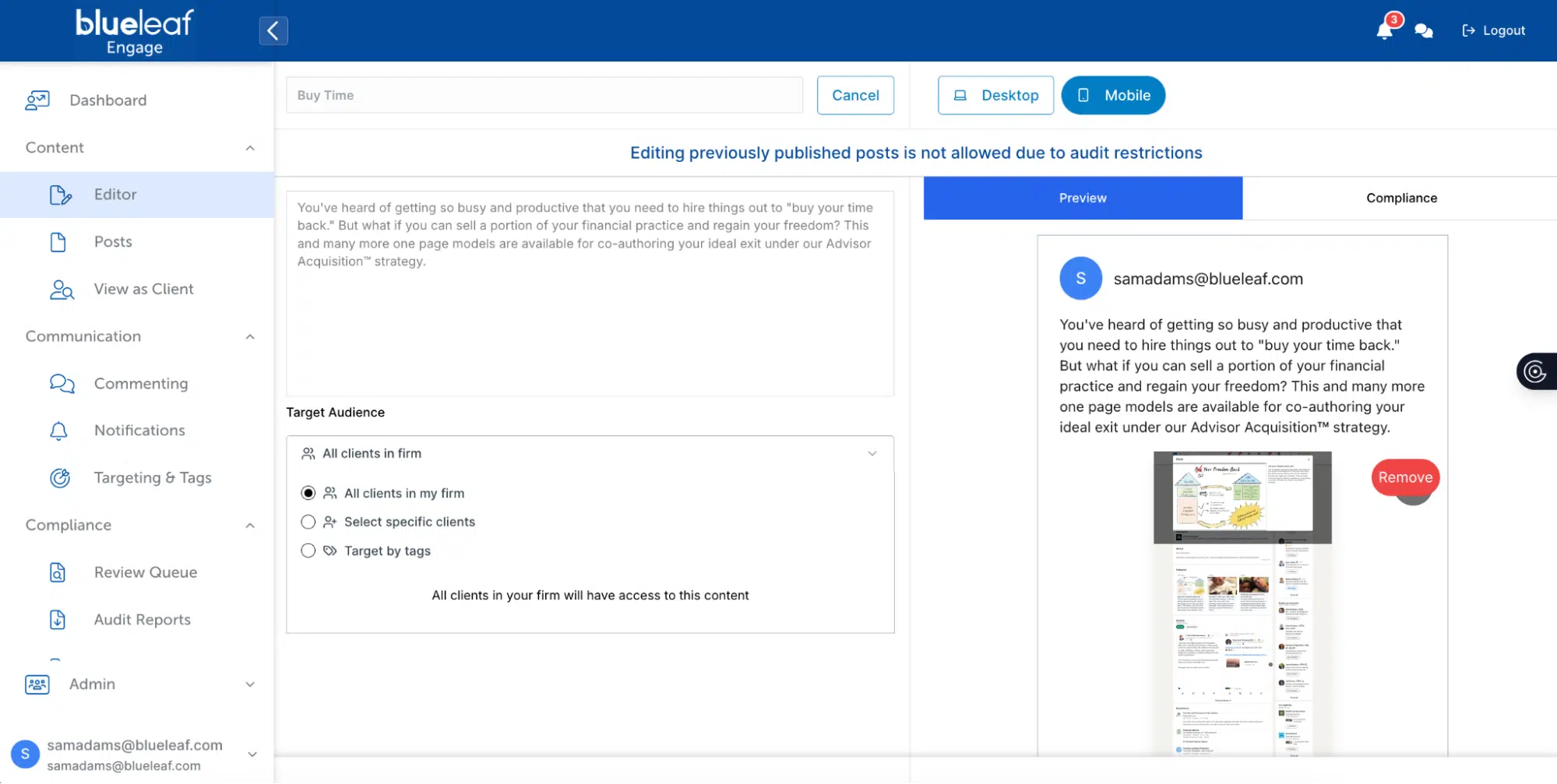
Video Handling: Embed a video and it plays inline on mobile, opens in a proper player on desktop, and shows a useful preview in email. Clients don’t have to think about “how do I watch this.” It just works.
Document Previews: Attach a PDF, and clients see a preview in their feed. They can download it if they want. Or they can just skim the preview. On mobile, the preview is optimized for thumb-scrolling. On a desktop, it’s formatted for mouse navigation.
None of this is magic. It’s just careful engineering. But it’s engineering that most platforms skip because it’s hard and expensive. They slap a responsive template on everything and call it “mobile-friendly.”
That’s not multi-channel. That’s lazy.
Client Control: The Secret Ingredient Nobody Thinks About
Here’s something that surprised me in our research: clients don’t just want more communication. They want control over their communication.
Some clients want email notifications for everything. Others want to check the portal on their schedule. Some love push notifications. Others find them intrusive.
The magic isn’t just multi-channel distribution. It’s distribution that respects how each client wants to interact.
In Blueleaf Engage, clients control their notification frequency:
- Immediate Notifications: Get alerted as content is published
- Daily Digest: Bundle everything into one email per day
- Weekly Summary: One comprehensive update per week
- Manual Check-In: No notifications at all. They’ll check when they’re ready
Beyond that, clients naturally express their channel preferences through how they use the platform. Maybe someone loves the mobile app for checking their portfolio, but disables push notifications because they find them intrusive. They’ll get an email instead. Another client might be mobile-only, checking the app daily but never opening emails. The system supports their behavior and adapts.
Meanwhile, you, as the advisor, control content targeting and distribution. You decide which clients get which content based on their needs. Retirees get different content than accumulators, and high-net-worth clients get different planning insights than mass affluent. That’s your expertise, your value-add.
What this means practically: you send content into the system once, targeted to the right segments. The system then delivers it to each client in the way they naturally engage. Some see a push notification. Some get an email. Some just see it next time they log in. Everyone gets the content, but on their terms.
This is why engagement rates are so much higher with this approach. You’re not forcing everyone into your preferred communication method. You’re meeting them where they are, while they maintain control over how intrusive (or not) those communications feel.
Real Examples: What This Looks Like in Practice
Let me show you how this plays out in real advisor practices.
Market Volatility Communication:
Jason (one of our long-time customers) records a 60-second video during a market dip. He uploads it to Blueleaf with a brief written summary.
Within minutes:
- 68% of his clients see a mobile notification
- The video plays in their feed—no clicking around
- 23% receive it via email (their preference)
- 9% see it next time they log into the web portal
- Clients can comment or message him directly
Result: He gets immediate feedback, catches panic before it spreads, and reinforces his value, all from one video upload.
Service Update About Tax Season:
Sarah’s firm is gearing up for tax season. She creates a checklist of documents clients need to gather. She uploads it with a brief explanation.
The system:
- Sends mobile notifications to clients tagged for tax planning
- Emails everyone else with a link to download the checklist
- Makes the checklist permanently available in their document vault
Result: Clients are prepared. Meetings are productive. Nobody’s scrambling to find documents the day before their appointment.
Quarterly Market Commentary:
A large RIA publishes its quarterly market commentary. It has charts, graphs, and detailed analysis.
The distribution:
- Executive summary in email with key takeaways
- Full report available in the portal (desktop-optimized)
- Key charts rendered properly in mobile feed
- Printable PDF in document vault
Result: Everyone gets what they need in the format that works for them. The compliance-conscious client who wants to read every word can do that. The busy professional who just wants the highlights gets those.
Why This Drives 6x Higher Engagement
Let me tie this back to the numbers because they’re remarkable. Traditional client portals see around 10% monthly engagement. With Blueleaf Engage’s multi-channel approach, we consistently see 60-90% monthly engagement.
Why such a massive difference?
- Friction Removal: Clients don’t have to remember to log into a portal. Content comes to them.
- Channel Flexibility: They engage on their terms, on their preferred channels.
- Format Optimization: Content looks good and works properly everywhere.
- Notification Intelligence: They get alerted to what matters, when it matters.
- Easy Interaction: Commenting, messaging, and engaging are simple, not separate processes.
But here’s what really matters: this isn’t just about technology. It’s about respecting your clients’ time and preferences. When you make it easy for them to stay informed and engaged, they do.
The Business Impact You Can’t Ignore
I’ve been talking about the client experience, but let me address the elephant in the room: your time.
“This sounds great, John, but I barely have time to create content once. You’re telling me to distribute it everywhere?”
Actually, no. I’m telling you the opposite.
With multi-channel distribution done right, you create content once, and the system handles distribution. You’re not copy-pasting into different platforms. You’re not reformatting for mobile. You’re not managing multiple notification systems.
You’re creating once and reaching everyone, everywhere.
Our customers report saving 5-10 hours per week on client communication management. That’s 250-500 hours per year. What’s that worth to your practice?
Plus, better engagement means:
- Fewer panic calls during market volatility
- More referrals (engaged clients refer more)
- Better client retention
- Increased share of wallet
- More productive meetings (clients are informed)
The ROI isn’t just in time saved. It’s in practice growth and client satisfaction.
Your Next Step
If you’re still manually managing multiple communication channels, or worse, if you’ve given up on frequent communication because it’s too hard, it’s time to see how multi-channel should actually work.
The technology exists. The results are proven. The only question is whether you’re ready to stop juggling and start engaging.
Want to see this in action? Schedule a demo. We’ll walk you through exactly how your content would flow across all channels, and why your clients will actually engage with it.
Because in 2025, your clients don’t just deserve better communication. They expect it. And now you can deliver it—without working harder.