One Brand, One Compliance Framework, Every Office
7 min Read
Twelve acquired firms. Twelve different client communication styles. Twelve sets of compliance review processes. One SEC examination. The fragmented communication infrastructure that comes standard with RIA aggregation is not just an operational inconvenience. It is a regulatory and brand liability that compounds with every deal.
The Aggregation Problem No One Talks About in the Deal Room
Enterprise RIA M&A due diligence is thorough about the things it knows how to measure: AUM, revenue, advisor headcount, client retention rates, ADV filings. It is considerably less thorough about the things that are harder to quantify: how does each acquired firm actually communicate with its clients, who reviews that communication before it goes out, and what does a client in the firm’s Boston office experience compared to a client in its Denver office?
The answer for most PE-backed aggregators is that we don’t know yet, and we’ll figure it out post-close.
What post-close reveals is a patchwork. Some acquired firms are running compliant communication workflows. Others are sending market commentary from personal Gmail accounts. Some have brand standards. Others have never thought about brand standards because they were independent. Some have written compliance approval processes. Others have the CCO read things informally when they remember. Every one of those variations is a liability. Together, they are in a crisis waiting for an SEC examination to find it.
What “Fragmented” Actually Means at Enterprise Scale
The word “fragmented” understates what most enterprise RIA communication infrastructure actually looks like after several years of aggressive acquisition. Consider a realistic scenario: a $15 billion PE-backed aggregator that has completed ten acquisitions over four years. Each acquired firm had its own technology choices, its own communication habits, and its own interpretation of what compliant client outreach looks like.
That firm is now managing three different portal platforms with no aggregated engagement data, four different email tools with no centralized compliance review, and advisor-initiated communications flowing directly to clients on an ad hoc schedule that no one at the enterprise level can see. Brand identity exists in the marketing materials. It has no reliable expression in the communications clients actually receive.
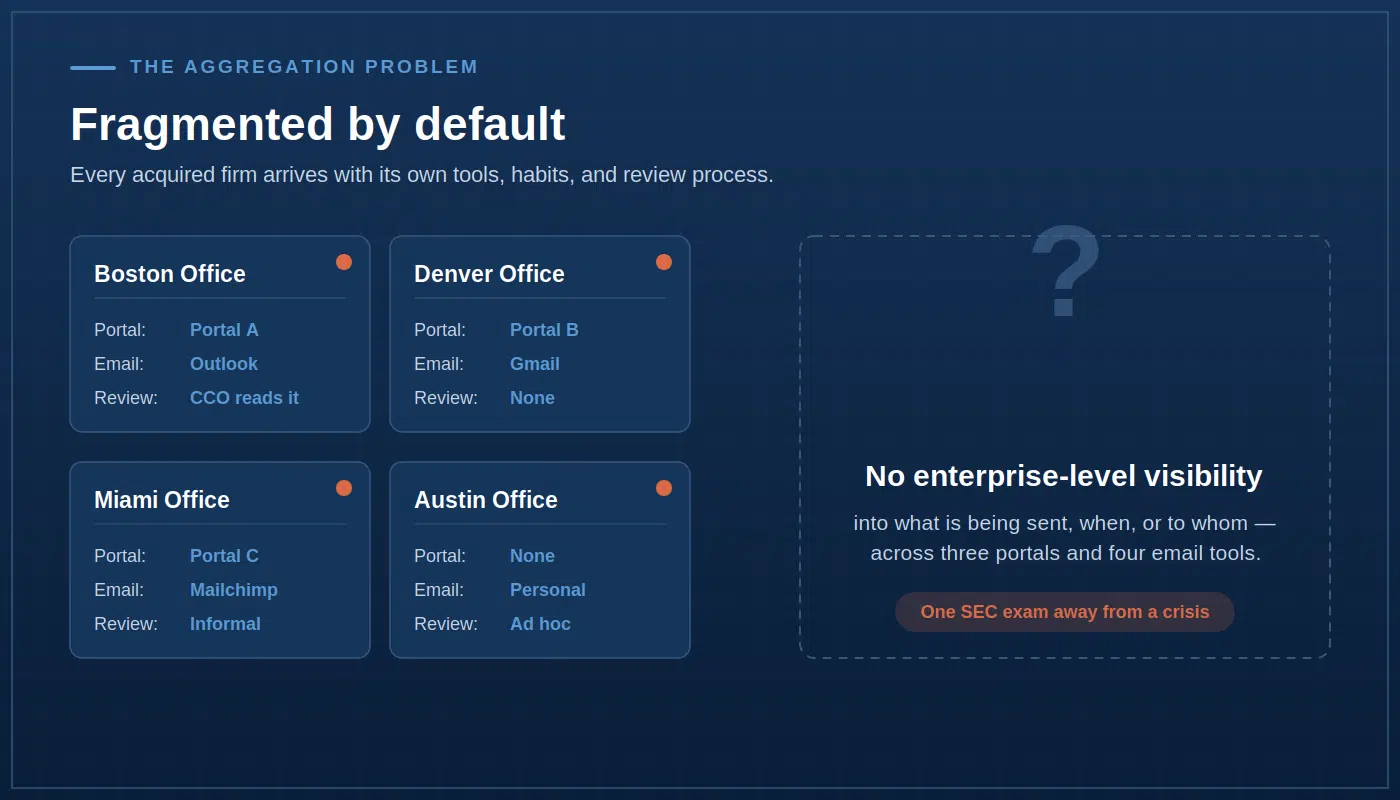
None of this is the result of negligence. It is the predictable outcome of acquiring firms that were built independently and integrating them without a unified client communication platform. The infrastructure problem is structural, not cultural.
You cannot have a brand without consistency. You cannot have compliance without visibility. And you cannot have either at enterprise scale without infrastructure that enforces both.
What Unification Requires
The instinct for most enterprise operators is to solve the fragmentation problem through policy: write a communication standard, circulate it to every office, and require compliance. This approach fails at scale for a predictable reason: policy without infrastructure is just aspiration. An advisor in a recently acquired firm who has been sending informal client emails for fifteen years will not reliably change that behavior because the parent firm issued a communication policy memo.
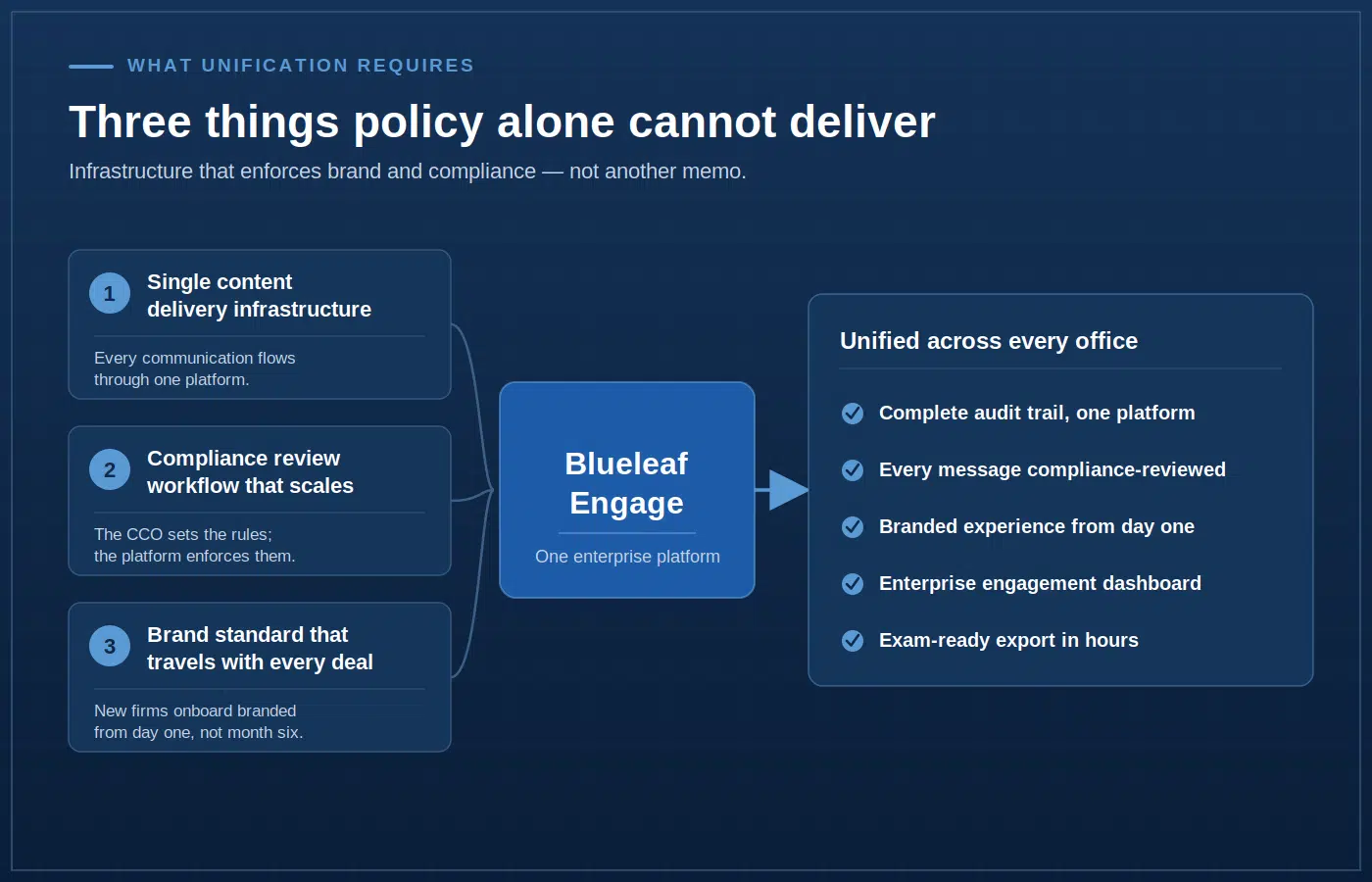
Unifying client communications at enterprise scale requires three things that policy alone cannot deliver.
A Single Content Delivery Infrastructure
Every client communication, market commentary, account update, firm announcement, and planning content should flow through a single platform that provides the enterprise with visibility into what is being sent, when, and to whom. Not to eliminate advisor personalization, but to ensure that personalization happens within a framework the firm controls.
Blueleaf Engage provides this infrastructure. A CMO at the enterprise level manages the content library and the brand standards. Individual advisors personalize within approved guardrails. Every communication that reaches a client has passed through the same compliance architecture, regardless of which office it originated from.
A Compliance Review Workflow That Scales
The compliance review process that works for a single-office RIA with twenty advisors does not scale to a multi-office enterprise with three hundred advisors across ten acquired firms. Asking the Chief Compliance Officer to personally review every piece of client communication is not a workflow. It is a bottleneck that advisors route around.
Engage routes every communication through firm-defined compliance approval workflows before delivery. The CCO sets the rules. The platform enforces them. Advisors submit content for review within the platform rather than emailing it informally. The audit trail is automatic, complete, and available for examination without a document collection sprint.
A Brand Standard That Travels With Every Acquisition
When a new firm joins the enterprise platform, its clients should begin receiving communications that reflect the acquiring firm’s brand: the logo, the color palette, the voice, the compliance disclosures, and the communication cadence that the enterprise has established as its standard — from day one, not after a rebranding project. The infrastructure that delivers that experience is already built and already running.
Engage’s multi-office architecture is designed specifically for this transition: new firms onboard to an existing communication infrastructure rather than building their own. The brand arrives with the platform.
Fragmented vs. Unified: What It Looks Like in Practice
| Scenario | Fragmented Infrastructure | Unified via Engage |
| SEC examination request for all advisor-client communications | Manual collection from 12 offices, 3 platforms, and multiple email accounts. Weeks of work. | Complete audit trail in one platform. Exportable in hours. |
| A new acquisition joins the platform | Communication blackout during integration. Ad hoc outreach until new systems are built. | Branded communication is live in week one. No gap in client experience. |
| CMO wants to update brand standards across the firm | Change requires retraining every advisor in every office. Enforcement is impossible. | Update the content library and templates. Every office reflects the change immediately. |
| An advisor sends unapproved market commentary to clients | No visibility until a client complaint or exam surfaces it. | Communication blocked at the platform level before delivery. |
| PE operating partner wants enterprise engagement metrics | Each office reports separately, in different formats, with no common baseline. | Unified engagement dashboard across every office and every book. |
The Brand Argument and the Compliance Argument Are the Same
It is tempting to treat brand consistency and compliance infrastructure as two separate problems with two separate owners: the CMO worries about brand, the CCO worries about compliance, and the CEO referees the turf. In practice, both problems have the same root cause and the same solution.
The root cause is the absence of a single communication platform that the enterprise controls. When advisors can send client communications through any channel they choose, using any format they prefer, without routing through firm-level review, the result is simultaneously a brand problem and a compliance problem. You cannot fix one without fixing the other.
Blueleaf Engage is the platform that fixes both. The CMO gets brand consistency across every office. The CCO gets a compliance review workflow that covers every communication. The CEO gets an enterprise-level engagement dashboard that makes client experience visible for the first time. And the advisor gets a tool that makes their practice run better, with more professional client communication and less manual effort, rather than a policy memo telling them to change their habits.
The firms that solve client communication fragmentation are not doing it to check a compliance box. They are doing it because consistent, branded, compliant communication is the foundation of a client experience that clients actually notice and refer to.
See what a unified client communication infrastructure looks like across an enterprise portfolio. [Request a Demo]
Blueleaf Engage provides the enterprise communication infrastructure that unifies brand, compliance, and client experience across every acquired firm, from day one of every transition, at the scale of the entire portfolio.