Platform Independence: Why Blueleaf Engage Works With the Systems You Already Have
7 min Read
The fastest way to kill an enterprise technology decision is to make it feel like a rip-and-replace. Blueleaf Engage is not that. It layers on top of your existing CRM, portfolio management platform, and custodial infrastructure. That means it can be live in weeks, not quarters, including inside a firm you just acquired.
The Integration Objection That Slows Every Enterprise Decision
There is a moment in nearly every enterprise technology evaluation when the COO asks the question that determines whether the conversation continues: how does this fit with what we already have? Enterprise RIAs are running Salesforce or Redtail, Orion or Black Diamond, Smarsh or Global Relay. A technology addition that requires replacing any of that is not a technology decision.
It is a multi-year implementation project. For a firm in active acquisition mode, that is a non-starter. Blueleaf Engage is built with this reality in mind. It layers on top of existing infrastructure, making it more useful without requiring any changes to it.
What “Works With Your Existing Systems” Actually Means
Platform independence is not a marketing claim. It is an architectural decision with direct operational consequences for enterprise firms, especially those in active M&A programs. Here is what it means in practice.
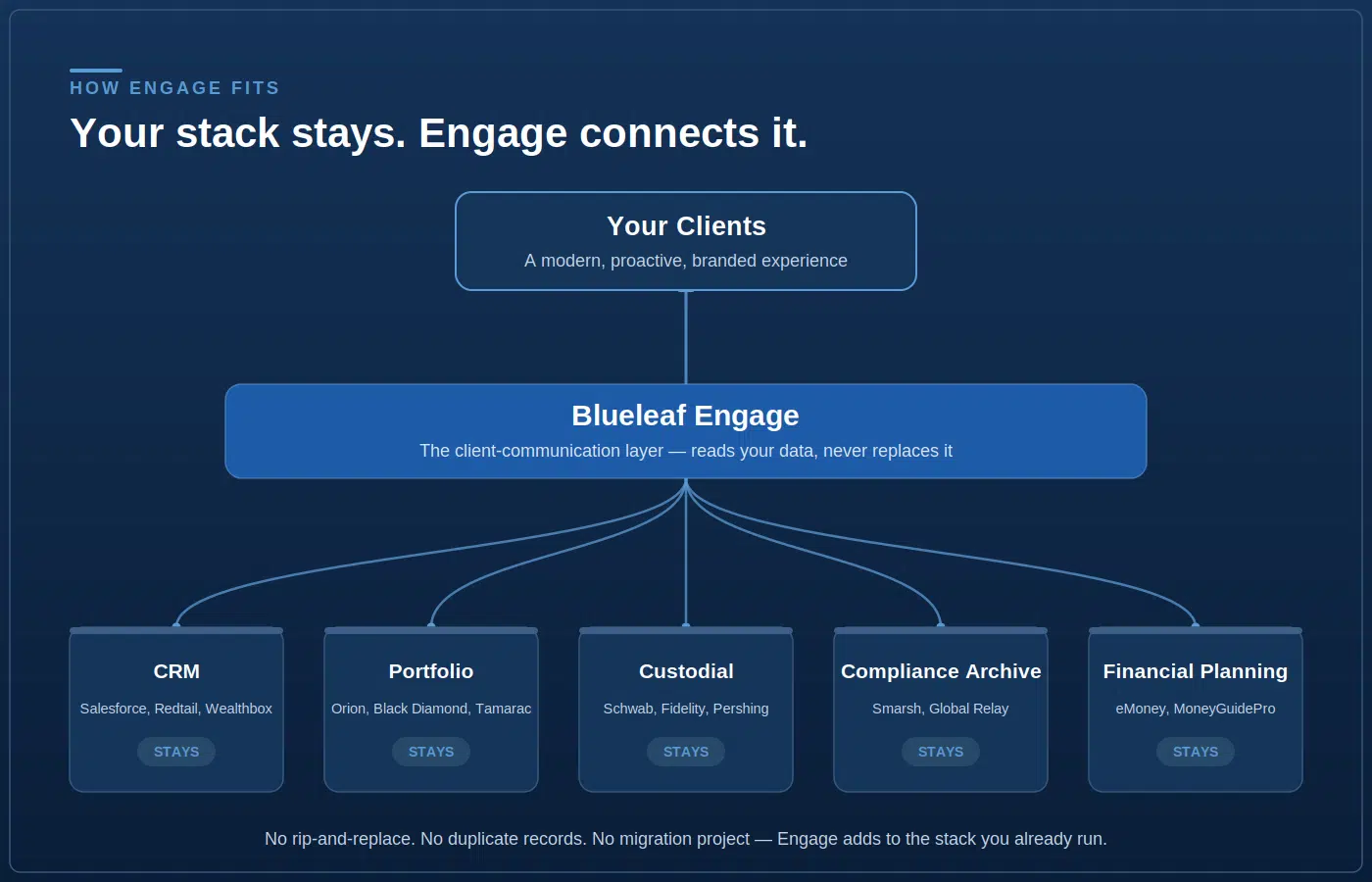
Your CRM stays. Engage connects to it.
Blueleaf Engage pulls client data from your existing CRM to personalize communications, segment client lists, and maintain accurate contact records, all without requiring advisors to maintain a second database or reconcile duplicate records. The CRM remains the system of record for client relationships. Engage uses that data to make client communication more targeted and more consistent.
For enterprise firms that have standardized on Salesforce across acquired offices or are in the process of doing so, Engage integrates with the CRM layer rather than competing with it. The investment in CRM standardization is preserved. Engage adds the communication infrastructure that the CRM was never designed to provide.
Your portfolio platform stays. Engage makes it visible.
One of the most persistent client experience failures in wealth management is the gap between the financial plan and what clients can actually see. Advisors manage portfolios in Orion, Black Diamond, or Tamarac. Clients log in to a portal that shows their account balances but does not indicate whether those balances are on track with the goals they discussed at their last review.
Engage aggregates financial data across custodians and presents it to clients in the context of their plan, not just as a balance sheet, but as a progress report. The portfolio platform does what it does best: manage the data. Engage does what it does best: make that data meaningful to the client through a modern, proactive experience.
Your compliance archiving stays. Engage feeds it.
Enterprise RIAs running Smarsh, Global Relay, or similar archiving platforms are not replacing those systems. They require infrastructure. Engage is designed to integrate with existing compliance archiving workflows, ensuring that every communication delivered through the platform is captured in the firm’s archiving system of record.
The CCO does not have to choose between the compliance archiving investment and the client communication platform. The two work together: Engage delivers the communication and feeds the archive. The audit trail is complete and automatic.
Engage and Your Existing Stack: A Plain-Language Guide
| Existing System | Engage Relationship | What Engage Means in Practice |
| CRM (Salesforce, Redtail, Wealthbox) | Works alongside | Engage reads client data to personalize and segment. No duplicate records. No parallel maintenance. |
| Portfolio platform (Orion, Black Diamond, Tamarac) | Works alongside | The portfolio platform manages the data. Engage makes it meaningful to the client. |
| Custodians (Schwab, Fidelity, Pershing) | Works alongside | Existing data feeds populate the client-facing experience Existing data feeds populate the client experience. No new custodial arrangements required. |
| Compliance archiving (Smarsh, Global Relay) | Works alongside | Every Engage communication is captured automatically t The audit trail is automatic and complete for anyone who asks for it. |
| Financial planning software (eMoney, MoneyGuidePro) | Works alongside | Planning goals surface in the client experience, connecting the plan to the portfolio in one view. |
| Client portal (legacy or proprietary) | Replaces | Low-engagement legacy portals are retired. Clients get a modern, push-first experience instead of a login screen that waits. |
| Manual email marketing (Constant Contact, Mailchimp) | Replaces | Ad hoc email tools are replaced with a compliance-reviewed, firm-branded platform. The upgrade advisors have been asking for. |
The M&A Speed Advantage
The platform-independence argument directly affects how fast an acquired firm can be integrated and how quickly clients experience the benefit of joining the enterprise platform.
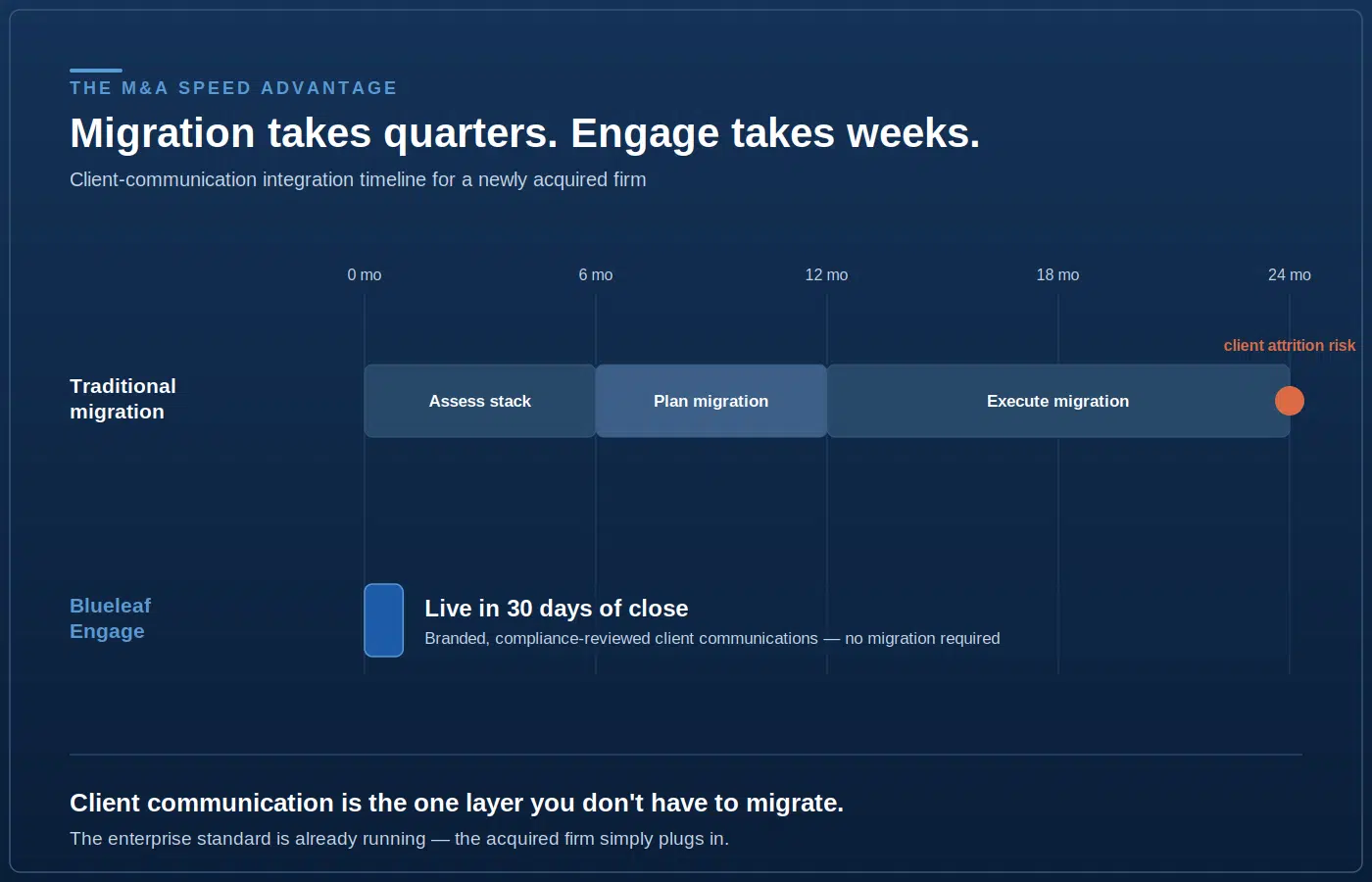
The traditional technology integration timeline for an RIA acquisition looks something like this: close the deal, spend three to six months assessing the acquired firm’s technology stack, spend another three to six months planning the migration, spend six to twelve months executing it, and hope that client attrition during the disruption period does not exceed the expected range.
That timeline assumes that every acquired system needs to be replaced with the enterprise standard. It is the right assumption for portfolio platforms and CRM. Those systems need to be unified for operational and compliance reasons. But it is the wrong assumption for client communication, because client communication is the one area where the enterprise already has a standard and a platform. Engage is already running. The acquired firm plugs in.
The fastest path to enterprise-standard client communication is not a migration. It is a platform that does not require one.
An acquired firm can be delivering Engage-powered, branded, compliance-reviewed client communications within 30 days of closing, not because the integration is being rushed, but because Engage was designed to onboard new offices quickly, without touching the rest of their technology stack.
For a head of M&A evaluating Engage as part of the enterprise platform, the integration timeline argument is straightforward. Engage does not add complexity to the technology integration roadmap. It removes it. Client communication doesn’t need to be migrated.
What the COO Evaluation Should Look Like
When a technology decision touches every office, every advisor, and every client relationship, the evaluation has to be rigorous. The right questions are not about the technology in isolation. They are about integration, governance, and M&A speed. These are the factors that determine whether a platform addition helps or hinders a firm in acquisition mode.
The right questions are the following:
- What existing systems does Engage connect to, and what does that connectivity require from our team to establish and maintain?
- What is the implementation timeline for an existing enterprise office versus a newly acquired firm?
- What does the data flow look like between Engage and our CRM, portfolio platform, and compliance archiving system?
- Who manages the platform at the enterprise level versus the office level versus the advisor level, and what does that governance model look like?
- What happens to Engage when we acquire a firm that uses a different CRM or portfolio platform from our standard?
These are the right questions because they focus on integration, governance, and M&A speed, the factors that determine whether a technology addition helps or hinders an enterprise in acquisition mode. Engage is designed to have clean answers to all of them.
The evaluation that matters is not whether Engage works in isolation. It is whether Engage makes the rest of the enterprise technology stack more useful and whether it can be live in every office, including the one you just acquired, before the 90-day transition window closes.
See how Engage fits into your existing stack in a 30-minute conversation. [Request a Demo]
Blueleaf Engage integrates with the CRM, portfolio platform, custodial, and compliance archiving systems that enterprise RIAs are already running. It can be live in a newly acquired office within 30 days of closing without a migration project.