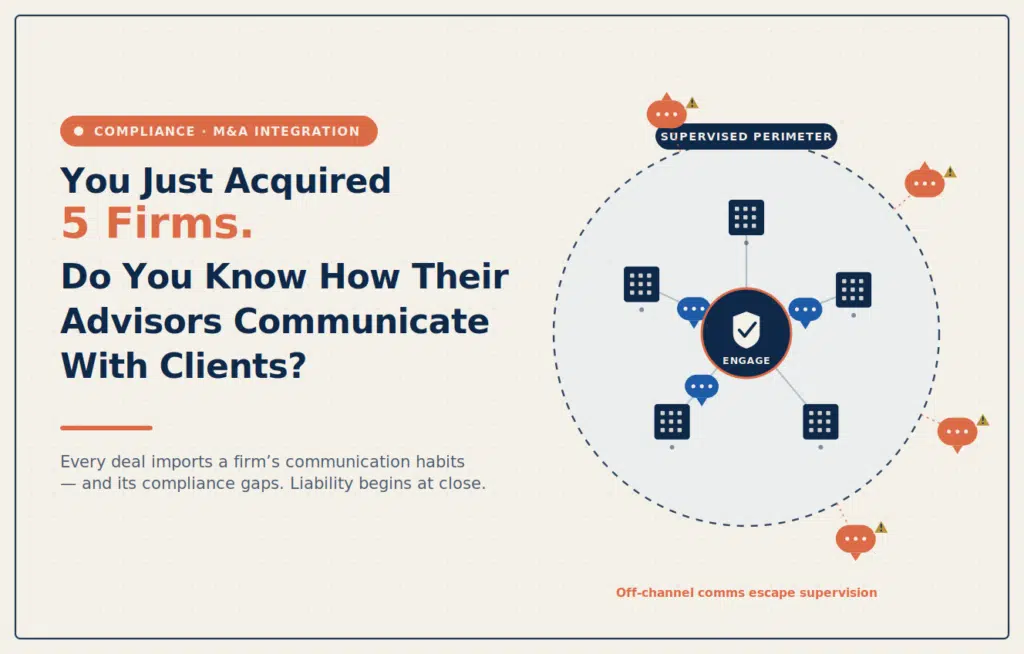
You Just Acquired 5 Firms. Do You Know How Their Advisors Are Communicating with Clients?
9 min Read
Growth through acquisition is the defining strategy of the modern enterprise RIA. PE-backed platforms are acquiring firms at a pace unthinkable a decade ago, consolidating AUM, adding advisor headcount, and building toward the scale that drives valuation multiples. The deal pipeline is the growth engine.
But every acquisition brings something the deal model doesn’t fully price in: the communication practices of the advisors you just hired.
Those practices, how advisors reach clients, which platforms they use, and what channels they rely on for day-to-day relationship management, don’t change the day the deal closes. And in most cases, they don’t change for months afterward. That gap between acquisition close and compliance integration isn’t just an operational inconvenience. It’s an open regulatory exposure.
The Compliance Assumption That Gets Firms in Trouble
Most enterprise RIA leaders understand, in principle, that acquired firms need to be brought onto the acquirer’s compliance framework. Communication policies. Archiving systems. Supervision workflows. These are items on the integration checklist.
The problem is that checklist items take time. Technology migrations take time. Advisor behavior change takes time. And the compliance framework you intend to implement in month six or month twelve doesn’t retroactively cover communications from months one through five.
The compliance framework you plan to implement doesn’t cover what’s already happened. Liability begins at close.
The SEC’s position on this is unambiguous: record-keeping obligations attach to the registered entity. When you acquire a firm and its advisors become your advisors, their communications with clients, including communications through channels your firm hasn’t yet supervised or archived, are your responsibility.
That’s not a speculative legal interpretation. It’s the explicit logic behind the 2022 and 2023 record-keeping enforcement actions, which found institutions liable not for isolated advisor misconduct, but for systemic failures to supervise communication channels at scale. The enterprise RIA structure of multiple acquired firms, diverse technology environments, and distributed advisor populations creates exactly the systemic exposure regulators have been targeting.
What Advisors Actually Do After an Acquisition
To understand the compliance risk, it helps to understand advisor behavior in the 12 to 18 months following an acquisition.
Most advisors at acquired firms are focused on one thing: keeping their clients. They’ve just been through an ownership transition, and clients are asking questions about what’s changing, the new firm, and whether the relationship they’ve built over the years will hold. Advisors are communicating with clients more than usual, not less.
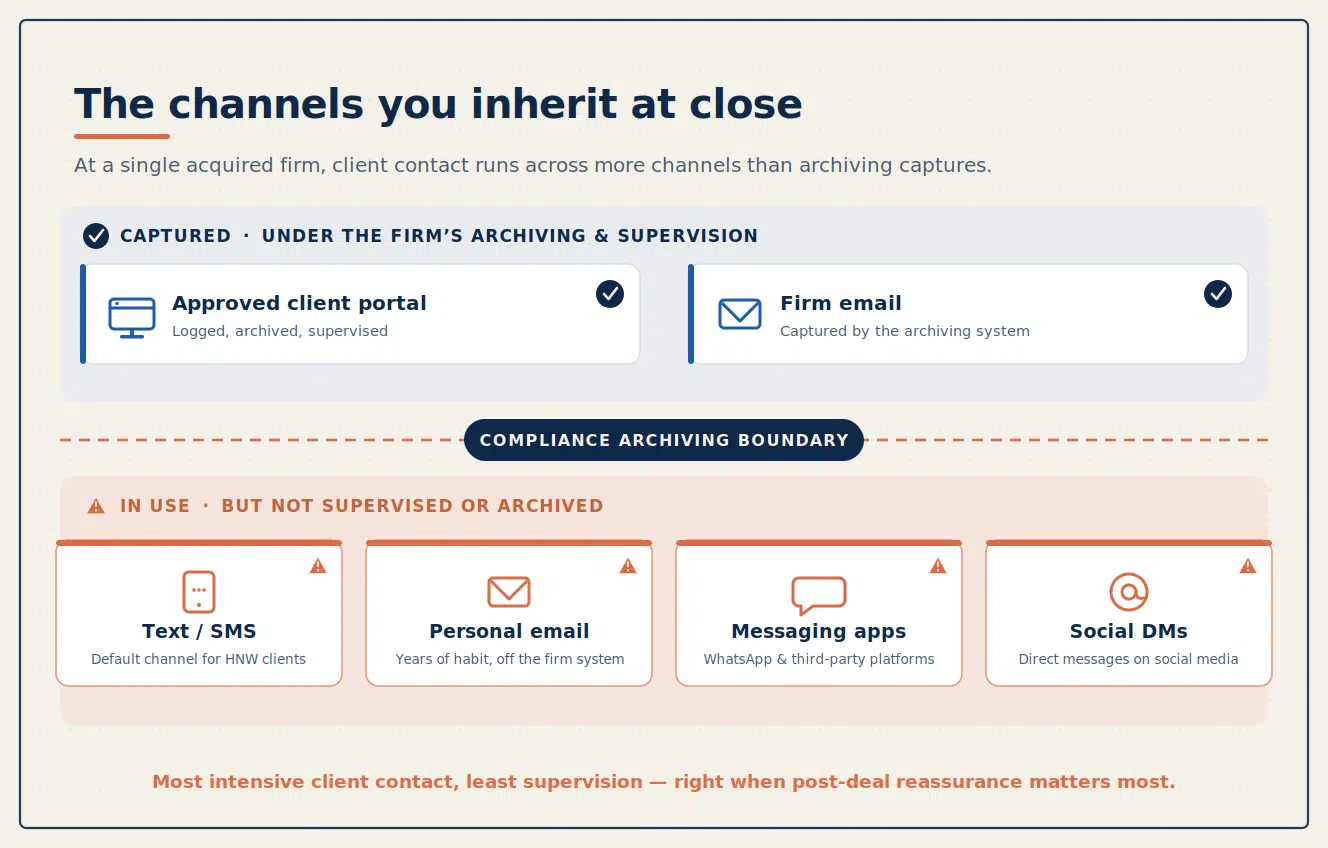
And they’re communicating in whatever way feels natural and responsive. If a client sends a text, the advisor responds by text. If the long-standing pattern with a particular family is to use WhatsApp, that pattern continues. If the advisor has been reaching out through personal email for years, they keep doing it because it works and because no one at the new firm has told them otherwise yet.
This isn’t negligence. It’s human behavior. But from a compliance standpoint, it means that during the period when advisor-client communication is most intensive, right after an acquisition, when relationship reassurance matters most, it’s also least supervised.
The Channels You Don’t Know About
Here’s a practical exercise worth doing with your compliance team: for each firm you’ve acquired in the last three years, can you answer the following questions?
- What communication channels were advisors using before the acquisition to reach clients?
- Which of those channels were being captured and archived under the acquired firm’s existing compliance infrastructure?
- Which channels were in use but not supervised, either because the acquired firm lacked the infrastructure or because advisor behavior outpaced the firm’s archiving capabilities?
- After the close, which of those unsupervised channels were still used during the integration period?
For most enterprise RIA platforms, honest answers to those questions reveal material gaps. Not because the acquired firms were reckless. Most run compliant practices at the point of acquisition. But because the channels advisors use to communicate with clients have proliferated faster than compliance infrastructure has evolved to capture them.
Text messaging is the obvious example. It’s the default communication channel for a significant portion of the population, including a large share of high-net-worth clients who are accustomed to reaching their advisors directly. Archiving advisor text messages requires specific technical solutions that many smaller and mid-sized advisory firms simply haven’t implemented. When you acquire those firms, you acquire that gap.
You can audit the financials, the AUM, and the advisor contracts. Are you auditing the communication practices?
What a Communication Compliance Audit Actually Looks Like
The firms handling this well have made a review of communication practices a standard component of pre-close due diligence. This doesn’t require a forensic examination of every advisor’s phone; it requires asking the right questions and documenting the answers.
A pre-close communication compliance audit should establish, at minimum:
- Which communication channels do advisors at the target firm currently use to reach clients (text, email, personal email accounts, third-party messaging platforms, or social media)?
- Which of those channels are captured under the firm’s current archiving and supervision infrastructure?
- Whether the firm has a written communication policy that covers off-channel usage, and whether advisors have attested to compliance with that policy.
- What supervision workflows are in place? Who reviews communications, how frequently, and does the process create a documented audit trail?
- Whether the firm has ever received regulatory inquiries or examination findings related to communication record-keeping.
This due diligence serves two functions. First, it gives you an accurate picture of the compliance liability you’re assuming at close, information that should inform deal terms, representations and warranties, and integration planning. Second, it establishes the baseline for your post-close integration plan, including a realistic timeline for bringing acquired advisors onto your communication supervision infrastructure.
The Integration Timeline Problem
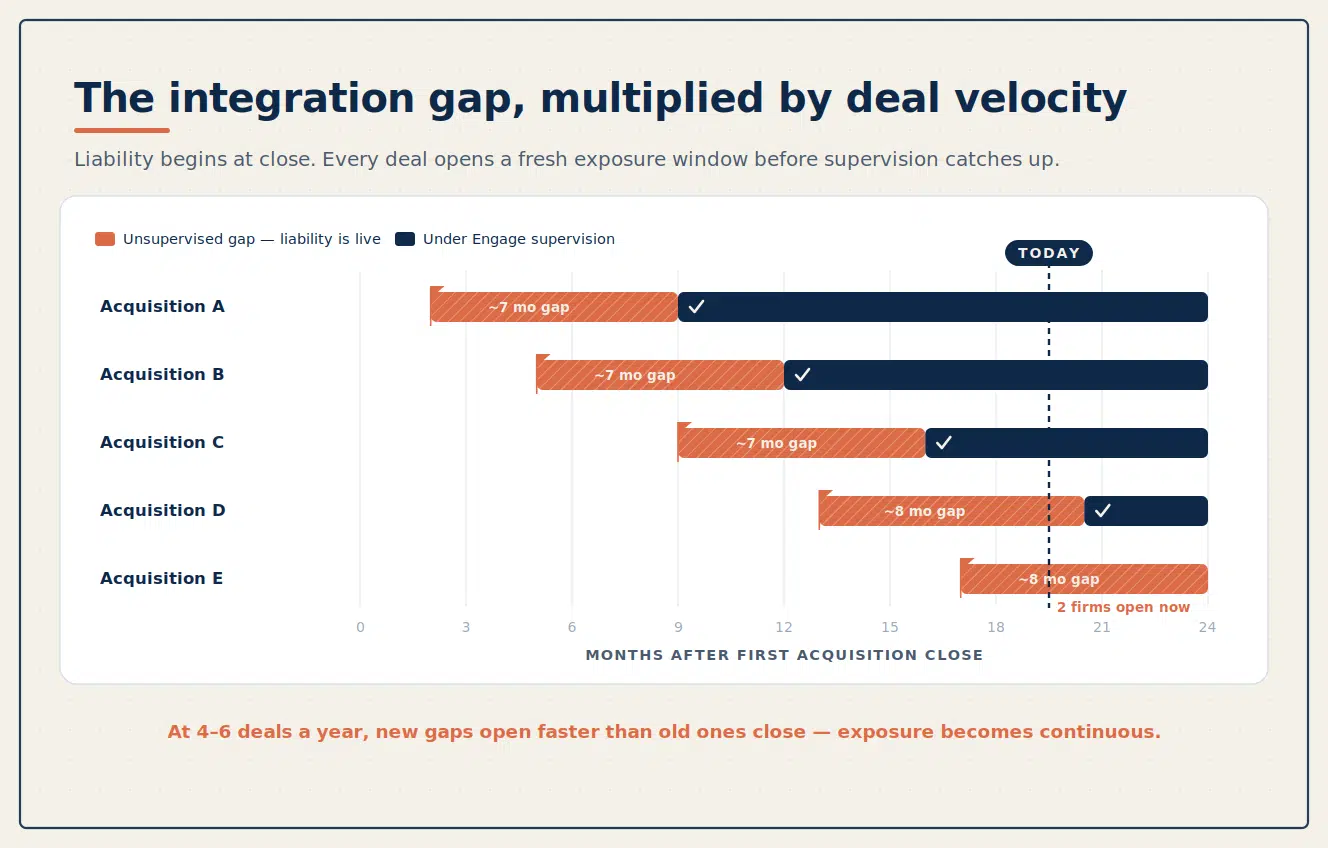
Even with strong pre-close diligence, the post-close integration period creates its own compliance risk. Technology migrations for communication archiving and supervision are not instant. They require vendor selection or configuration, advisor training, and a transition period during which advisors may be using both old and new systems.
The gap between close and full compliance integration is, in many ways, the highest-risk period for enterprise RIAs, and that risk multiplies with acquisition velocity. A platform completing four to six acquisitions per year is perpetually managing integration timelines across multiple acquired entities simultaneously. The compliance team isn’t closing gaps one at a time; it’s chasing gaps that are opening faster than they can be closed.
This is why communication compliance infrastructure for enterprise RIAs can’t be treated as a point-in-time project. It needs to be a scalable, continuous capability, one that can absorb new firms quickly without creating compliance dead zones between acquisition and integration.
The Examination You Haven’t Prepared For
SEC examinations are designed to surface exactly this kind of gap. Examiners who review an enterprise RIA’s communication record-keeping will look at whether the firm has a written policy, whether advisors have attested to it, whether the archiving infrastructure captures the channels advisors actually use, and whether the supervision process creates an adequate audit trail.
They will also look at recently acquired firms. They understand that M&A-driven growth creates integration lag, and they know where to look for the compliance gaps it produces.
A firm that can answer every examiner’s question with documented evidence, a clear communication policy, advisor attestations, comprehensive archiving across all channels, and a supervision workflow with a complete audit trail is a firm that turns examination into a demonstration of operational strength. A firm that can’t answer those questions is a firm that turns examination into a remediation exercise, with all the time, cost, and reputational risk that entails.
An SEC examination of a recently acquired firm isn’t a surprise. It’s a scheduled test of whether your integration process is working.
The Strategic Upside of Getting This Right
There’s a reason the most operationally sophisticated enterprise RIA platforms invest in communication compliance infrastructure before they have to: the firms that get this right create a durable competitive advantage in the acquisition market.
When your firm can demonstrate to acquisition targets that you have a proven, advisor-friendly onboarding process that brings new advisors onto a compliant communication infrastructure within 60 to 90 days of close, you differentiate yourself from competitors whose integration timelines stretch to 12 or 18 months. Advisors care about this. So do the principals of the firms you’re acquiring, who know their reputations depend on how well the transition is managed.
And for PE sponsors evaluating the platform’s readiness for a future transaction, whether that’s a strategic acquisition, a secondary buyout, or an eventual IPO, clean compliance history is a prerequisite for the premium multiples that justify the growth investment. Every examination finding, every remediation plan, every regulatory disclosure is a conversation a future buyer will want to have before closing. The firms that minimize those conversations are the ones that control their exit timelines.
Key Takeaways
- Every acquisition imports the communication practices and the compliance gaps of the acquired firm. Liability begins at close, not at integration.
- The 12 to 18 months following an acquisition are the highest-risk period for off-channel communication: advisor-client contact is intensive, and supervision infrastructure is still being built.
- Pre-close due diligence should include a communication practice audit to accurately scope the compliance liability being assumed.
- Enterprise RIAs with high acquisition velocity are perpetually managing multiple integration timelines simultaneously. Compliance infrastructure must scale with deal pace, not lag behind it.
- Clean communication compliance history is an M&A asset: it accelerates deal timelines, supports premium valuations, and demonstrates operational maturity to PE sponsors and future acquirers.
About Blueleaf Engage
Blueleaf Engage is the enterprise client engagement platform built for PE-backed RIA platforms and large advisory firms. Engage provides a compliance-first client communication infrastructure, including full message archiving, audit trails, and supervised communication workflows, designed to scale with your firm as you grow through acquisition.
Learn more at https://www.blueleaf.com/client-portal-engage-system/ .