Your PE Sponsors Want 20% Growth. Your Client Portal Isn’t Helping
9 min Read
The PE thesis only works if scale unlocks organic growth. The portal at the center of your client experience was never designed to deliver it.
When private equity backs an RIA, the investment thesis is rarely a mystery. Buy quality firms, integrate them at scale, drive organic growth, realize the multiple. The model has been refined across hundreds of transactions over the last decade. The playbook is well understood.
What is less well understood is why so many PE-backed platforms stall on the organic growth part.
The acquisition strategy works. The integration strategy is maturing. The operational efficiencies are real. But when the board asks what is driving organic growth — new clients, wallet share expansion, referrals from the existing base — the answer is often some version of: we’re working on it.
In most cases, “working on it” means asking advisors to do more. More outreach. More events. More coffee meetings. More referral conversations. It means investing in a CRM upgrade, a new marketing automation tool, a rebrand. It means deploying more capital into the acquisition pipeline to offset the organic growth that isn’t materializing fast enough.
None of that addresses the actual problem. The actual problem is that the infrastructure most enterprise RIAs are running on — the client portal at the center of the client experience — was never designed to drive growth.
Private equity didn’t invest in your firm to watch it grow at 5%. They invested to see what happens when institutional capital meets a scalable growth model. The portal is not that model.
The Mandate Is Not Subtle
Private equity’s interest in the RIA space has accelerated sharply. PE-backed RIAs now control roughly 23% of all assets managed by firms with $100 million or more in AUM — a share that is growing faster than the overall market. The investment thesis is clear: consolidate, scale, and unlock the organic growth that fragmented independent firms could never pursue systematically.
That last part is the critical assumption. The PE thesis only works if scale unlocks organic growth. If it doesn’t — if the platform grows primarily through acquisitions while organic growth stagnates — the multiple at exit compresses.
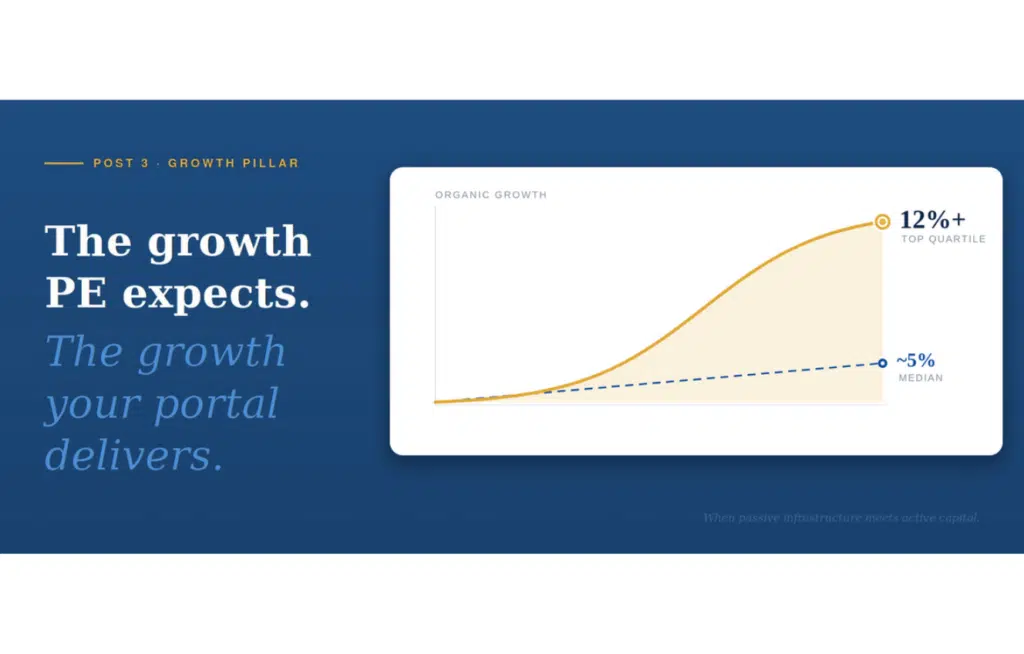
And the data shows a meaningful gap. For large RIA firms with more than $250 million in AUM, the median organic growth rate runs around 5%. Top-performing firms — the top 20% by performance metrics — deliver organic growth of 12% or more. The same Schwab benchmarking data shows that top performers also attract 85% more new clients than their peers and generate twice the revenue growth over any five-year period.
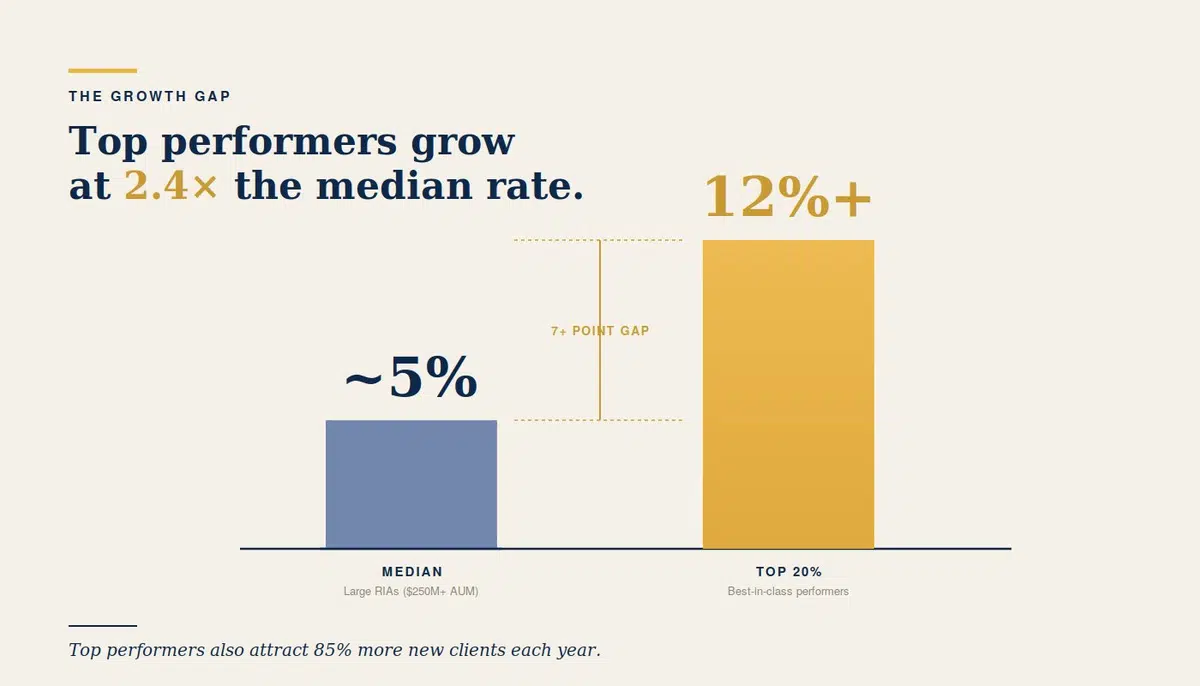
That gap is not explained by advisor quality or client demographics. It is explained by infrastructure and intentionality. Top-performing firms have documented referral programs, clear client value propositions, and systematic strategies for pursuing growth from the existing client base. Most enterprise RIAs have a portal and good intentions.
What a Portal Actually Does
Client portals solved a real problem when they were introduced. Clients wanted on-demand access to their account information — performance data, statements, documents, portfolio holdings. Portals delivered that. They remain useful for exactly what they were designed to do: give clients self-service access to their financial information.
That is where their usefulness ends.
A portal is passive infrastructure. It sits and waits. It does not reach out to clients. It does not surface planning opportunities. It does not deliver content that demonstrates the firm’s value between annual reviews. It does not remind a client of their advisor’s expertise when their business partner mentions a liquidity event. It does not create the kind of ongoing presence that converts a satisfied client into an active referral source.
The portal model assumes that clients will come to you — that if you build a good enough interface, clients will log in, engage with their financial picture, and remain deeply connected to the firm between meetings. The data does not support that assumption.
Industry benchmarks consistently show monthly active portal usage in the range of 10% to 30% across enterprise RIA platforms. That means somewhere between 70% and 90% of your clients go a full month without any interaction with your digital infrastructure. And in months when there is no scheduled review or triggering event, many go considerably longer.
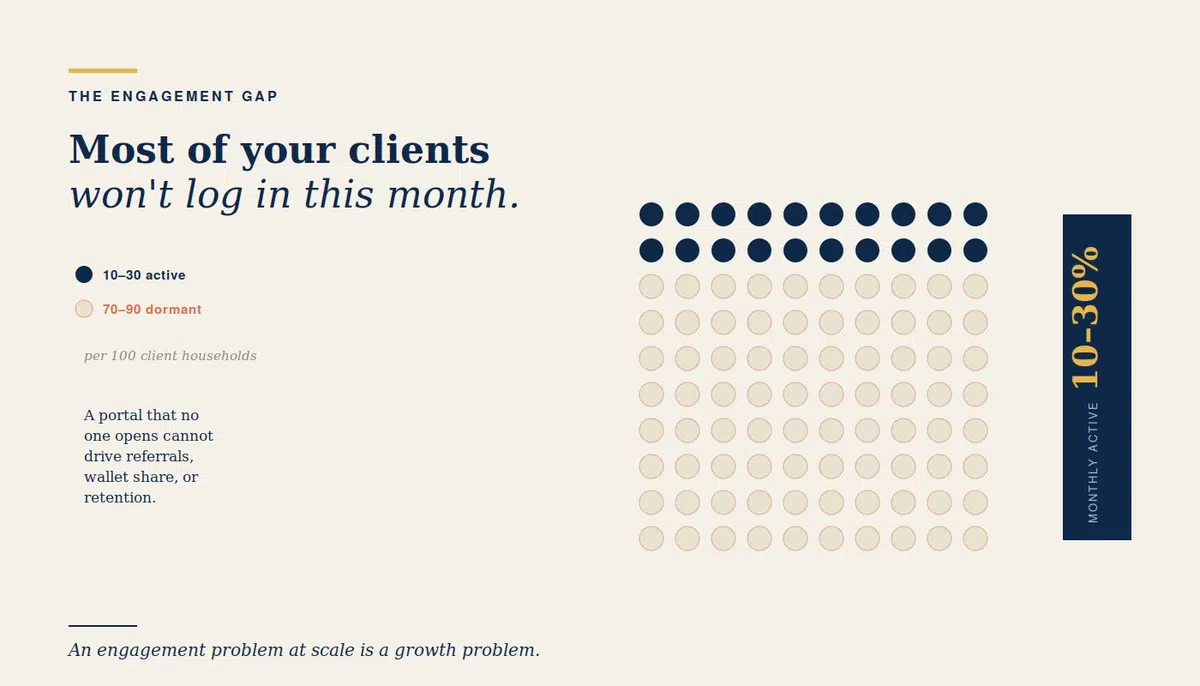
Typical monthly active usage rate across enterprise RIA client portals.
That is not a client satisfaction problem. Most clients at enterprise RIAs are satisfied. It is an engagement problem. And an engagement problem at scale is a growth problem.
The Growth Math Your Portal Is Breaking
Let’s be specific about what low engagement actually costs.
Organic growth in wealth management flows through three primary channels: new client referrals, wallet share expansion from existing clients, and retention through advisor transitions. The portal touches all three — badly.
Referrals require presence. Clients who only hear from their advisor at scheduled reviews do not think about their advisor between meetings. Referrals are spontaneous — they happen when a client is in a conversation and their advisor comes to mind. That mental availability requires ongoing contact. One or two touchpoints per year cannot sustain it.
Wallet share requires visibility. Clients who hold outside assets — held-away accounts, business assets, inheritance proceeds — bring them to their advisor when they trust that their advisor is actively managing the full picture of their wealth. That trust is built through proactive communication that demonstrates insight. It erodes when clients stop hearing from you.
Retention requires continuity. When a senior advisor retires or an M&A transaction disrupts the client relationship, the clients most likely to leave are the ones least connected to the firm’s infrastructure and brand. A client whose primary relationship is with a person — not a firm — is a flight risk the moment that person is gone. Engagement with the firm’s content and platform builds the institutional relationship that survives those transitions.
None of these growth drivers are activated by a portal. All of them require proactive, consistent, firm-initiated outreach that keeps the advisor relationship alive between meetings. That is not what portals were built to do.
A portal waits. A growth engine reaches out. Enterprise RIAs have invested heavily in the former and almost nothing in the latter. The organic growth gap is the predictable result.
Why Scale Makes This Harder, Not Easier
Individual advisors at smaller firms can sometimes close the engagement gap through personal effort. A highly motivated advisor with 80 clients can make the calls, send the notes, and maintain the personal presence that generates referrals and expands wallet share. It is not sustainable and it does not scale, but it can work at the individual level.
Enterprise RIAs cannot run on individual effort. When you have 200 advisors across 30 offices serving thousands of client households, the engagement quality of those relationships is a function of infrastructure — not personal hustle.
This is the paradox of PE-backed scale: the very growth that makes the platform attractive also makes the engagement problem harder. More advisors means more client relationships that need consistent engagement. More offices means more variation in how engagement is actually delivered. More acquisitions mean new client bases that need to be connected to the enterprise brand before the relationship walks out the door.
Scale amplifies the problem. It does not solve it.
And yet the infrastructure most enterprise platforms are deploying at scale is the same portal model that was designed for a 50-client boutique firm in 2012. The platform has grown. The engagement infrastructure has not kept pace. That misalignment is showing up in organic growth numbers that fall well short of the PE mandate.
85% more new clients attracted annually by top-performing RIAs vs. their peers
The Questions Your PE Sponsor Is Going to Ask
If you are running a PE-backed RIA or preparing for an exit, the organic growth conversation is coming. The questions will be direct. The answers need to be better than “our advisors are focused on referrals.”
Here are the questions worth pressure-testing against your current infrastructure:
- What percentage of your client base receives proactive, advisor-branded communication at least monthly? Not a firm newsletter — content that is personalized, relevant, and positioned as coming from their advisor.
- How does your organic growth rate compare to the top-quartile benchmark for your AUM tier? If you are running at 5% while top performers are at 12%, what structural explanation do you have for that gap?
- What happens to client relationships during an advisor transition? How quickly does your platform re-engage affected clients, and what is your measured retention rate in the first 90 days post-transition?
- What is your monthly active engagement rate across the client base? If you cannot answer this question with a specific number, that itself is diagnostic.
- What infrastructure, beyond the portal, are you deploying specifically to drive organic growth from existing clients at scale?
If the honest answer to that last question is “we’re relying on our advisors and our portal,” the organic growth mandate is going to be harder to hit than the investment thesis assumed. That is not a people problem. It is an infrastructure problem.
The Portal Was Never the Growth Engine
Private equity did not invest in your firm because it has a good portal. They invested because the client base represents a concentrated pool of high-quality growth opportunities — referrals, wallet share, cross-generational retention — that a scaled platform could pursue systematically.
Pursuing those opportunities systematically requires infrastructure that is designed to do it. Infrastructure that reaches clients proactively. That delivers value between meetings. That keeps the firm’s brand and the advisor’s expertise top-of-mind across hundreds of thousands of touchpoints every month.
The portal was designed to give clients access. It was not designed to generate growth. Those are different problems, and they require different solutions.
The firms delivering 12% organic growth know this. The firms delivering 5% are still waiting for their portal to figure it out.
Next in the Series: Post #4 — Off-Channel Communication Is a Billion-Dollar Problem. Is Your Firm Next?