Why Your Best Clients Don’t Refer: The Engagement Gap That’s Killing Organic Growth
7 min Read
Ask any advisor at any enterprise RIA who their best source of new clients is, and the answer is almost always the same: referrals from existing clients.
Then ask how systematically their firm pursues that channel. The silence that follows tells you everything.
Referrals are the highest-quality, lowest-cost growth opportunity in wealth management. They convert at rates that make every other channel look expensive. They come pre-qualified. They arrive trusting. And they almost never happen by accident.
They happen because a client thought of you at the right moment — and that moment only comes to clients who are actively engaged.
For most enterprise RIAs, that moment never comes.
Referrals are not a relationship outcome. They are an engagement outcome. You cannot refer a firm you’ve stopped thinking about.
The Referral Equation Nobody Is Solving
The mechanics of a referral are simple. A client has a conversation with someone who mentions a financial challenge — a liquidity event, an inheritance, a business transition, a divorce. The client thinks: I know someone who handles this.
That thought requires two things. First, the client has to believe you can solve the problem. Second, they have to think of you at all.
The first condition, enterprise RIAs have largely solved. You have the capabilities, the credentialed team, the institutional infrastructure. Your clients know what you do.
The second condition is where the system breaks down.
Thinking of your advisor requires that the advisor is present in your life. Not physically — but mentally. Are they sending you things worth reading? Are they reaching out about relevant market events before you have to ask? Are they giving you reasons to forward something to a friend?
For most RIA clients, the honest answer is: no, not really.
1–2× average proactive client contacts per year at a typical enterprise RIA
Why Low Engagement Kills the Referral Pipeline
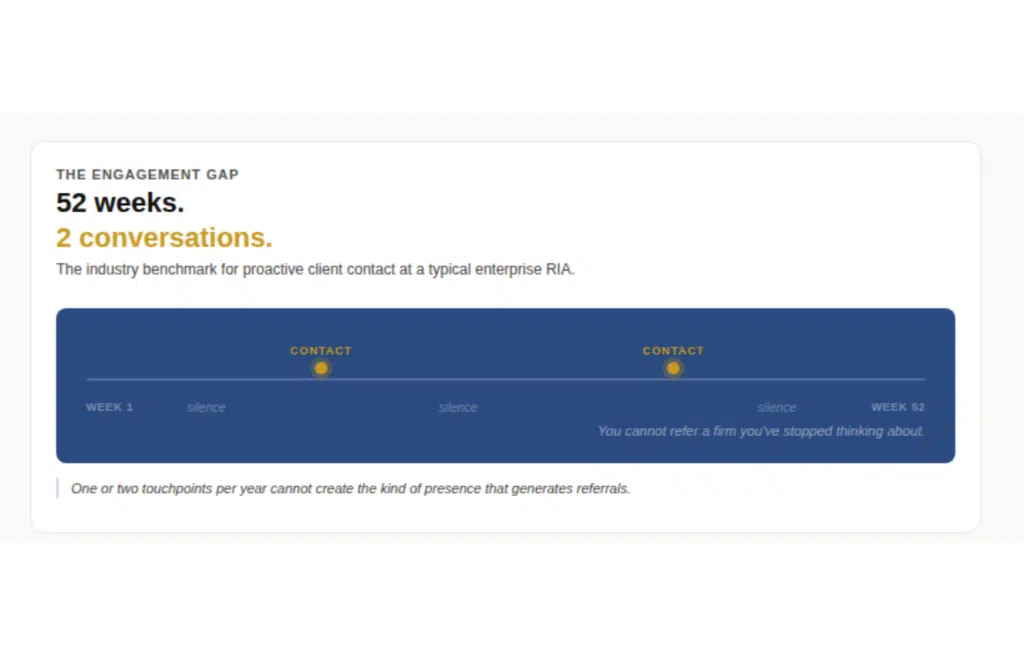
The industry benchmark for advisor-to-client contact is somewhere between one and two proactive touchpoints per year — outside of quarterly reviews and reactive calls when something goes wrong.
That number is structurally insufficient for generating referrals.
Think about how referrals actually surface. They happen in conversations — at dinner, at a golf course, in a boardroom, on a Zoom call. They are spontaneous. They require the referred firm to be mentally accessible to the client at the precise moment the opportunity arises.
One or two annual touchpoints cannot create that kind of presence. The advisor is not competing against other advisors for mental space. They are competing against the thousand other things in a client’s life. And a relationship that goes dark for six months loses.
This is not a commentary on advisor effort or client satisfaction. Satisfaction scores at enterprise RIAs tend to be high. Clients are not leaving. They are simply not thinking about you often enough to put your name forward.
The gap between satisfaction and advocacy is the engagement gap — and it is costing firms far more than they realize.

Satisfied clients stay. Engaged clients refer. The two outcomes look identical until you measure them.
The Math of the Missed Referral
There is no clean line item in a P&L for missed referral revenue. That is part of why it persists. The referrals that never happened do not show up in a loss column. They do not trigger a performance review. They are simply absent.
But the math is not hard to run.
A $5 billion AUM firm with 500 client households has, in theory, 500 people who could refer. Industry data suggests that highly engaged clients refer at least once every two to three years. Disengaged clients refer rarely — perhaps once every seven to ten years, or not at all.
Close that gap by half, and you are looking at a materially different organic growth trajectory — measured in dozens of new households and hundreds of millions in new AUM over a three-year cycle.
For a PE-backed firm with a growth mandate baked into the investment thesis, that delta is not a nice-to-have. It is a board-level conversation.
And here is the second-order implication: every dollar of organic growth not generated from existing clients is eventually replaced with inorganic growth. Acquisitions. At eight to twelve times revenue. Financed with capital that could have been deployed elsewhere.
The missed referral is not a soft cost. It is a compounding strategic liability.
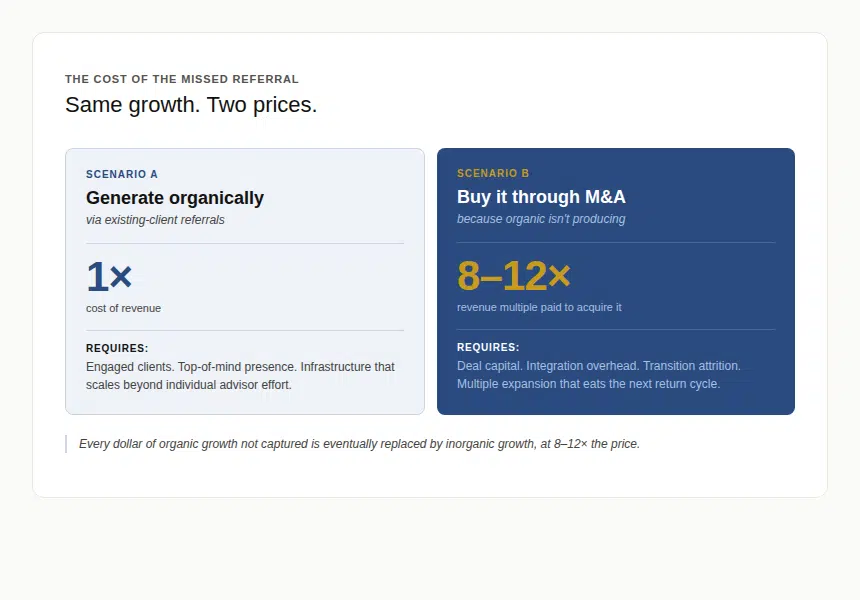
What firms ultimately pay when organic growth fails to produce.
Why Enterprise Scale Makes This Worse
Individual advisors can sometimes close the engagement gap through sheer personal effort — handwritten notes, personal calls, a relentless commitment to staying present with every client. It is inefficient and hard to sustain, but it happens.
Enterprise firms cannot run on heroics.
When you have 200 advisors across 30 offices managing thousands of client relationships, the engagement quality of those relationships is not a function of individual effort. It is a function of infrastructure. And most enterprise RIAs do not have infrastructure designed to drive engagement at scale.
They have portals that clients passively log into — or, more commonly, don’t. They have email systems that send compliance-approved newsletters that nobody opens. They have CRMs that track when a call happens but cannot make the next call more valuable.
None of that creates the kind of ongoing presence that converts a satisfied client into an active referral source.
The firms that are building organic growth engines at scale are doing something different. They are delivering personalized, advisor-branded content to clients continuously — not once a quarter. They are staying relevant between meetings. They are giving clients reasons to share.
That capability does not exist in a portal. It does not live in a CRM. It requires a different kind of infrastructure entirely.
The engagement gap is not a people problem at enterprise RIAs. It is an infrastructure problem. Individual effort cannot scale across hundreds of advisors and thousands of clients without the right systems underneath.
The Questions Worth Asking
Before your next business development review, consider a few questions your current data probably cannot answer:
What percentage of your client households have received proactive, advisor-branded communication in the past 90 days — not a firm newsletter, but something that felt personal?
How many referrals did your firm generate last year? How many of those came from clients who had been in active, frequent contact with their advisor?
What is the referral conversion rate for your top 20% most engaged clients versus your median client? Do you even have that data?
If a client wanted to share something from their advisor with a colleague today, what would they share — and how easy would it be for them to do it?
Most enterprise RIAs cannot answer these questions with precision. That is not a criticism — it is a structural observation. The systems were not built to capture engagement as a growth metric. They were built for compliance, portfolio management, and service delivery.
That was sufficient in a slower-moving market. In a PE-backed environment where organic growth is a core return driver, it is not.
The Referral Channel Is Not Broken. It’s Underfed.
Your best clients want to refer you. They trust you with their most important financial decisions. They have relationships with people who need exactly what you do. The pipeline is there.
What is missing is the infrastructure to keep you present enough in their lives that when the right moment arrives — the dinner table conversation, the golf course question, the text from a colleague — they think of you immediately.
That is not a relationship problem. It is an engagement infrastructure problem. And it is solvable — but not with the tools most enterprise RIAs are currently deploying.
The question is whether your firm is willing to build it.
Blueleaf Engage is the client marketing engine built for enterprise RIAs — a platform that proactively delivers branded content, market commentary, and firm updates to every client household across every channel they use. It turns satisfied clients into active referrers, at scale.