You’re Spending Millions to Acquire Clients. What Are You Spending to Keep Them?
5 min Read
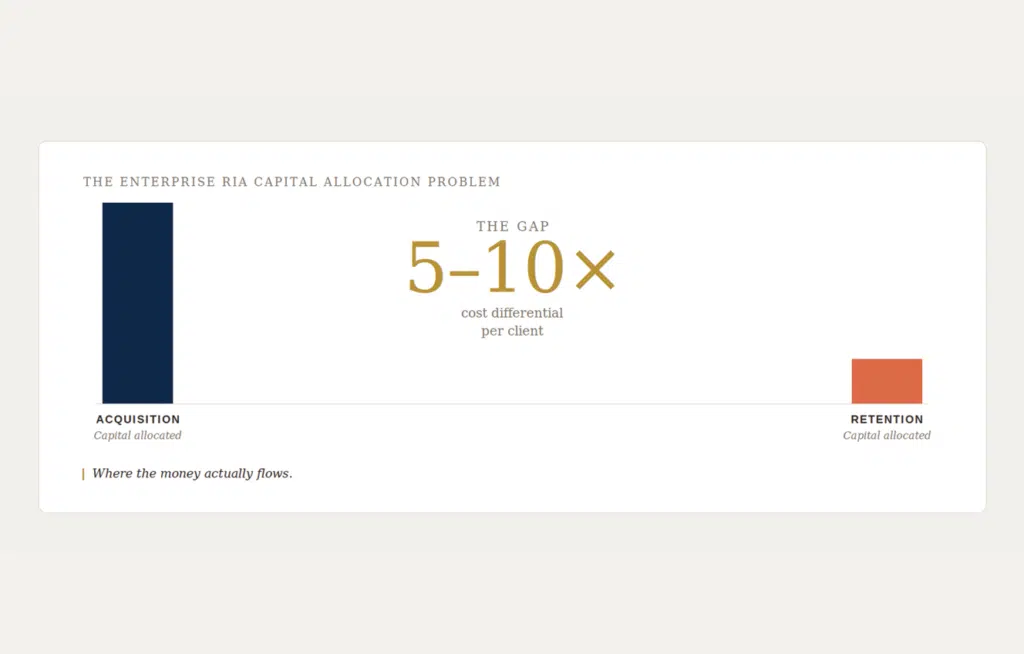
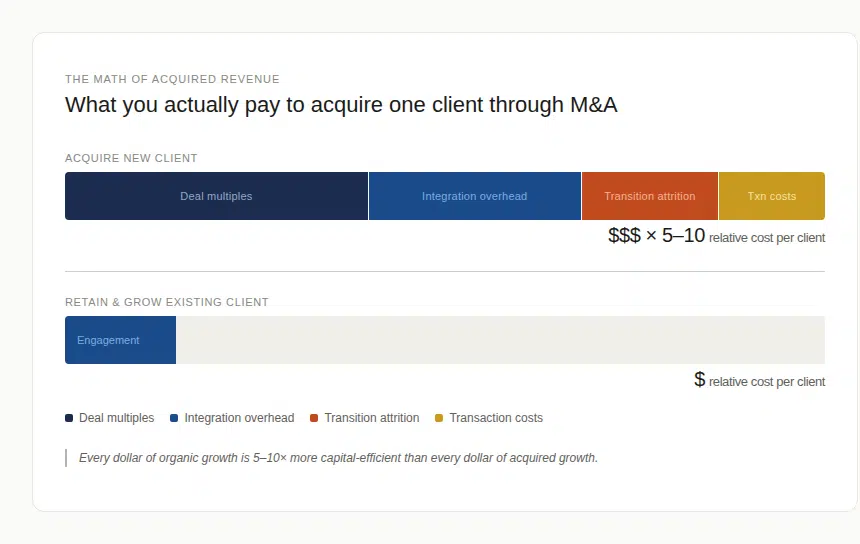
Acquiring a new client through M&A costs between 5 and 10 times as much as retaining and growing the one you already have. Their capital allocation tells a completely different story
Most enterprise RIA leaders know this math, at least in the abstract. And yet, when you look at where capital actually flows inside a PE-backed wealth management firm, the allocation tells a completely different story. The acquisition pipeline gets resourced. Integration teams get built. Technology that supports deal flow gets funded. The advisor recruiting budget gets defended in every board meeting.
The Organic Growth Problem No One Talks About
PE growth mandates are typically framed around two levers: acquisition volume and organic growth. The firms that hit their numbers consistently are the ones that move both levers simultaneously. Acquiring firms while organic growth is flat means you’re running to stand still, buying revenue that erodes almost as fast as you add it.
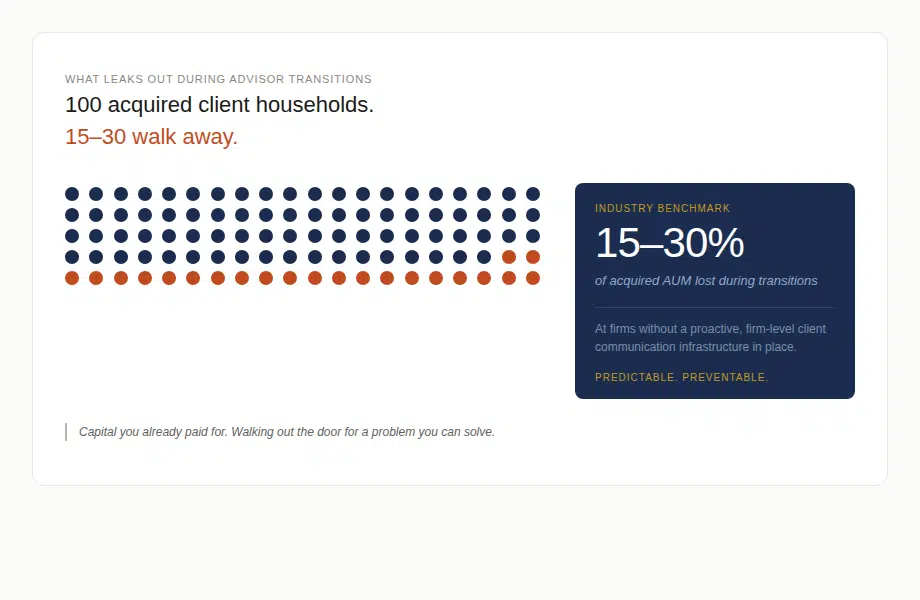
The data on organic growth at enterprise RIAs is uncomfortable. Industry benchmarks consistently show that firms without a systematic client engagement strategy achieve organic growth rates in the low single digits. Referral rates are anemic. Wallet share expansion is sporadic, driven by individual advisor initiative rather than firm-level strategy. Client attrition during advisor transitions, one of the most predictable and preventable drains on acquired AUM, ranges from 15% to 30% at firms without a proactive communication infrastructure.
None of these is a mystery. They’re the predictable output of a specific organizational failure: the firm has no client marketing function.
What “No Client Marketing” Actually Looks Like
In almost every other industry, companies that serve existing customers have a systematic way to communicate with them between transactions — to demonstrate value, surface new opportunities, and keep the relationship alive when no formal meeting is scheduled.
Enterprise RIAs, almost universally, do not.
What they have instead is a collection of individual advisor relationships, each managed at the advisor’s discretion, with no firm-level visibility into engagement frequency, no systematic delivery of content or commentary, and no mechanism for the firm to demonstrate value to the client between quarterly reviews.
The advisor calls when they have something to say. The portal sits there, waiting to be logged in to. The client hears from their firm when a statement arrives or a review is scheduled. In between, they hear nothing. They’re not unhappy, necessarily. But they’re not engaged either. And unengaged clients don’t refer. They don’t consolidate assets. And when their advisor leaves or retires, or when the firm they’re with gets acquired by a firm they don’t recognize, they take the call from the competing advisor who has been staying in touch.
This is the blind spot in most enterprise growth strategies. The acquisition engine is running. The organic engine isn’t.
The Acquisition Math, Revisited
Consider what happens to the economics of a typical RIA acquisition when client attrition is factored in.
A firm acquires a $500M AUM practice at a 7x EBITDA multiple. The deal closes. Integration begins. Advisors are distracted by new systems, new compliance requirements, and new management. Clients notice the disruption; the portal looks different, the emails come from a different domain, and the quarterly report has a different logo. Nobody proactively explained the value of what just happened to them.
Eighteen months later, 20% of client AUM has walked out the door. That’s $100M in acquired assets gone, representing roughly $1M in annual recurring revenue at a 100bps fee. The multiple you paid for that revenue was 7x. The cost of that attrition, in deal value terms, is $7M.
The platform that could have prevented most of that attrition costs a fraction of that. Not a rounding error fraction. An order-of-magnitude fraction.
The question isn’t whether you can afford systematic client engagement. It’s whether you can afford to keep treating it as a feature instead of a growth function.
The Referral Problem Is the Same Problem
Organic growth has two primary engines: referrals from existing clients and wallet share expansion from existing clients. Both require the same prerequisite: clients who think about their financial firm between scheduled appointments.
Clients who interact only with their advisor during formal reviews don’t think about them between reviews. The advisor who gets the referral is the one who sent something valuable last week, not the one the client met with three months ago.
The referral opportunity is there. The mechanism to capture it isn’t.
What Has to Change
The firms that are outperforming on organic growth metrics are not, for the most part, out-advising their competitors. They’re out-communicating them. They’ve built or deployed a systematic way to stay in front of clients between meetings: a single high-trust channel clients actually check, one where every message is specific to their financial situation, not a generic newsletter that looks the same for every household in the book.
This is what a client marketing function looks like in wealth management. It’s not a CRM. It’s not a portal. It’s not a quarterly email newsletter that went out because compliance finally approved it. It’s a systematic, firm-level capability for delivering value to clients at scale, the way that every other category of financial services has figured out how to do, and that most enterprise RIAs still haven’t.
The acquisition budget is funded. The integration infrastructure is built. The question on the table for every PE-backed enterprise RIA right now is whether the client marketing function ever gets the same level of investment or whether organic growth stays flat while the firm keeps buying revenue it can’t hold onto.
Blueleaf Engage is the client engagement platform built for enterprise RIAs. Every client automatically receives a personalized update on their portfolio, plan, and financial position through a branded portal the firm owns and controls. No manual work per client. No clients going quiet after a transition. Firms running it see 90%+ monthly engagement rates. ((Learn more / Request a demo.))