The Content Management System Built for Financial Advisors
10 min Read
I talk to a lot of advisors about their client communication process. The conversation usually goes something like this:
“We know we should be creating more content for clients, but honestly? It’s a nightmare. Our marketing director spends hours in Canva creating something. Then it sits in compliance for two weeks. By the time we get approval, the market’s moved on and the content’s not relevant anymore. So we end up sending nothing.”
Sound familiar?
Here’s the thing: the problem isn’t that advisors don’t want to create content. It’s that the tools they’re using weren’t built for financial services. You’re trying to use consumer tools like MailChimp or Constant Contact, juggling compliance reviews in email threads, and manually posting the same content to six different places.
That’s not a content problem. That’s a systems problem.
Why Content Creation Actually Matters
Before we dive into the “how,” let’s talk about the “why” for a minute.
In a prior blog post, we looked at successful advisors who are touching clients 150 times a year. That’s not 150 phone calls. That’s a mix of automated updates, targeted content, service updates, and yes, those traditional meetings and calls.
Content is the engine that makes frequent, valuable engagement possible. Without it, you’re stuck in that 20-25 touches per year model – quarterly reports, maybe a monthly newsletter if you’re ambitious, and a handful of meetings. Your clients are hearing from you 20 days a year and getting radio silence the other 340.
Meanwhile, CNBC is in their face 24/7. Their brother-in-law is texting them about the latest Reddit stock. TikTok financial “influencers” are telling them to buy gold and bury it in their backyard.
You need to be in that conversation. And to do that consistently, you need a content system that works for financial services, not against it.
Visual Content Creation: Finally, Tools That Make Sense
Let’s start with the basics: creating content shouldn’t require jumping between five different tools.
Most advisors I talk to are either hiring someone to create content, or they’re cobbling together a process involving Word docs, email attachments, Dropbox folders, and prayer. Neither approach scales.
The Blueleaf content creation interface is built around one principle: one place to write, attach media, and distribute. That’s it.
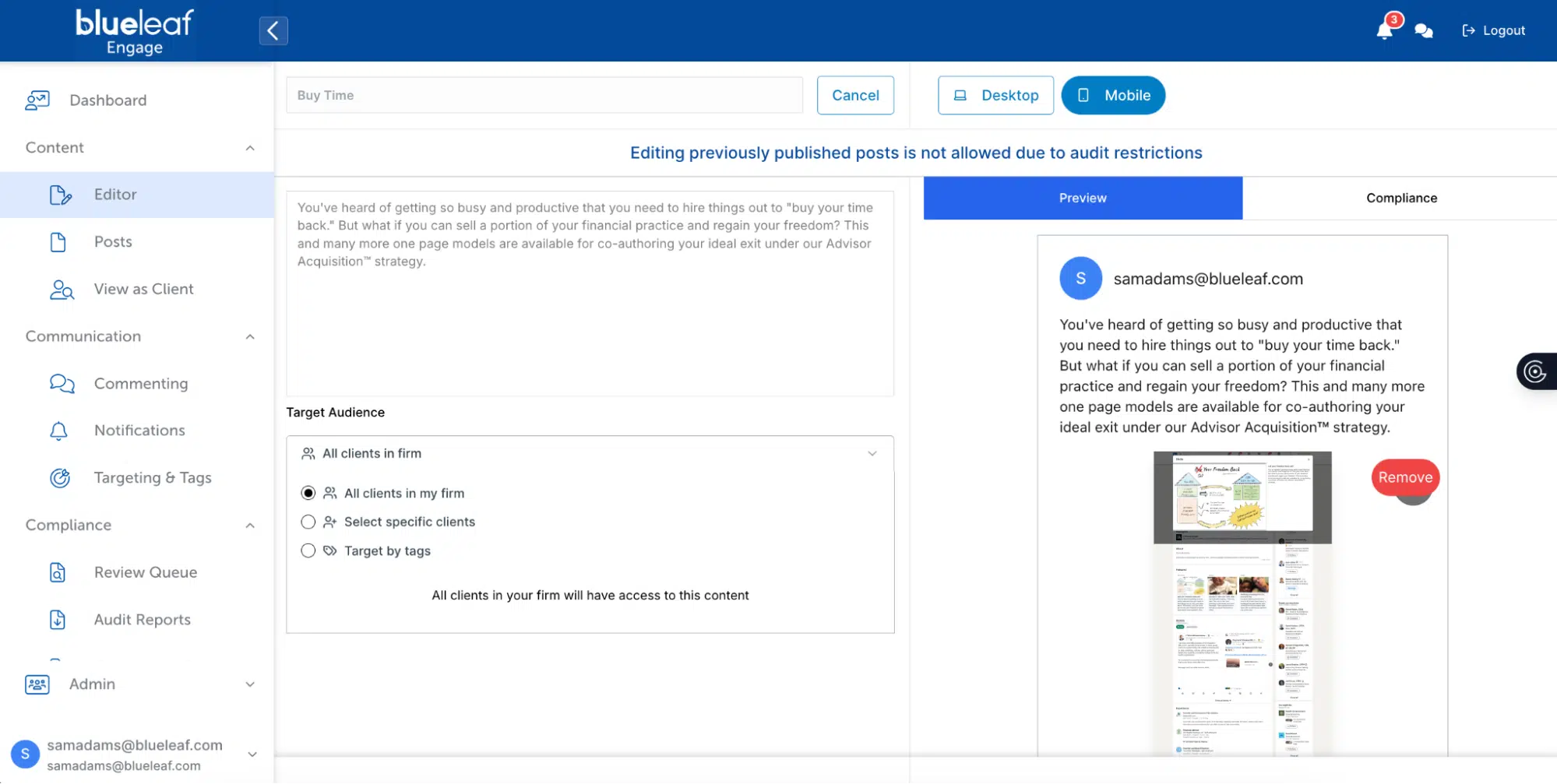
Here’s what that looks like in practice:
You’re writing a quick update about recent market volatility. Instead of writing it in Word, saving it, uploading it to MailChimp, then separately uploading it to your portal, and emailing a different version to clients who prefer email, you just write it once in Blueleaf.
Add that PDF report you already created in your portfolio system. Attach the video you recorded on your phone explaining what this means. Upload a relevant chart image. All in one place.
Then here’s the magic: the system automatically formats your content appropriately for each channel. Clients who check the mobile app see it formatted for mobile. Web users see it optimized for the web. Email subscribers get an email version. Same content, presented properly for how each client actually consumes it.
You’re not designing multiple versions. You’re not a graphic designer. You’re just writing and attaching media in one centralized place, and the system handles the distribution and presentation.
Think of it like LinkedIn’s post composer, but built for advisor-client communication. Simple text input, media attachments, then the platform handles the rest.
Content History: Stop Recreating the Wheel
Here’s a common scenario: Six months ago, you wrote a great explanation of tax-loss harvesting. Had a perfect chart. Nailed the language. Now it’s relevant again, but where is it? Was it in an email? A newsletter? That PDF you sent someone?
Finding your own past content shouldn’t be a scavenger hunt.
Blueleaf keeps your entire content history searchable in one place. Every post you’ve created, every piece of media you’ve attached, every update you’ve sent—it’s all there.
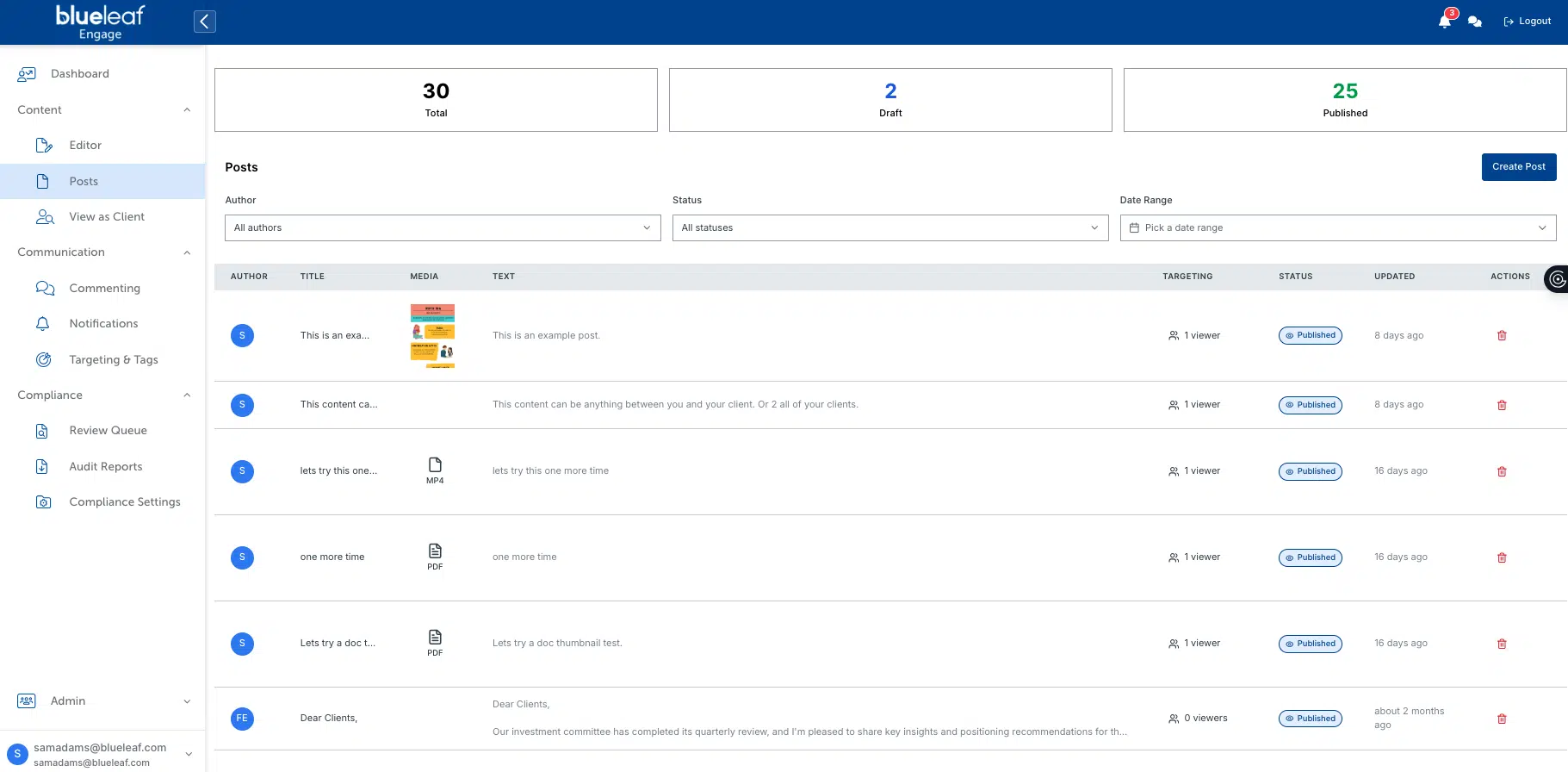
Need to update your market volatility explanation from last quarter? Search for “volatility,” pull up that post, and you’ve got your starting point. The video you embedded, the document you attached – it’s all right there in the original post.
Here’s what this actually means for your workflow:
Instead of starting from scratch every time (“What did I say about bonds last time?”), you search your past posts, find what worked, and either reuse it as-is or use it as a template for your update.
That chart you uploaded in March explaining interest rates? It’s in that March post. Want to use a similar chart now? Pull up that post, see what you did, and build on it.
You’re building a searchable archive of your best work. Not a separate media library you have to organize—just your actual communication history, readily available when you need it.
One advisor told me,
“I used to spend an hour trying to remember what I said to clients about something last year. Now I just search for it and find the exact post in 30 seconds.”
That’s the value. Not fancy organization systems. Just being able to find what you already created and build on it.
Bulk Operations: Send to the Right People, Not Everyone
Here’s what actually happens without bulk operations:
You have an important update about required minimum distributions. You know it’s only relevant to your clients over 73. But your options are: 1) send it to everyone and annoy the 40-year-olds, or 2) maintain separate email lists in MailChimp for every topic, or 3) set up clunky CRM workflows.
Most advisors pick option 1 because options 2 and 3 are annoying to maintain. So everyone gets everything, whether it’s relevant to them or not.
Here’s the real problem bulk operations solves: targeted communication without the list management headache.
You create content once. Use tags to target the right audience—maybe it’s clients tagged with “retirement planning,” or “high net worth,” or “business owners.” Click distribute. The right people get it through their preferred channel.
No separate email lists to maintain. No CRM workflows to troubleshoot. Just tag-based targeting using the client data you already have in the system.
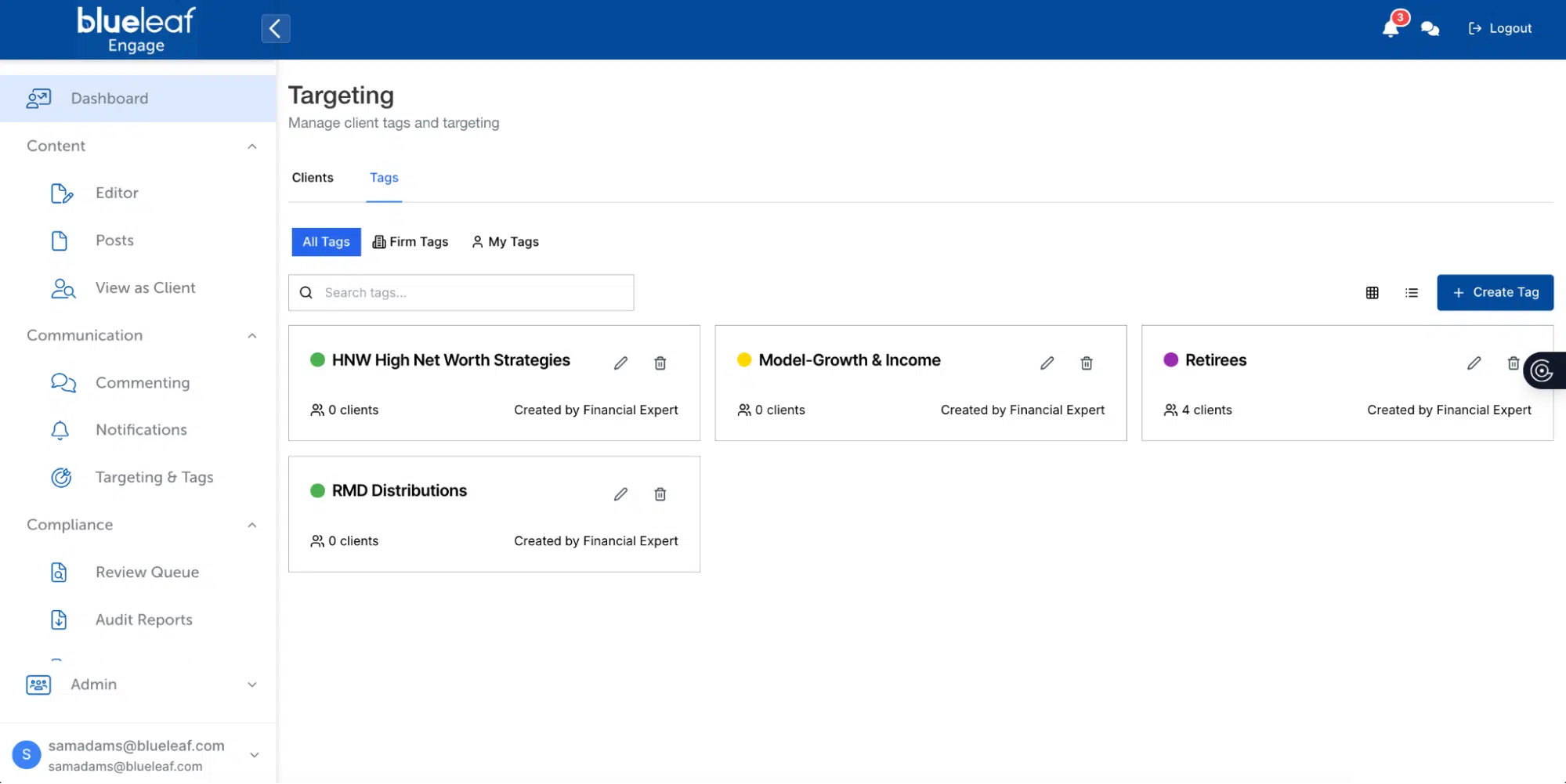
Here’s where this really pays off: scheduled content series.
Let’s say you want to send a series of three educational posts about tax strategies over the next three weeks. You want them to go to clients tagged with “tax planning interest.”
Instead of maintaining a separate list and remembering to send three different updates, you create the three posts, tag your target audience, and schedule them to go out over three weeks. The system handles the distribution.
The value isn’t just efficiency. It’s making targeted, relevant communication actually feasible instead of just blasting everyone with everything because segmentation is too much work.
One advisor told me,
“We used to send everything to everyone because maintaining separate lists was a nightmare. Now we actually send retirement content to clients tagged with retirement interests and tax content to clients tagged for tax planning. Engagement went up because people started getting stuff that actually matters to them.”
That’s the point. Tag-based targeting plus scheduling makes smart segmentation practical, not just possible.
How It All Works Together
Here’s what this looks like in practice:
Your marketing director logs in on Monday morning. She needs to send a market update. She searches your past posts for “market volatility” and pulls up the post from last quarter that clients really engaged with.
She uses that as her starting point—writes her new update, attaches this week’s chart that she exported from your portfolio system, and adds a quick market commentary. It takes her 20 minutes.
She tags it for “all clients” and schedules it to go out on Wednesday at 8 AM. The system will automatically format it for mobile, web, and email. Done.
While she’s in there, she creates next week’s update too. Same process. Searches for her last interest rate post, updates the numbers, and schedules it for next Wednesday. Another 15 minutes.
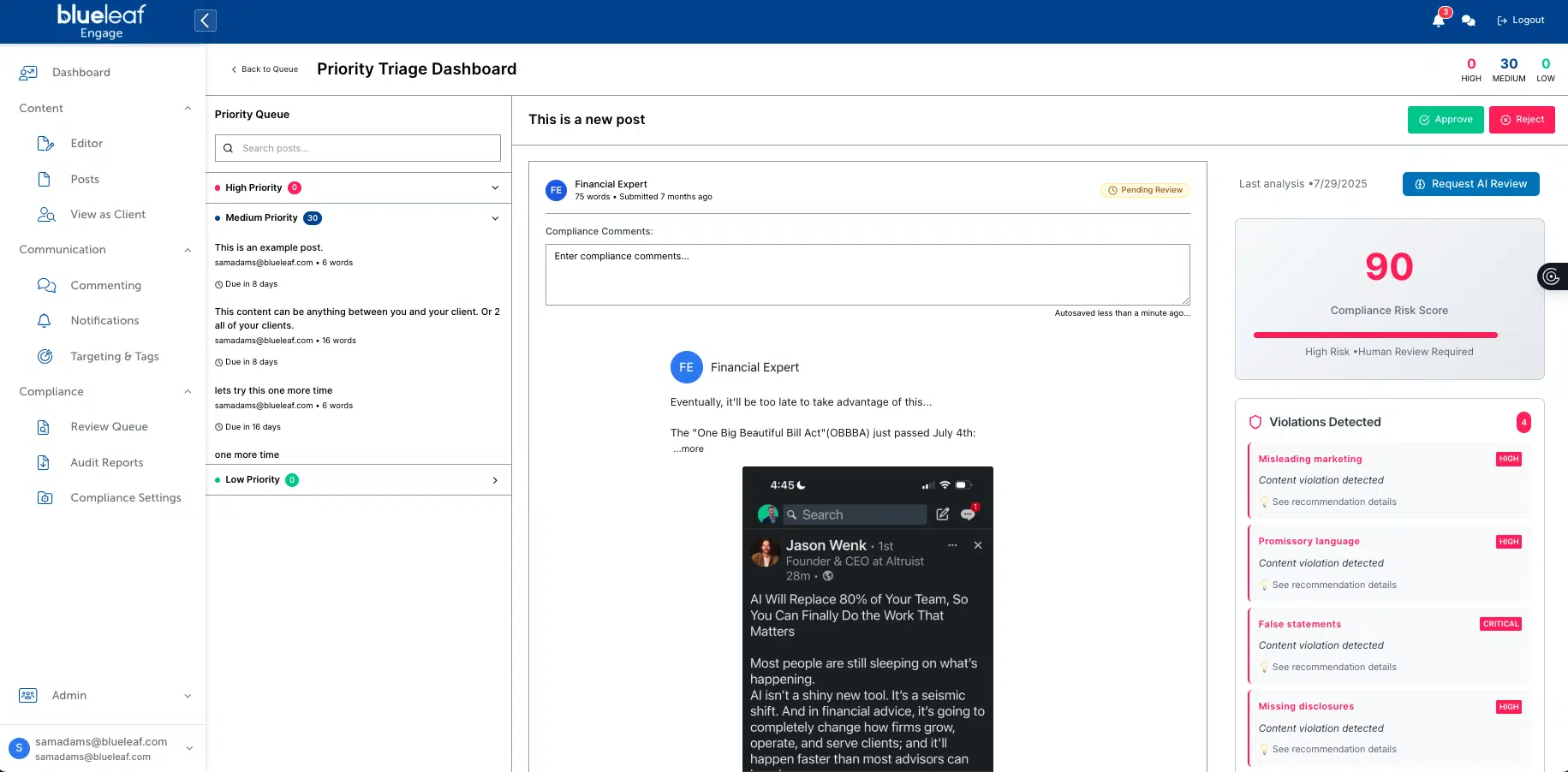
Your lead advisor gets a notification that the content has been submitted for review. He reviews it, decides to add a quick 60-second video with his perspective. He records it on his phone, uploads it, and attaches it to Wednesday’s scheduled post.
On Wednesday morning, 350 clients get the update. Thirty percent open it on mobile during their morning commute. Another 40% read it at their desk. A few reply with questions, which get routed to the right advisor.
The update went through your compliance workflow before it went out. If anyone asks six months from now what you said about that market event, you pull up the post history. There it is.
Next Monday, your marketing director searches for this week’s post, starts there, and updates the content. It takes 15 minutes.
That’s what a content management system built for advisors looks like. It’s not about adding more work. It’s about making the work you’re already trying to do actually manageable.
The Bigger Picture
Look, I get it. You became an advisor to help people with their money, not to become a content creator. But in 2025, engaging clients digitally isn’t optional. It’s table stakes.
The question is whether you’re going to do it with tools that make it easy or tools that make it painful.
Most of the advisors we work with tell us they knew they needed to do more content. They just couldn’t figure out how to make it work with their compliance requirements, their limited time, and their need to look professional.
A proper content management system doesn’t solve the “what should I say” problem—that’s your expertise. But it solves the “how do I say it efficiently, at scale, while staying compliant” problem. Which, frankly, is the bigger obstacle for most firms.
The compliance piece alone is worth the price of admission. Instead of emailing drafts back and forth, wondering if compliance actually reviewed something, or scrambling six months later to prove what you sent, it’s all handled in the workflow. Content goes through your compliance process. Everything’s documented. You can sleep at night.
When you remove the friction from content creation, something interesting happens. Advisors actually enjoy it. They like being able to share their expertise quickly. They like seeing clients engage with their content. They like not spending hours fighting with technology or waiting for compliance approval in email threads.
And clients? They love hearing from their advisor more than twice a year. They appreciate the regular updates, the educational content, and the sense that someone’s actually paying attention to their money.
That’s the real goal here. Not more content for content’s sake, but more meaningful engagement with the people who trusted you with their financial futures.
If you’re ready to move beyond scattered tools and email-thread compliance reviews, it might be time to look at a CMS actually built for financial advisors. Not just adapted from some other industry, but designed from the ground up for how you actually work.
Because your clients are out there, consuming content every day. The question is whether it’s your content or someone else’s.
Want to see how Blueleaf’s Content Management System can transform your client communications? Schedule a demo to see it in action.