The Client Marketing Engine Your Enterprise RIA Is Missing (and Why It’s Not Your CRM)
9 min Read
Enterprise RIAs have invested heavily in tools to manage client data. That includes CRM platforms, portfolio reporting systems, financial planning software, and custodial portals. The modern advisory technology stack is deep, well-integrated, and increasingly sophisticated.
And yet, for most enterprise RIA platforms, the answer to a straightforward question remains unsatisfying: how are you proactively marketing to your current clients?
For most enterprise RIAs, the honest answer is “inconsistently, reactively, and largely at the individual advisor’s discretion.”
That’s not a CRM problem. It’s a client marketing infrastructure problem. And it’s one that a new category of platform is specifically built to solve.
Why Your CRM Is Not a Client Marketing Engine
The CRM conflation is worth addressing directly because it’s the assumption that keeps most enterprise RIAs from recognizing the gap.
CRM platforms are built to manage information about clients: contact records, relationship history, account details, task reminders, and pipeline tracking. They’re exceptionally good at what they do, and what they do is help advisors and relationship managers organize and act on client data.
CRM platforms don’t generate and distribute personalized client content. They don’t create a channel through which clients receive consistent, scheduled communications from the firm, not just from their individual advisor, but from the enterprise. They don’t track client engagement with content, surface re-engagement signals, or create the kind of persistent, branded touchpoints that build firm-level relationships.
Your CRM knows everything about your clients. It just doesn’t do anything with that knowledge unless an advisor manually acts on it.
That distinction matters enormously for enterprise RIAs. Advisor-dependent client communication works reasonably well when the firm has a small, stable advisor base with deep individual client relationships. It scales poorly when the firm is managing hundreds of advisors across dozens of acquired entities, when client relationships are in transition because of M&A activity, and when the goal is to build enterprise brand equity alongside individual advisor relationships.
The CRM is a database with workflow tools. A client marketing engine is something fundamentally different: it’s the infrastructure that turns client data into continuous, proactive engagement, systematically, compliantly, and at a scale no individual advisor initiative can match.
What “Client Marketing Engine” Actually Means
The term deserves precision, because it describes a specific set of capabilities that operate together to produce a measurable outcome: higher client engagement, stronger retention, and more referral-driven organic growth.
A client marketing engine for an enterprise RIA has four core functions:
- Proactive content delivery: The platform generates and distributes branded, personalized content to clients on a scheduled basis: market commentary, planning insights, firm updates, and educational material. Automatically, consistently, and at scale across the entire client base.
- Engagement tracking: The platform measures how clients interact with delivered content: what they open, what they read, what they engage with, and what they ignore. This engagement data surfaces which clients are active and which are disengaged and potentially at risk.
- Compliance infrastructure: All content passing through the platform is subject to compliance review and approval workflows before distribution. Every communication is archived, timestamped, and auditable. Advisors can personalize within compliance-approved parameters. The firm maintains supervision and record-keeping obligations without creating a bottleneck that slows advisor activity.
- Brand consistency at enterprise scale: Client communications carry the firm’s brand, voice, and positioning, not just the individual advisor’s. This builds enterprise-level client relationships that survive advisor transitions, support cross-selling and upselling, and create the kind of institutional identity that distinguishes a sophisticated advisory firm from a collection of individual practitioners operating under a shared name.
These four functions work together. Proactive content delivery without engagement tracking is broadcasting into a void. Engagement tracking without compliance infrastructure creates regulatory exposure. Compliance infrastructure without brand consistency produces communications that feel bureaucratic rather than relationship-building. The engine requires all four components operating in concert.
The Engagement Gap Is the Growth Gap
Here’s the number that reframes this from a nice-to-have to a strategic priority: across the wealth management industry, client portal engagement rates average between 10% and 30% of the client base. That means for most enterprise RIAs, somewhere between 70% and 90% of clients are not regularly engaging with the digital touchpoints the firm has invested in building.
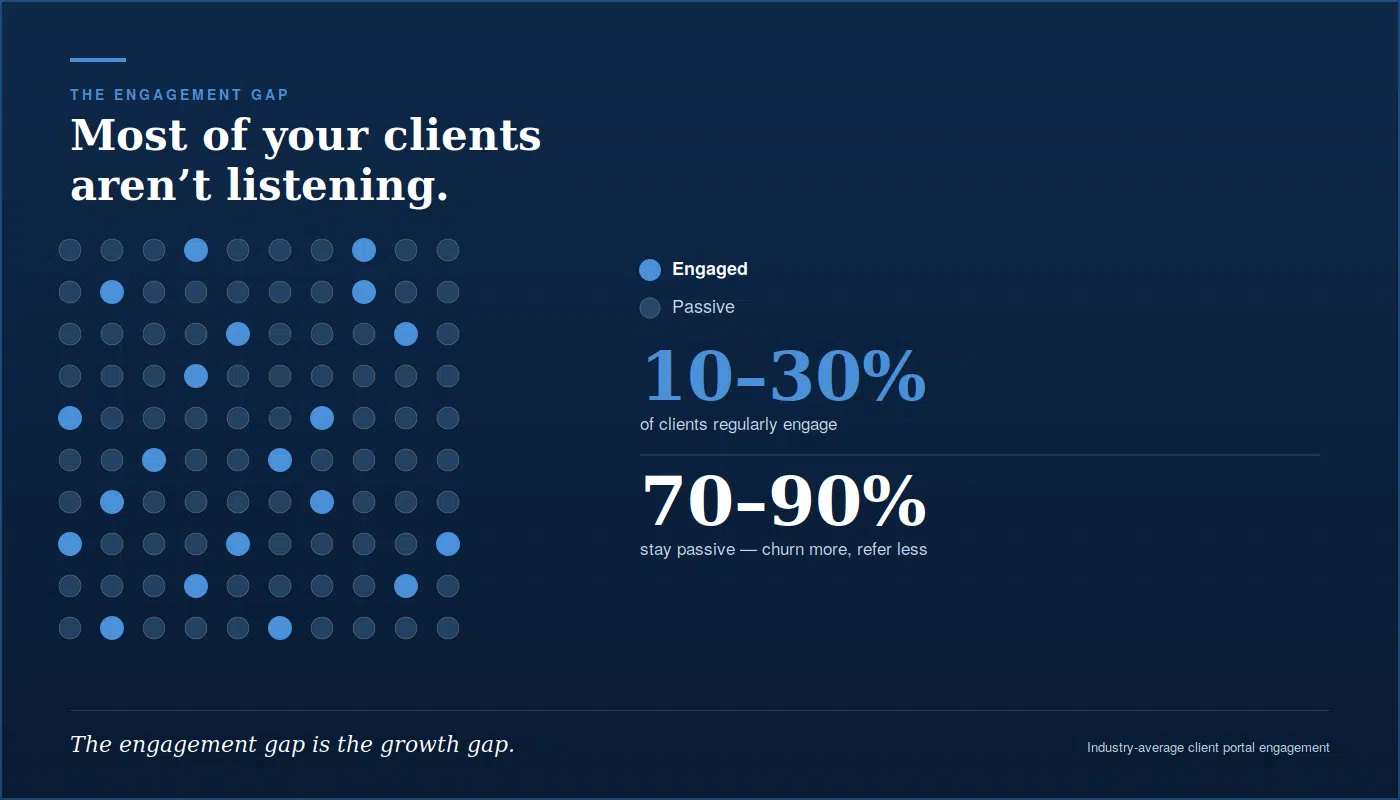
Those disengaged clients aren’t necessarily dissatisfied. They’re passive. And passive clients behave very differently from engaged ones:
- Significantly more likely to leave when an advisor departs, because the advisor relationship is the only thread connecting them to the firm.
- Referral behavior is strongly correlated with engagement. Clients who regularly interact with firm content and feel connected to the firm’s perspective are more likely to share it with peers in their network.
- Vulnerable to competitive solicitation. An advisor from another firm who reaches out with thoughtful content has an easier path with a client who hasn’t heard from their current firm in six months.
- Represent unrealized wallet share. Planning needs, additional assets, next-generation relationships. The potential is in the book, but the engagement that surfaces it isn’t happening.
A 10% portal engagement rate isn’t a technology adoption problem. It’s a growth strategy problem wearing a technology costume.
For a PE-backed enterprise RIA managing $5 billion in AUM, the difference between 15% client engagement and 75% client engagement isn’t an abstract metric. It’s the difference between advisor departures that take clients with them and ones that don’t, and between renewal conversations that require minimal effort and ones that start from scratch.
The engagement gap is the growth gap. Closing the gap requires infrastructure that most enterprise RIAs don’t currently have.
Why This Isn’t a Portal Upgrade
It’s worth being clear about what a client marketing engine is not, because the instinct is often to frame this as an improvement to the existing client portal.
The client portal is a document repository, account aggregation view, and statement access point that most advisory firms offer. It is a passive tool that waits for clients to log in. When clients do log in, they find what they were looking for. The portal is a service channel. It’s a place clients go when they need something.
A client marketing engine is an active tool. It goes to clients, rather than waiting for them. It creates reasons to engage rather than requiring clients to have a reason to visit. It generates the kind of consistent, value-added touchpoints that build a relationship with the firm independent of any particular transaction or need.
The distinction matters for how enterprise RIA leadership should think about investment in this category. Adding features to an existing portal, like better document organization, improved account aggregation, or a cleaner mobile interface, is an improvement to a service channel. Building a client marketing engine is an investment in a growth channel. The ROI logic is different. The strategic framing is different. And the organizational capability required to execute it is different.
What This Looks Like in Practice
For enterprise RIA leadership evaluating what a client marketing engine actually changes operationally, the practical picture looks something like this:
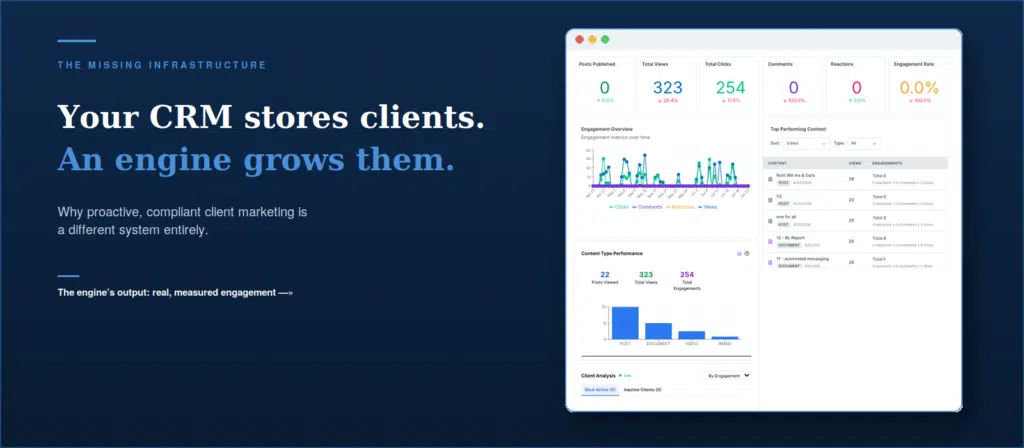
Instead of clients receiving a quarterly statement and an occasional advisor email, clients receive a consistent cadence of branded content: market perspectives, planning insights, and relevant financial education, delivered through a portal experience that’s designed to be engaging rather than functional. The content is generated and reviewed at the enterprise level, approved through a compliance workflow, and distributed automatically. Advisors can customize within compliance-approved parameters, but the engine runs whether any individual advisor initiates anything or not.
The compliance team has full visibility and supervisory control over everything being distributed. The archive is comprehensive and audit-ready. When an SEC examiner asks to review client communications, the answer isn’t a scramble through email servers and advisor inboxes. It’s a complete, organized record of every communication the firm has sent.
The leadership team has engagement data across the entire client base: which clients are active, which are passive, which have gone quiet, and which have increased their engagement ahead of a planning meeting. This data informs relationship management priorities, advisor coaching, and retention strategy in ways that no CRM system, however well-configured, can replicate.
When your client portal becomes a marketing engine, retention becomes a system — not a hope.
The Strategic Case for Enterprise Leadership
For CEOs and presidents of enterprise RIA platforms, the client marketing engine argument comes down to three strategic imperatives.
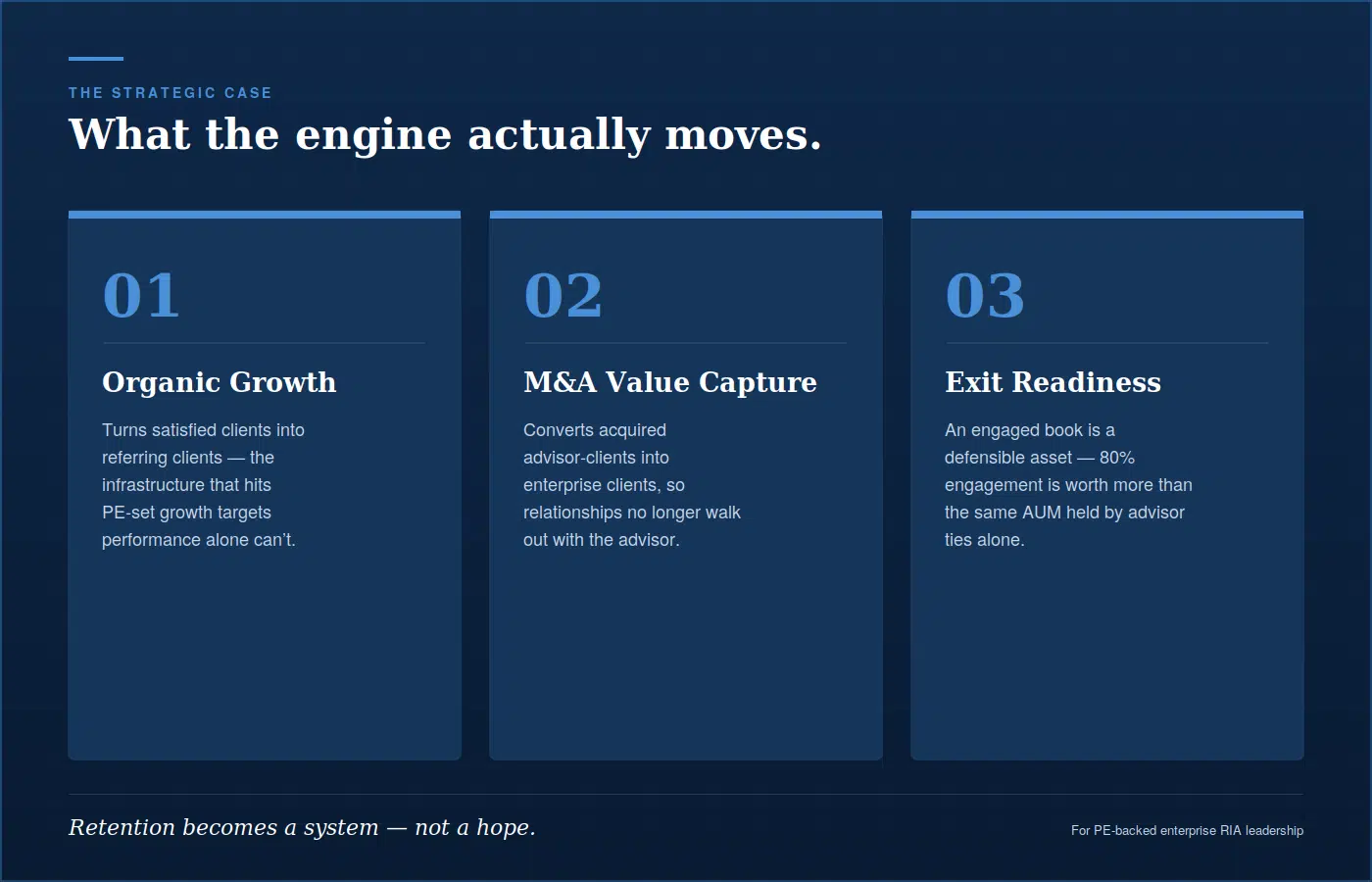
First, organic growth. PE sponsors have set organic growth targets that advisory firms were not historically built to hit. The firms that will meet those targets aren’t the ones with the best investment performance. Performance is table stakes. They’re the firms that have built the client engagement infrastructure that turns a satisfied client into a referring client. That infrastructure doesn’t exist in the CRM. It doesn’t exist in the custodial portal. It needs to be built deliberately.
Second, M&A value capture. When an enterprise RIA acquires a firm and absorbs 500 new client households, the goal isn’t just to not lose those clients; it’s to deepen those relationships at the enterprise level so that they’re no longer purely dependent on the individual advisor who brought them in. A client marketing engine is the mechanism by which acquired clients become enterprise clients, not just advisor clients.
Third, exit readiness. A PE-backed RIA platform preparing for a future transaction needs to demonstrate not just AUM and revenue but also the operational and engagement infrastructure that makes those metrics defensible and growable. A client base where 80% of households are regularly engaging with firm content is a more defensible asset than one where the same AUM is held together by individual advisor relationships that could walk out the door.
The firms building this infrastructure now aren’t doing it because it’s interesting. They’re doing it because the growth math requires it. Firms that wait until they need it will be building from a standing start at the moment when speed matters most.
Key Takeaways
- CRM platforms manage client data. A client marketing engine turns that data into proactive, systematic, compliance-approved engagement, a fundamentally different capability.
- Industry-average client portal engagement rates of 10–30% represent a significant, measurable growth gap: disengaged clients refer less, churn more, and represent unrealized wallet share.
- A client marketing engine has four interdependent functions: proactive content delivery, engagement tracking, compliance infrastructure, and enterprise brand consistency.
- This is not a portal upgrade. It’s a shift from a passive service channel to an active growth channel, with different ROI logic and different strategic implications.
- For PE-backed enterprise RIAs, the client marketing engine is the infrastructure that makes organic growth targets achievable, M&A value capture systematic, and exit metrics defensible.
See what a client marketing engine looks like in practice. [Request a Demo]