From 10% to 90%: What Real Client Engagement Looks Like for PE-Backed RIAs
3 min Read
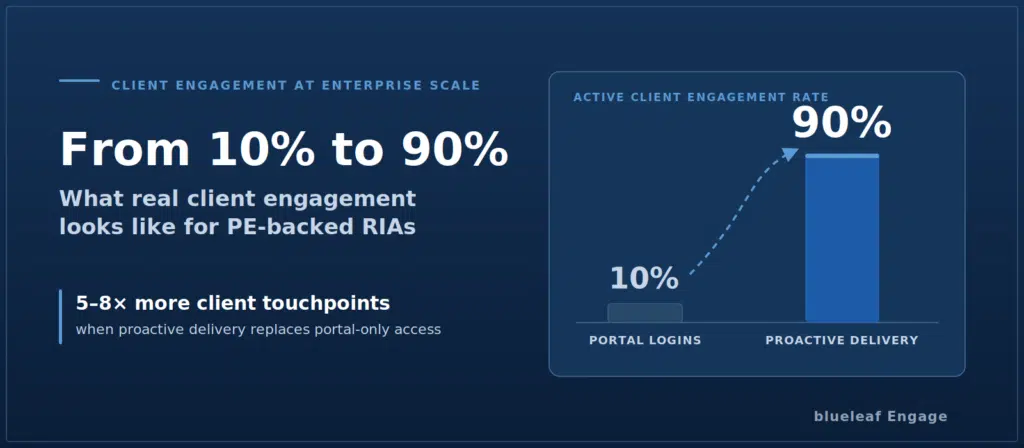
Most enterprise RIA executives know their client portal engagement numbers. They just don’t talk about them. Industry benchmarks put active portal usage at 10–15% for the average wealth management firm. In other words, for every client who logs in regularly, nine receive no meaningful digital touchpoints from their advisor firm at all.
That number isn’t a technology problem. It’s a model problem. And for PE-backed firms under pressure to demonstrate organic growth, NPS improvement, and AUM retention across a growing portfolio of acquired businesses, it’s an increasingly urgent one.
| 10–15%
Typical portal login rate at enterprise RIA firms (industry benchmark) |
5–8x
Increase in client touchpoints when proactive delivery replaces portal-only access |
Why Portal Engagement Numbers Stay Stuck
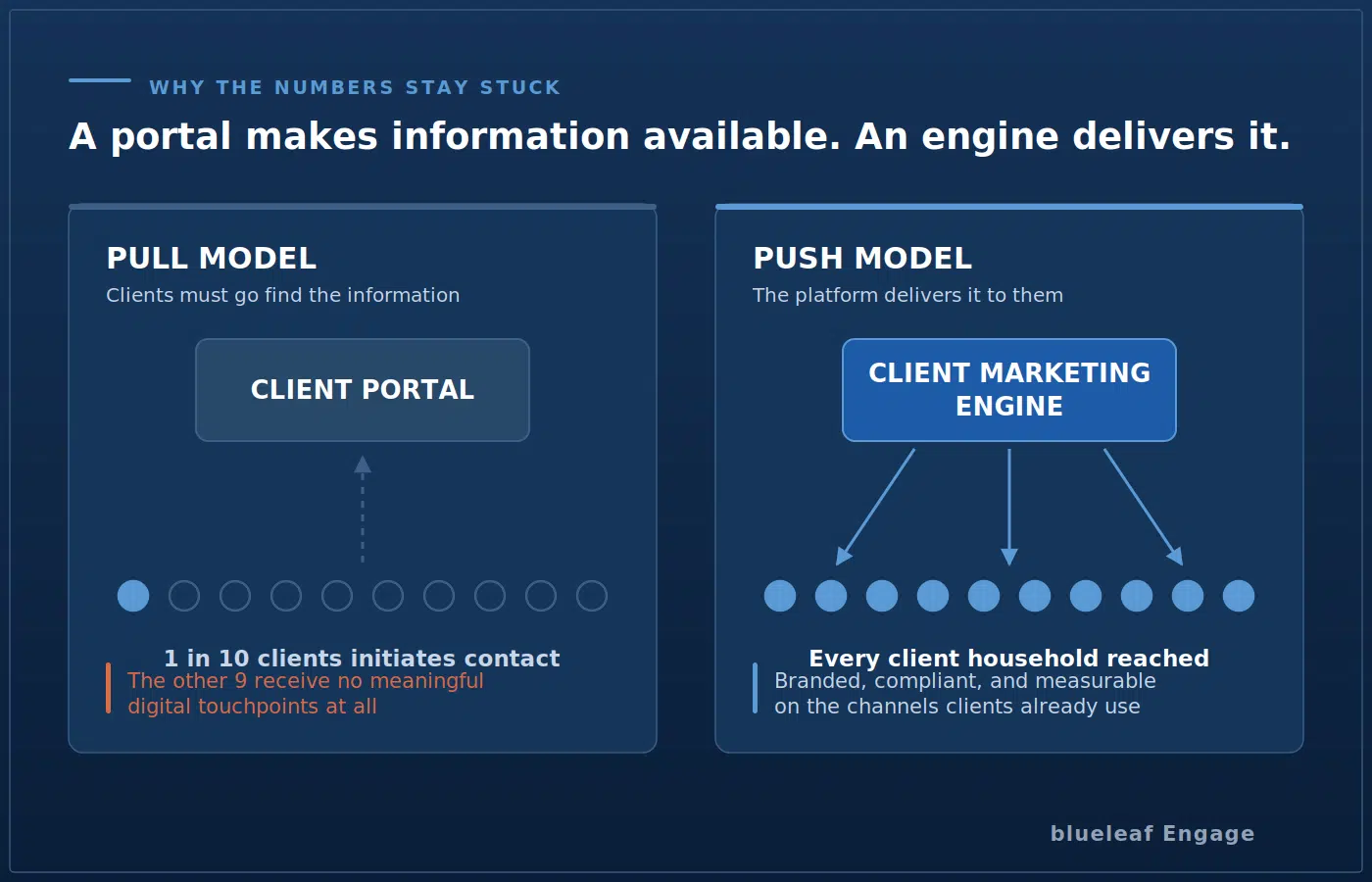
Client portals were built to make information available. They were not built to deliver it. The architecture assumes that clients will seek out their financial data, read market updates, and act on planning prompts on their own initiative, without prompting, without personalization, and without any mechanism to know whether the communication ever landed.
In practice, most clients don’t log in unless they have a specific question or a transaction to complete. That leaves the 90% of the portfolio relationship that should be proactively managed entirely unaddressed. We’re talking about the market commentary, the portfolio context, the life-stage communications, and the referral triggers.
A portal makes information available. A client marketing engine makes sure clients actually receive it and that the firm can prove it.
What ‘90%’ Actually Means in Practice
The firms achieving significantly higher engagement rates aren’t doing more work. They’ve shifted from a pull model (clients log in to find information) to a push model (the platform delivers relevant, branded content directly to clients via the channels they already use).
The result isn’t just better open rates. It’s a measurable shift in how clients perceive the relationship with their advisor, from transactional to proactive. For PE-backed firms, that translates directly to the metrics that matter at the portfolio level:
- Reduced client attrition in the 12–18 months post-acquisition
- Higher NPS scores across acquired firm portfolios
- More referral conversations initiated by clients who feel consistently engaged
- Advisor retention improvement when the tech stack is competitive
The Enterprise Angle: Consistency at Scale
For a single-office RIA with 200 clients, the gap between 10% and 90% engagement might be a relationship management problem that skilled advisors can close manually. For a PE-backed aggregator managing 20,000+ client households across 12 acquired firms, that gap is a structural liability.
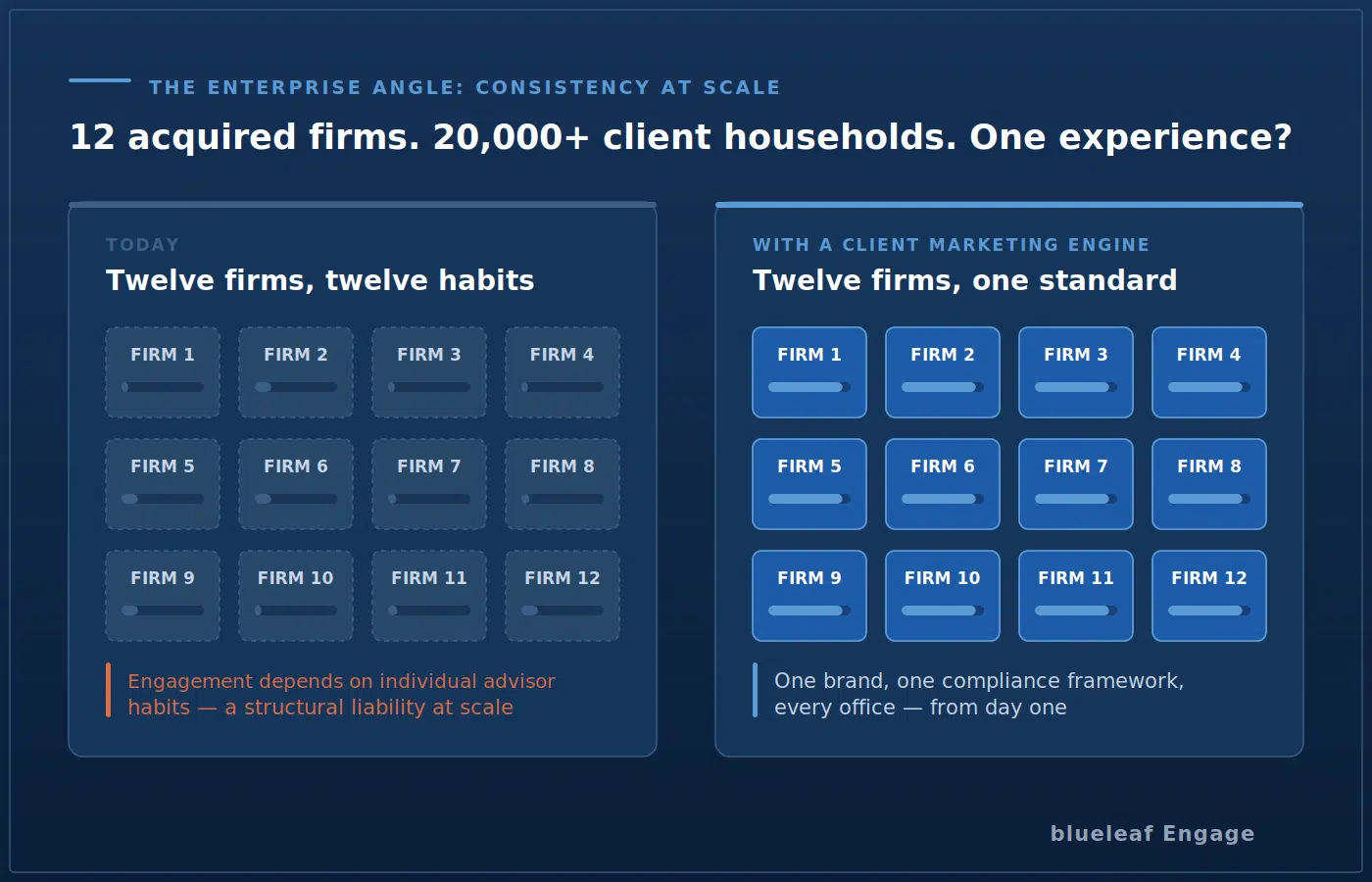
Each acquired firm came with its own communication practices, advisor habits, and client relationships. The platform-level question isn’t whether individual advisors are doing a good job. It’s whether the enterprise can deliver a consistent, compliant, brand-aligned experience to every client household, regardless of which office they’re in or which advisor manages their account.
The firms delivering 90% engagement aren’t working harder. They’ve built a system that works without depending on individual advisor effort.
What the PE Sponsor Needs to See
Operating partners evaluating their portfolio firms’ organic growth capacity increasingly ask the same question: what is the firm’s actual client marketing infrastructure? Not the CRM. Not the portal. The active delivery mechanism that generates consistent, measurable touchpoints at scale.
The answer for most firms is, “Nothing formal.” And for PE sponsors that have underwritten their investment on 15–20% organic growth targets, that answer is increasingly unacceptable.
See what moving from 10% to 90% engagement looks like in practice. [Request a Demo]