Consolidation Stops at Portfolio Management: What It Costs When Client Communication Never Converges
8 min Read
By the time an enterprise RIA has closed its fifth acquisition, most of the operating stack has converged. One portfolio management and performance reporting platform. One or two custodial relationships. One billing engine, one CRM standard, one compliance calendar. Integration teams are good at this work, and the systems that hold client data are the ones they converge first.
Client communication is the exception, and it is rarely a decision anyone made. It does not present itself as a system. It presents as advisors sending their own email, a marketing coordinator at the acquired firm running a newsletter, a content subscription someone signed up for three years ago, and a review process that lives in an inbox. Nothing breaks when it is left alone, so it gets left alone.
Which is why the question of how many systems touch client communication has an answer that surprises people when they say it out loud. It is not five or six. It is five or six for every firm the organization has bought, and the number goes up with the next deal rather than down.
5 × every firm acquiredPortfolio management converges on the first integration pass. Client communication is the one function that multiplies with deal count, because it never makes the integration checklist. |
Consolidation Converges Data, Not Conversations
The integration playbook has a clear order of operations. Custodial relationships, portfolio accounting, performance reporting, billing, and CRM converge first, because they carry the numbers the firm reports on and the records examiners ask for. Communication ranks below all of it for three reasons: the spend at any single firm is small enough to stay under the threshold that triggers a review, the activity belongs to advisors rather than to operations, and no one at the enterprise level is accountable for it.
The result is an organization that can produce one consolidated performance report for every household it serves and cannot say what any of those households were told last quarter. The data converged. The conversation did not.
Consolidation converges the systems that hold the client’s data. It almost never touches the systems that talk to the client.
The Portfolio Management Platform Already Does This. Up to a Point.
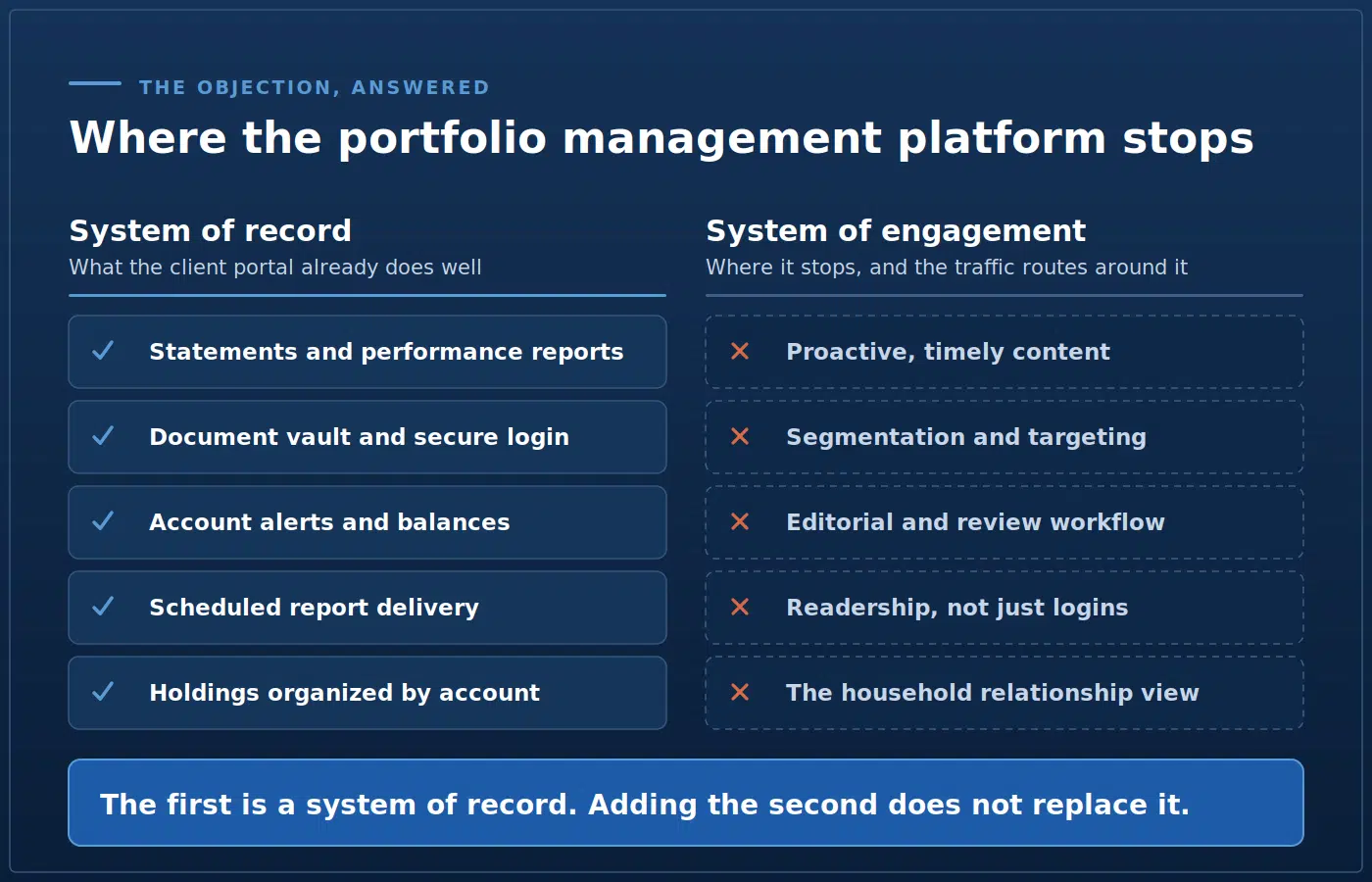
Any enterprise RIA evaluating a client communication layer runs into the same internal objection, usually from someone who has just finished a platform migration: the portfolio management system already has a client portal. It does, and it does that job well. It delivers statements and performance reports on a schedule, hosts a document vault, posts account alerts, and gives clients a secure place to log in and see what they own. For account data it is the system of record, and it should stay that way.
Where it stops is everything that is not account data. The portal delivers when the firm produces a report, not when a market move, a tax deadline, or a planning milestone gives the firm something worth saying. It has no segmentation, so there is no way to send one message to households approaching required minimum distributions and a different one to plan participants at a recently acquired firm. It has no editorial or review workflow for marketing communication, which is precisely why that traffic routes around it into email tools and personal inboxes. It reports logins rather than readership, so the firm cannot tell which households are engaged and which have gone quiet. And it is organized around accounts rather than around the relationship the firm is trying to keep.
The distinction worth holding onto is between a system of record and a system of engagement. The portfolio management platform is the first one. Adding the second does not require replacing it, migrating into it, or reopening the decision that put it there.
The Cost Is Per Deal, Not Per Firm
The financial argument follows from the multiplication rather than from the licensing. Each acquired firm arrives with its own communication spend, and because nothing in the integration plan forces it to converge, most of it survives the deal:
- Email or mass communication platform: $12,000 to $30,000 per year, per firm
- Third-party content or newsletter subscription: $10,000 to $40,000 per year, per firm
- Advisor-level communication and scheduling tools: $10,000 to $50,000 per year, per firm
- Communication review and archiving, frequently duplicated: $20,000 to $60,000 per year
- Marketing coordinator time at the acquired firm, usually carved out of an existing role
Individually, every one of these sits below the threshold that would trigger a consolidation review, which is exactly why they survive. Collectively, they are the one line in the operating budget that scales with deal count instead of with assets. A firm five acquisitions carries five versions of the same spend, five review processes, and five different answers to the question of what its clients heard last quarter.
Consolidating that layer is not a rip and replace. The portfolio management platform, the CRM, and the custodial relationships stay exactly where they are. What converges is the layer above them: who can send, what gets reviewed, where the record lives, and what the firm can see.
| Category | Communication left to converge | One communication layer |
| Portfolio management platform | Unchanged, system of record | Unchanged, system of record |
| Communication spend | Recurs with every acquisition | Consolidated above the platform |
| Supervision and archive | One process per acquired firm | One queue, one record |
| Advisor autonomy | Varies by inherited tool | Advisor writes, firm sets standards |
| Onboarding an acquired book | 3 to 6 months per firm | 2 to 4 weeks per firm |
| Firm-level view of engagement | Assembled by hand, if at all | Every household, every message |
What Owning the Channel Does Not Mean
Consolidating communication raises a reasonable objection inside an advisory organization, and it is better answered directly than left to rumor. Advisors hear that the firm will own the channel and assume it means the firm is taking the relationship. It does not mean that.
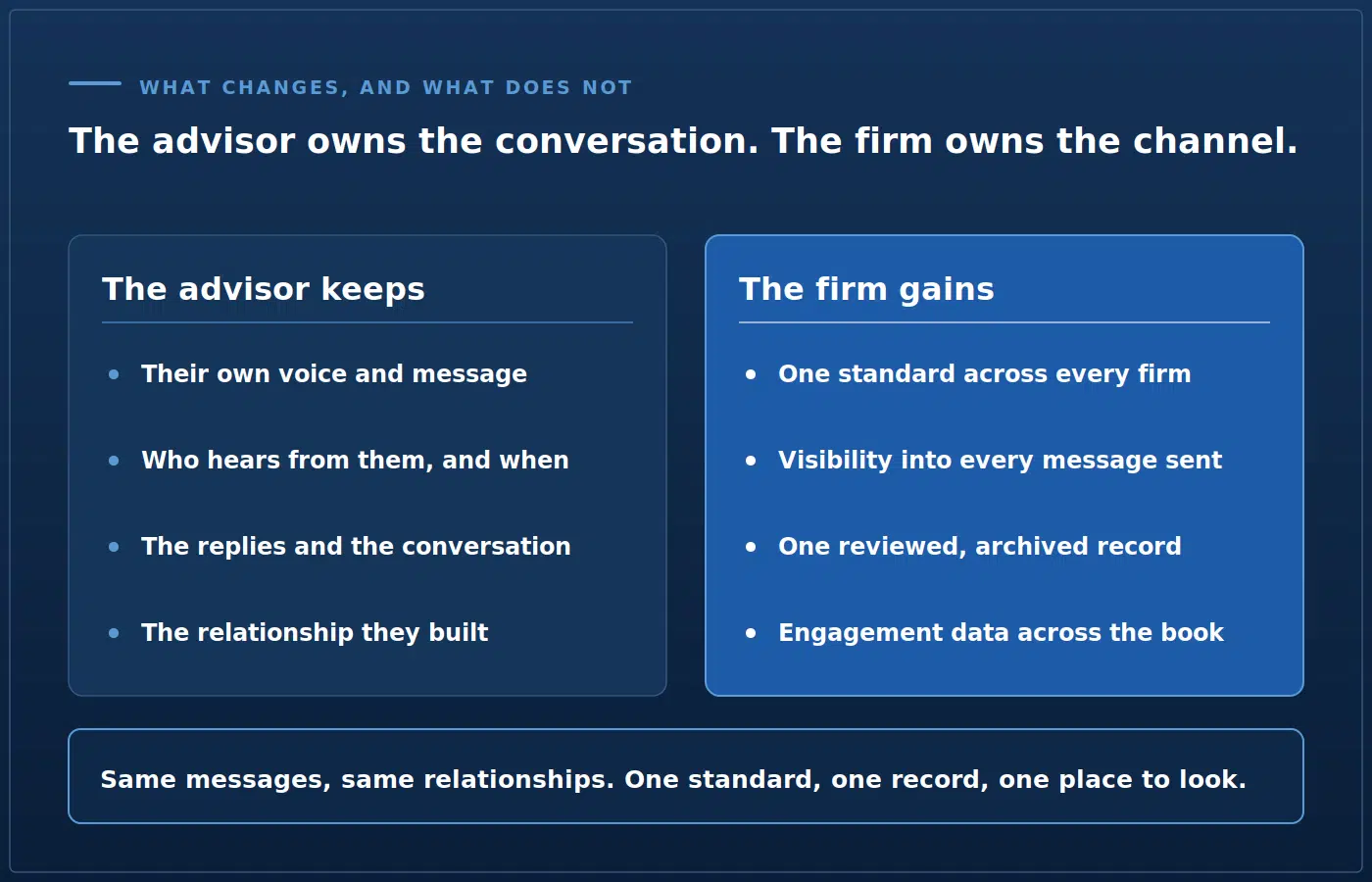
Advisors keep writing their own messages, in their own voice, to their own clients, on their own timing. They decide what goes out and to whom, they answer the replies, and they keep the relationship that brought the client in. Nothing in the layer changes who the client calls when the market drops.
What the firm gains is the infrastructure underneath the message: one standard for what client communication looks like across every firm it has bought, visibility into everything that goes out, a single reviewed and archived record, and engagement data across the whole book rather than firm by firm. The firm owns the channel in the same sense that it owns the email domain, the letterhead, and the compliance file. It does not own the conversation.
That distinction is what makes a transfer of control possible without disruption. When an advisor retires, exits, or moves into a different role, the client’s communication history, preferences, and content stream belong to the firm and carry on uninterrupted. The relationship survives the transition because the channel did. For a PE-backed organization, that is the difference between owning a book that depends on one advisor staying and owning one that belongs to the enterprise.
Speed of Control Transfer
For a firm closing three to five acquisitions a year, the layer approach changes the integration math. Because the communication layer sits on top of the portfolio management platform rather than replacing it, onboarding an acquired firm does not wait behind a portfolio data migration. Client records come across, the firm’s brand and content standards get applied, advisors are added, and the channel is live.
The realistic alternative is not a competing project. It is the default, which is nothing: the acquired firm keeps its tools, its advisors keep their habits, and clients keep hearing from the firm they originally signed with rather than the firm that now owns the relationship. Every quarter that persists is a quarter of enterprise value sitting with an individual advisor instead of with the platform.
Every week after close that a client still hears from the firm they signed with is a week the acquisition has not really happened.
Framing the Decision
The decision in front of the executive team is not whether to reopen platform choices the organization has already made. The communication layer does not touch them. It is whether client communication stays the one function that multiplies with every deal, or becomes the one layer where the firm sets a standard once and applies it to every firm it buys. Portfolio management consolidation proved the organization can operate as one company on the numbers. Communication is where it either does or does not operate as one company in front of the client.
Blueleaf Engage sits on top of the portfolio management platform an enterprise RIA already runs, consolidating client communication into a single reviewed, archived, and measurable channel, with advisors keeping their voice and the firm keeping the record.
