The SEC Doesn’t Care Which Firm You Bought It From: Compliance Liability in the Age of RIA Aggregation
7 min Read
When a deal closes, the seller’s name comes off the door, but their communication habits stay, and the responsibility for them becomes yours.
Every acquisition has a closing date. Regulators don’t treat it as a fresh start.
The day after close, the acquired advisors work under your registration. Their newsletters, market emails, and website posts go out under your supervision. When an examiner asks for records, the request comes to you.
No exam letter asks which firm an advisor came from. It asks what your firm did.
That is the core of compliance liability in aggregation. You buy the book, and with it you take on everything the advisors say to clients.
The Deals Keep Coming
RIA consolidation has not slowed much. Echelon Partners counted 125 RIA transactions in the third quarter of 2026, in a report released in October 2026. Through September, the year’s total reached 387, up 12.2% from the same point in 2025.
73.6% of Q3 2026 RIA deals were announced by PE-backed acquirers (Echelon Partners, October 2026)
Most of that volume comes from serial buyers. Each deal adds advisors, offices, and client lists. Each one also adds a set of communication habits built under someone else’s compliance program.
A firm that closes four deals a year can end up with four ways of talking to clients. Within a few years, there may be twenty.
The SEC Has Said Where It Will Look
Regulators have noticed the pattern. The SEC’s Division of Examinations released its fiscal 2027 priorities on October 23, 2026.
The adviser section names a specific target. The Division will prioritize advisers that have grown “through mergers, acquisitions or other means.” It also flags firms with “multiple geographically dispersed branch offices.”
The question for those firms is whether the compliance program kept pace. Marketing is listed among the core program areas examiners will review.
This is not new. The fiscal 2026 priorities, released in November 2025, also singled out advisers involved in mergers and acquisitions. Two years in a row is a signal, not a coincidence.
An exam doesn’t ask which firm an advisor came from. It asks whether your program covers them.
What Transfers at Closing
The legal history of the seller depends on how the deal is structured. In a stock purchase, the acquired entity’s past usually comes with it. In an asset purchase, more of it may stay behind. Your deal counsel will know which applies.
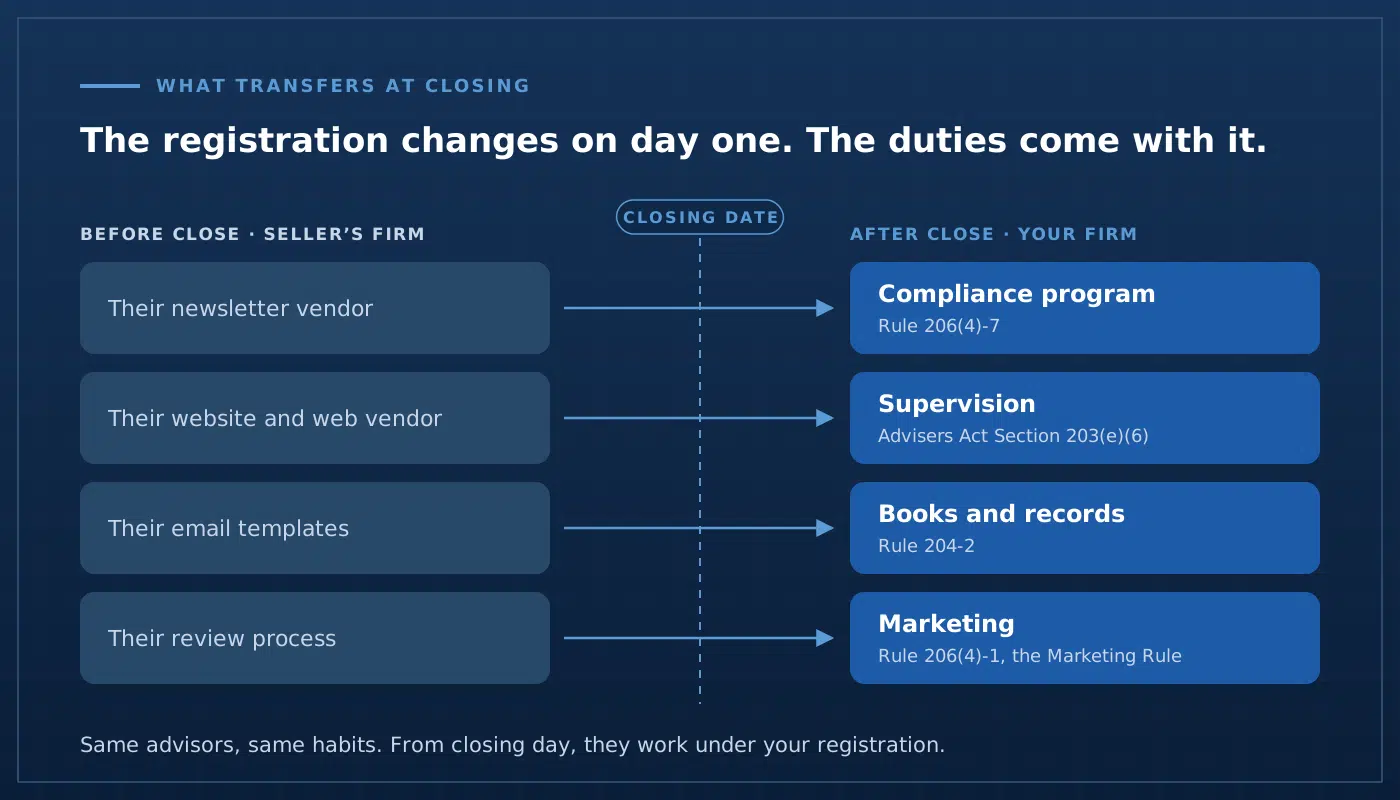
The forward-looking duties don’t depend on structure. Once acquired, advisors work under your registration, and four obligations become yours.
- The compliance program. Rule 206(4)-7 requires policies reasonably designed for the firm as it operates today, including offices that joined last quarter.
- Supervision. Acquired advisors are now your supervised persons. A failure to supervise them is your firm’s failure.
- Books and records. Rule 204-2 requires firms to keep advertisements and certain client communications. If an office uses its own vendor, the records still have to be produced on request.
- Marketing. Newsletters, market updates, and website posts sent to many clients can count as advertisements under the Marketing Rule. Their claims must hold up to your standards.
A Small Case With a Large Lesson
Some of the clearest warnings come from small cases. On September 4, 2025, the SEC settled with Meridian Financial, an investment adviser, for $75,000.
The facts were ordinary. A claim in the firm’s published content didn’t match its Form ADV. Examiners asked for copies of that content, and the firm could not produce them. Neither could its vendor.
One firm, one vendor. Now picture a consolidator with a dozen acquired offices. Each office may run its own site, its own email newsletter, and its own vendor contract.
The question an examiner asked Meridian is the same one they can ask you. Show us what you showed clients.
The Rules May Change. The Duties Haven’t.
The regulatory tone has shifted since 2025. In early 2026, SEC Chairman Paul Atkins said the agency is examining recordkeeping expectations for digital communications. Rule changes may follow.
But the duties to supervise and keep records are still in force. In January 2025, the SEC settled with nine advisers and three broker-dealers over off-channel messages, for about $63.1 million combined. Each firm was also charged with failing to reasonably supervise its people.
Those were large firms with large budgets. Supervision still broke down across offices and levels. Waiting for relief is not a compliance plan.
Where Integration Falls Behind
Integration plans usually start with the portfolio management platform. Accounts move, trading consolidates, and reporting converges. That platform is the system of record for assets, and it does that job well.
Client communication is often left for later. Each acquired office keeps the tools it had. The result is not one gap but one gap for every firm acquired.
| Communication | Where it often lives after close | Typical review |
|---|---|---|
| Email newsletter | The acquired office’s marketing vendor | Varies by office |
| Market-event email | Advisor’s inbox or mail tool | Often none before sending |
| Website and blog | Office site and web vendor | Varies; archiving uncertain |
| Social posts | Advisor’s own accounts | Archive tool, if connected |
| One-to-one email | Firm email system | Sampled after the fact |
An illustrative picture of a multi-office firm one year after several acquisitions.
Each row may be reviewed differently, archived differently, or not archived at all. The GC and CCO inherit the full set.
What a Shared Communication Layer Changes
Blueleaf Engage sits on top of the firm’s existing portfolio management platform. It doesn’t replace trading, reporting, or the client portal. It gives every office one place to publish client communication, under one set of standards.
For the messages that go through it, that changes four things.
- One review workflow. Posts from every office land in a single compliance queue. Reviewers see the same risk scores and history, whichever office wrote the post.
- Rules, then AI. Content from sources the firm marks as trusted can clear review by a rule the firm sets. AI sorts and risk-scores what remains, so reviewers start with the riskiest items.
- A record that holds. Published posts can’t be edited after the fact. Audit reports can be pulled by date range when an examiner asks.
- Set roles by office. Admins, authors, viewers, and compliance officers get set permissions. The firm decides who can publish and who must approve.
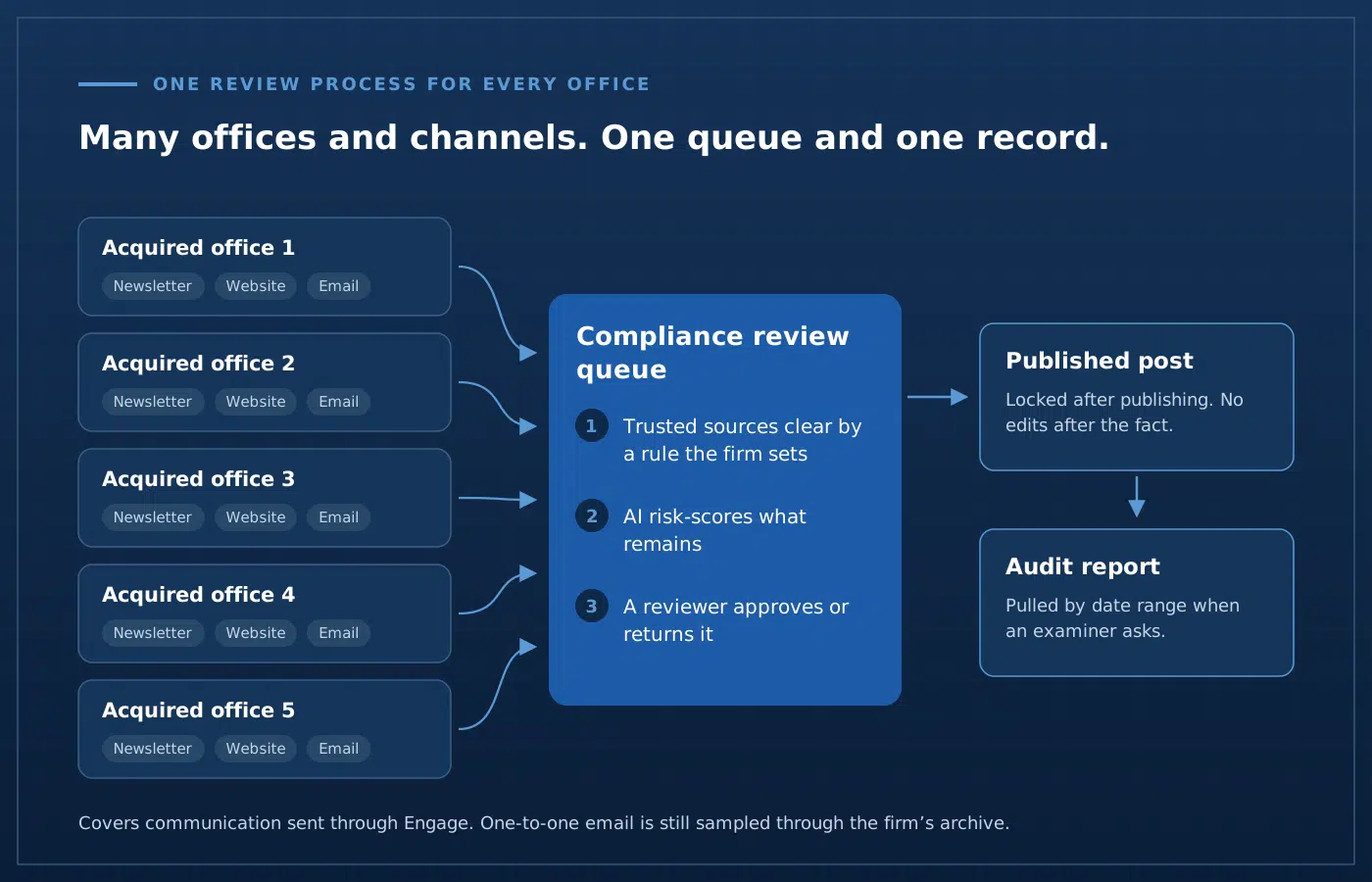
The limits matter too. Engage sees only the communication that goes through it. Advisors still email and text clients outside it, and most firms sample one-to-one email after the fact. Pre-approval fits marketing and mass communication best. That is also where the Marketing Rule exposure sits.
For how a pre-approved content library keeps acquired advisors talking after close, see Your Compliance Team Shouldn’t Be the Reason Your Advisors Go Quiet After the Deal Closes.
Advisors Keep Their Relationships
Acquired advisors often hear “central compliance” and expect to lose their voice. That is not how it works.
Advisors still write their own messages. They still choose which clients hear from them. Their relationships stay theirs.
What changes is ownership of the channel. The firm sets the standards. It sees every message sent through the platform. It keeps the record.
For a newly acquired advisor, that can make life easier. They get one clear path to approval instead of guessing at a new firm’s rules.
Questions for the GC and CCO Before the Next Close
These belong on the diligence list and the integration plan, not the post-exam remediation plan.
- Where does each acquired office send newsletters and market updates today?
- Who retains those messages, and could we produce them within days of a request?
- Which content would we treat as an advertisement under our policies?
- On what date do acquired advisors move to our review process, and what happens until then?
- Does our annual compliance review cover every office added this year?
Your Registration, Your Record
Aggregation builds scale, and scale brings attention. The SEC has now said, two years running, that firms built through acquisition are a focus.
The firms that hold up best won’t be the ones with the fewest deals. They’ll be the ones that can show, office by office, what went to clients and who approved it.
The SEC doesn’t care which firm you bought it from. It cares whether your program covers it.
See how enterprise RIAs bring every office’s client communication under one review process. [Request a Demo]
