Your Compliance Team Shouldn’t Be the Reason Your Advisors Go Quiet After the Deal Closes
8 min Read
The weeks after a deal closes are when acquired clients decide whether to stay. They are also when acquired advisors are learning a new review process. That overlap is where serial acquirers lose books they just paid for.
The deal has closed. The announcement is out. Somewhere in the acquired book, a client is reading an email that says their advisor has joined a larger firm.
That client has questions. Will my advisor stay? Will my fees change? Who is this new firm? The client is waiting to hear from the person they trust.
That same week, the advisor is learning a new compliance process. There are new approvers, new rules for marketing content, and new tools. Nobody knows yet how long a review takes. So the easy choice is to wait.
Waiting feels safe to the advisor. To the client, it looks like silence. And silence at that moment puts the book you just paid for at risk.
Clients are most nervous right after the deal closes. That is exactly when a new review process tends to make advisors go quiet.
What Happens to Clients After a Sale
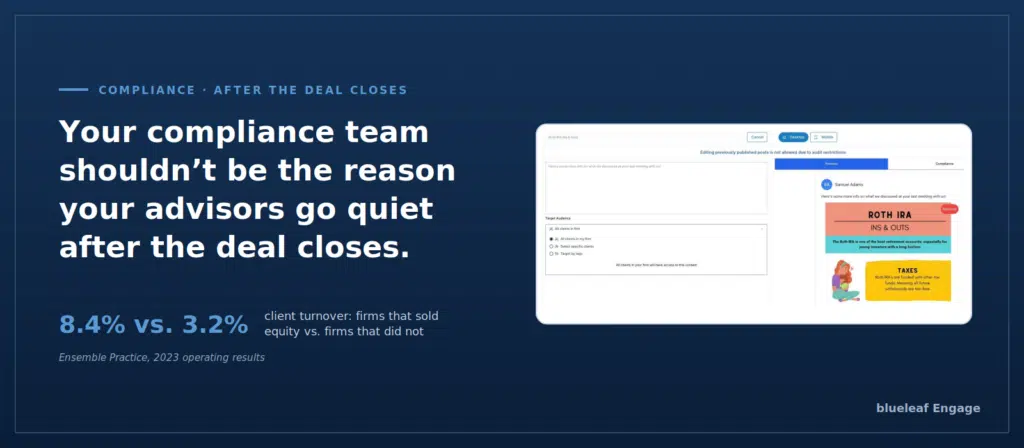
The Ensemble Practice studies operating results across advisory firms. In its survey of 2023 results, firms that sold equity lost 8.4% of their clients that year. Firms that did not sell lost 3.2%. The data covered both minority and majority transactions.
8.4% vs. 3.2% client turnover in 2023 at firms that sold equity vs. firms that did not (Ensemble Practice)
Two caveats apply. Ensemble’s founder, Philip Palaveev, has noted that its sample of acquired firms is small. And some turnover is deliberate, since firms often let go of smaller or poorly matched relationships.
Even so, the direction is clear. Palaveev described the dynamic plainly when he reported the numbers. When firms change hands, clients get nervous. Change is unsettling, even when the new firm is better.
For a serial acquirer, that gap is not abstract. On an acquired book of 1,000 households, the gap between those rates means roughly 50 more households leaving in a year. At $1 million per household and 100 bps fee. That is about $500,000 a year in revenue that does not stay. At 4x revenue, it’s about $2 million that you might as well light on fire.
Why Acquired Advisors Go Quiet
Advisors do not go quiet because they stop caring. They go quiet because the rules just changed.
Before the deal, an advisor might have sent a market update with a quick sign-off from a small compliance team. After the deal, that same update goes into a larger firm’s review queue. The advisor does not know the standards yet. A first draft comes back with changes. The next one sits in the queue for days.
Meanwhile, the acquirer’s compliance team is absorbing a new group of advisors, a new set of content, and a new compliance history. Those teams are rarely large. In the 2026 Investment Management Compliance Testing Survey, 45% of firms ran compliance with two to five people, including the CCO. Sixty percent of CCOs also held another executive role. The most common was COO, at 19%.
In many firms, then, the person running compliance is also running integration. That person cannot review everything faster just by trying harder.
None of this means compliance should relax. The acquirer’s supervision applies from day one. The problem is a process that forces a choice between speed and oversight at the moment the book can least afford a slow answer.
What the First 90 Days Should Look Like
The goal is simple. Acquired clients should hear from their own advisor early and often, with content that compliance has already approved.
That means the acquirer prepares before close, not after. A day-one content library holds the pieces every acquired book needs. Think of a transition letter, a plain note on what is and is not changing, team introductions, and market commentary. Compliance reviews each piece once.
On day one, acquired advisors can send those pieces to their clients under their own names. The firm can tag the acquired households and target transition content to them. Custom messages still go to review, and reviewers can take them in order of risk.
The advisor keeps talking. The client keeps hearing from the person they trust. Compliance keeps its standards.
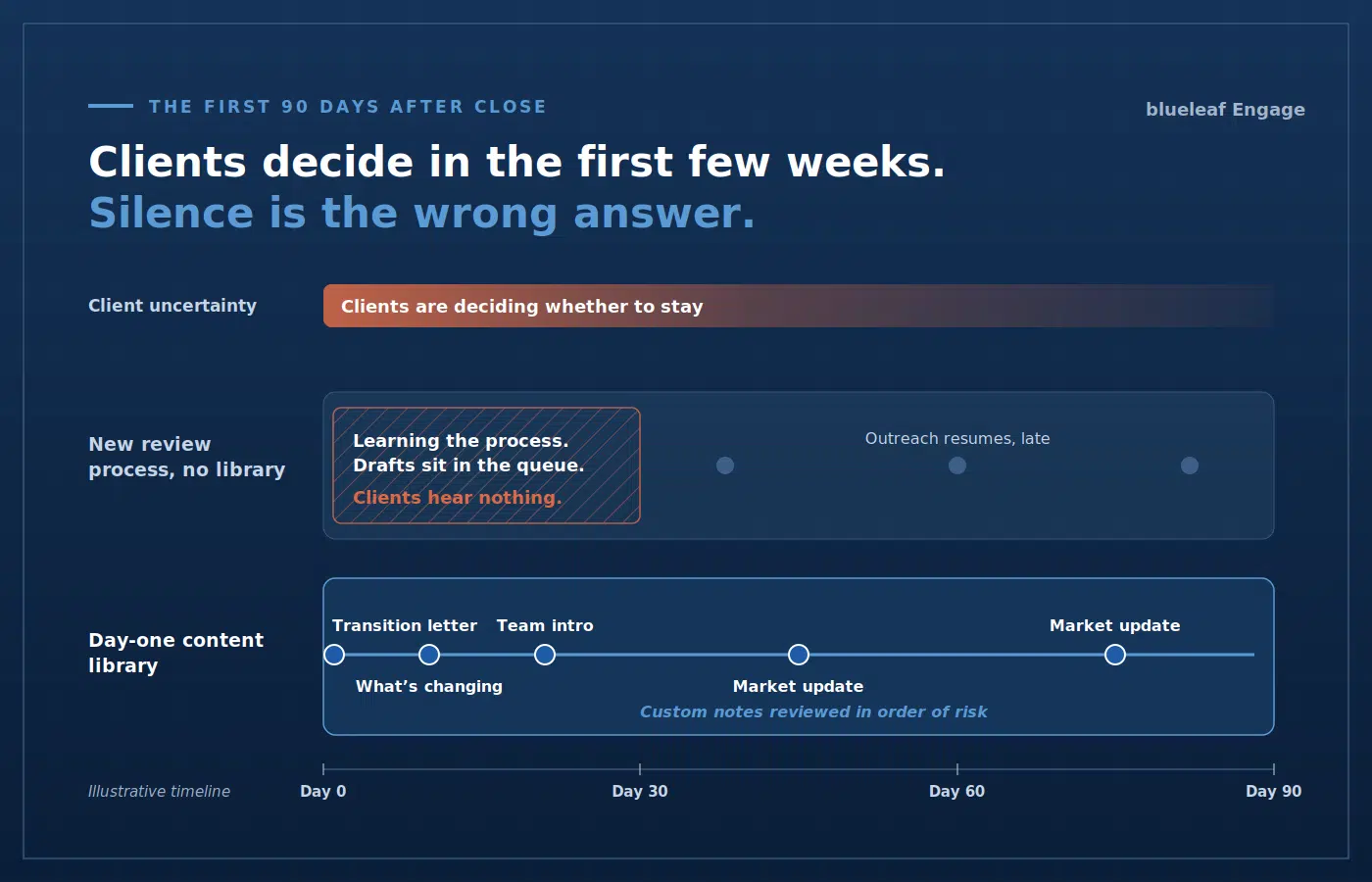
A content library approved before close lets acquired advisors reach clients on day one, without a shortcut around review.
How This Works Inside Blueleaf Engage
Blueleaf Engage sits on top of the firm’s existing portfolio management platform. It does not replace that system. It governs the client communications that advisors send through it. Advisors still write their own messages and keep their own relationships. The firm sets the standards and sees every message that goes through the platform.
Three mechanisms do the work, and it matters which is which.
- A rule, not AI, clears library content. The compliance team designates trusted sources and authors, such as the firm’s content library. Content from those sources is approved automatically under that rule. It is still logged and archived.
- AI sorts what is left. Everything else lands in a review queue with a risk score and a list of identified risks. Reviewers can filter by risk level and work the highest-risk items first. A person still makes every approval decision.
- The record stays intact. Compliance Officer is its own user role. Published posts cannot be edited after the fact. The platform generates content audit and compliance summary reports for any date range.
The scope matters too. Engage sees only what goes through it. Advisors will still email and text clients outside the platform, and those channels stay under the firm’s existing supervision and archiving.
The COO Math, Scoped Honestly
Pre-approval mostly applies to marketing and mass communications: newsletters, market commentary, event invitations, and posts to a client feed. Most firms review one-to-one email by sampling it after it is sent. So the model below covers marketing and mass communications only.
Consider a firm with 150 advisors. Assume each sends two marketing or mass communications a week, across 50 weeks. That is 15,000 items a year. At 12 minutes of manual review each, that is 3,000 hours, or about 1.7 reviewers at 1,800 productive hours apiece.
The labor cost comes from public data. The Bureau of Labor Statistics put the median compliance officer wage at $78,420 in May 2024. Its June 2026 compensation data show wages at 68.5% of employer cost for full-time private-sector workers. That implies roughly $115,000 per reviewer, fully loaded.
Now assume 70% of volume comes from the content library. The trusted-source rule clears it, and compliance spot-checks 5% at five minutes each. The remaining 30% goes to human review. With AI sorting the queue, average review time on those items drops to seven minutes.
|
150 advisors, marketing and mass comms, annual |
Manual review | Library rule only | Library rule + AI sort |
|---|---|---|---|
| Items needing full human review | 15,000 | 4,500 | 4,500 |
| Library items spot-checked (5%) | — | 525 | 525 |
| Minutes per reviewed item | 12 | 12 | 7 |
| Review hours | 3,000 | ~940 | ~570 |
| Reviewer FTE (1,800 hrs each) | 1.7 | 0.5 | 0.3 |
| Annual reviewer cost (~$115K loaded) | ~$190,000 | ~$60,000 | ~$36,000 |
Illustrative model. Wage data: BLS Occupational Outlook (May 2024 median) and Employer Costs for Employee Compensation (June 2026).
Under these assumptions, review hours fall by about 81%, and the firm saves about $155,000 a year. The content library does most of that work. The rule alone accounts for about 85% of the savings. AI sorting adds the rest by shortening review time on custom content.
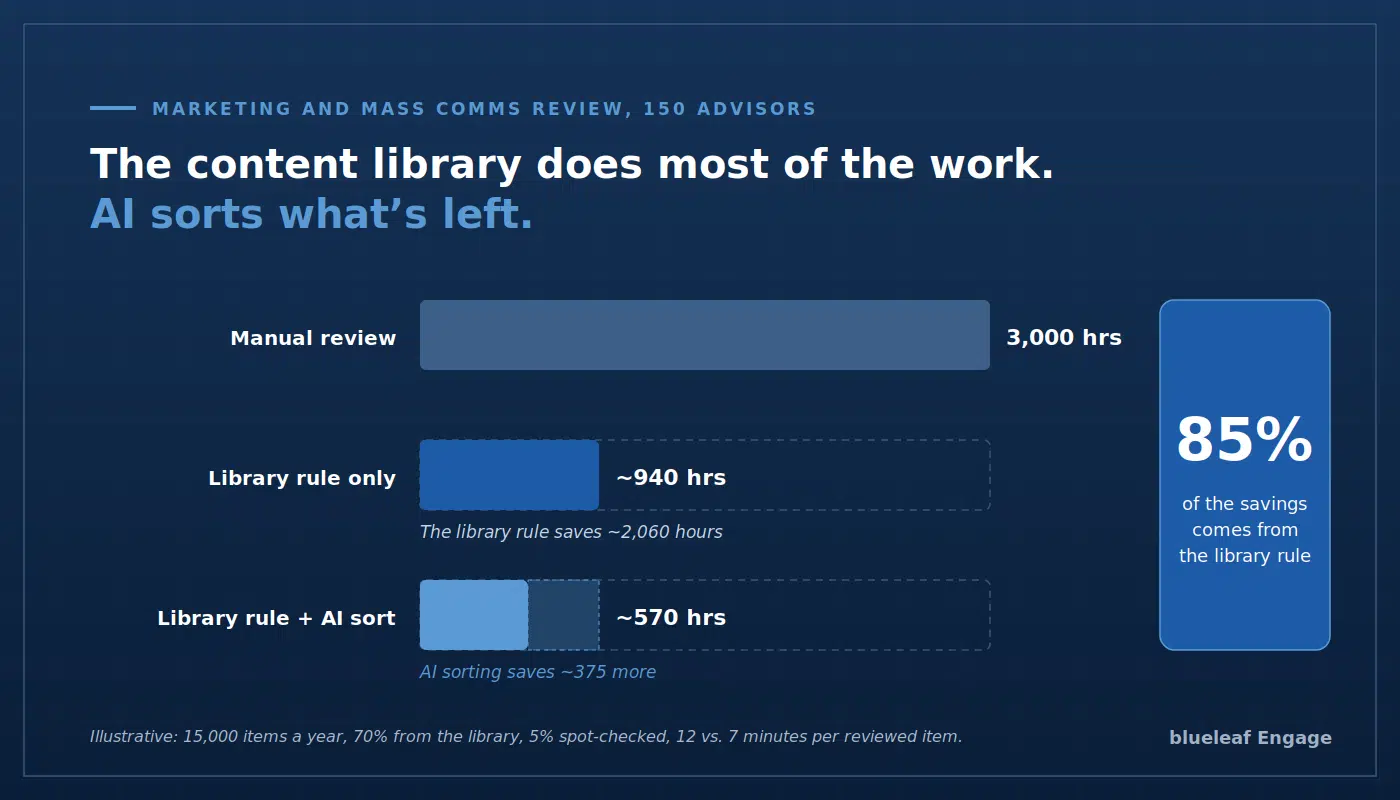
The dollar figure is modest. The more important effect is capacity at the moment it is scarcest. When a new group of advisors arrives, the queue does not have to back up. Most of what they need to send is already approved.
What the CCO Should Document
Auto-approval is only defensible if the policy behind it is written down. The firm should record which sources are trusted, who approved that list, and how often it is sampled.
Rule 206(4)-7 already requires written compliance policies and an annual review of their effectiveness. The trusted-source rule and the sampling results belong in that program. So does the plan for bringing acquired advisors into the review workflow.
Questions to Answer Before the Next Close
- Which pre-approved pieces will every acquired advisor be able to send on day one?
- Who reviews the transition content, and how far ahead of close is it approved?
- What is the expected review turnaround for custom messages from newly acquired advisors?
- How will the firm identify acquired households and track whether each one has heard from its advisor?
- Where are the trusted-source rules and its sampling results documented?
Keep the Advisors Talking
Serial acquirers spend months on valuation, legal terms, and integration plans. The client relationship is what they are actually buying. It is also the part most exposed in the first weeks after close.
Compliance should not have to choose between oversight and speed in that window. With a content library approved before close and a queue sorted by risk, it does not have to. The advisors keep talking, and the clients keep listening.
See how Blueleaf Engage keeps acquired advisors in front of their clients from day one. [Request a Demo]