Why Billing Always Ends Up Belonging to One Person

11 min Read
Nobody at your firm decided that billing belongs to whoever runs it. It happened, because the software turned operating it into a skill worth three years of tuition. Here’s a quarter of billing told twice: once the way it usually goes, and once the way it goes when the system can be set up the way you actually bill.
There’s one person at your firm who runs billing. You know who. So does everyone else.
Nobody decided that. It happened.
It’s the last week of the quarter, and two days are already gone. Not blocked off. Gone. Everyone knows those two days belong to billing, and they know who they belong to. You’ve been planning around it for years, the way you plan around weather.
Here’s what’s waiting. An account that opened in February and never got a fee schedule. Six accounts that came in unassigned and can’t be billed until somebody claims them. An exclusion set back in March that nobody has looked at since. A client who funded in week six and needs prorating. A household that moved enough assets to cross a tier. And the arrangement nobody wrote down, the one you find out exists when someone else runs billing and the file comes out wrong.
None of it is new information. The February account has been missing a fee schedule for seven weeks. Every one of these was true, and knowable, and sitting there for most of the quarter.
They all get found on the same two days.
What that costs you:
- It stops with one person. They take a week off in April and billing waits.
- Everything lands at once. Ninety days of five-minute questions arrive in the two days with the least room for them.
- You fix the same things every cycle. A correction to the output dies when the run closes, so you make it again next quarter.
- It doesn’t get shorter as you grow. Add clients, add an advisor, add a custodian, and the two days get longer.
The first two you feel every quarter. The second two are why it never gets better.
Why It’s Always That Person
Ask why billing belongs to whoever it belongs to, and the answer sounds like institutional knowledge. They know the clients. They know the exceptions. They’ve been here longest.
Some of that’s true. Most of it isn’t the reason.
The reason is that they’ve spent three years learning a piece of software written for someone who does billing for a living. It asks them to pick an accounting method and assumes they know what that answer implies. It buries the setting they need three menus deep, next to four that sound like it. They want to see which holdings are being left out of the calculation. So they open a page of tickers and control-F their way through it.
That’s real expertise, and it took real time to build. It just isn’t expertise about your firm. It’s expertise about the tool.
The knowledge that makes billing work at most firms isn’t knowledge about billing. It’s knowledge about the software.
Which makes it a strange thing for a practice to be carrying. It isn’t written down. It doesn’t transfer by being explained. And it walks out the door when the person does.
You’ve probably felt the edge of that already. They take a week off in April and billing waits for them. Or they give notice, and you find out how much of your revenue process was living in one person’s head.
Why It All Lands in the Same Week
The harder question isn’t who. It’s why now.
Most billing systems can’t tell you anything until you run billing. Running billing calculations is the only diagnostic they have. The system doesn’t know your February account has no fee schedule. It’s never tried to work out a fee for it, and it won’t try until you ask.
The only way to find out what’s wrong with a cycle is to calculate the cycle. And you calculate the cycle at the end of the cycle. Right when you need to bill clients.
Nobody chose that. The software arranged it. Ninety days of small, cheap, five-minute questions get held in escrow. Then they arrive all at once, in the week with the least room for them, with clients waiting.
The Same Quarter, Run Differently
So we run it continuously instead. Now let’s look at that same quarter again. The next cycle is updated every day, all quarter, whether anyone’s thinking about billing or not. And we alert you about any issue we find.
Week three. An account looks short on cash to cover the fee. We alert you. You raise cash in the account. That’s the whole event. No client ever knows there was a question, and nobody spends a Tuesday in April explaining a failed debit.
Week five. A new account came in with no fee schedule. We alert you. You click Resolve, pick the schedule, leave a note about why. Two minutes. It doesn’t come back next cycle, because the decision updates the setup.
Week nine. A client’s fee has moved more than the threshold you set. We alert you. You open the client, see the household crossed a tier when assets moved, decide that’s exactly right, and resolve it with a note saying so.
Week twelve. You open the billing run. Nothing is flagged. Four steps: review the accounts, review the fees, check the exceptions, approve. You’re finished.
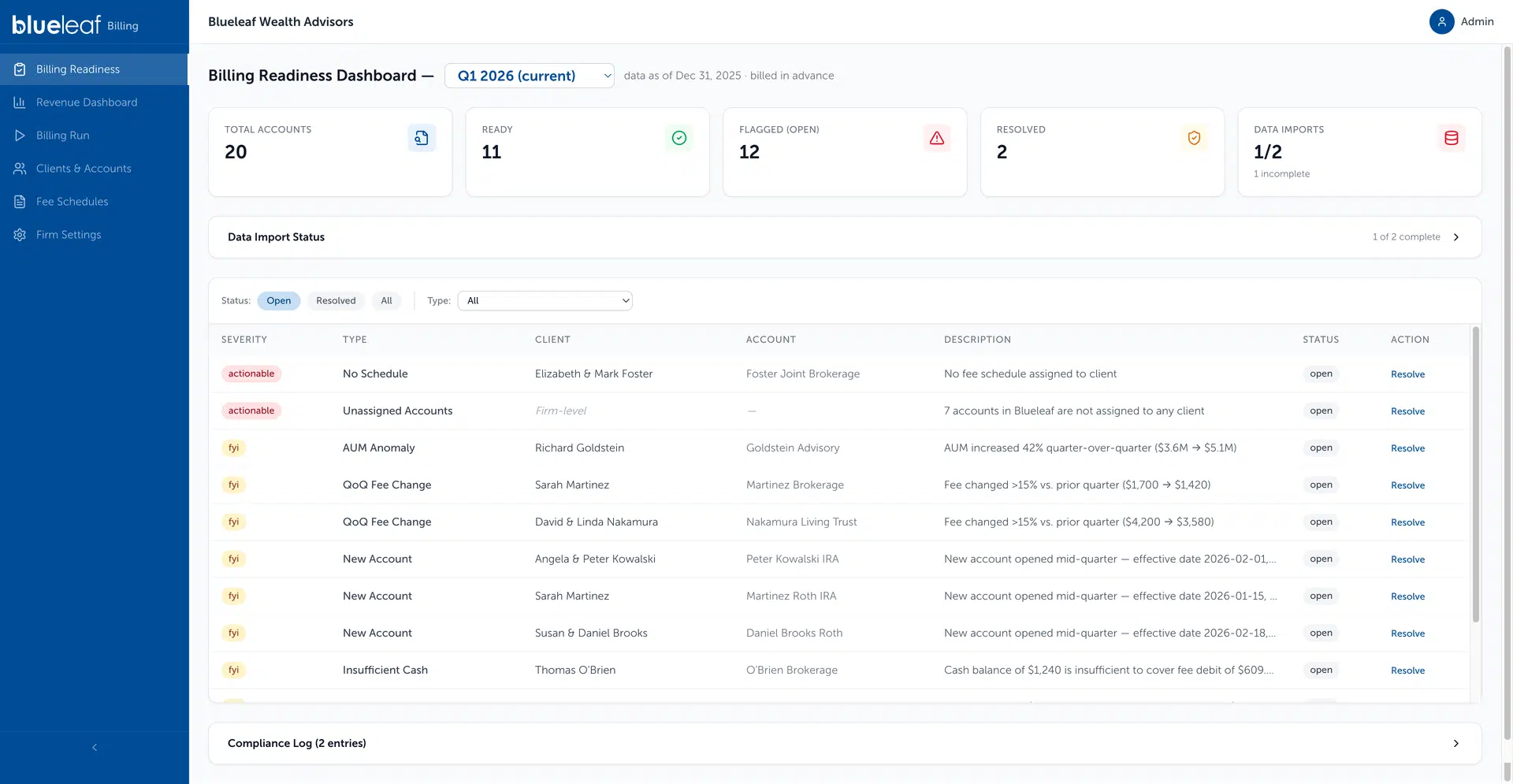
Everything we find, as we find it.
The work didn’t disappear. It got distributed. The same decisions, made in the week each one came up, when each one costs five minutes instead of an hour of a bad afternoon.
Two things make that possible. The readiness view is live, so it reflects what’s true today rather than what was true the last time someone ran a report. And you can look forward. Open the projected run for the period that hasn’t closed yet, and you see what you’re heading toward while there’s still time to do something about it.
A Hundred and Fifty Rows
There’s a version of this that no flag can catch, and it’s the more interesting half.
One advisor we talked to used to finish a billing cycle and then start deleting. His old system couldn’t tell a zero-fee account from a billable one. So it wrote every account into the export file, and the custodian rejected the file when it found fees of zero. Sometimes a hundred and fifty rows, by hand, every cycle.
Look at what that actually was. Not a chore somebody assigned him. Not him being fussy about his file. He had a rule: zero-fee accounts don’t go to the custodian. The software had nowhere to put it. The file came out wrong every cycle, he corrected it by hand, and it came out wrong again.
He wasn’t solving a hard problem a hundred and fifty times. He was doing the software’s remembering for it.
So we made it something you can just tell the system. Tick Exclude on the account and it stays excluded. The account keeps its balance, still appears for the client, and simply stops producing a fee, permanently, with nothing to reapply next quarter. If you’ve got a hundred and fifty of them, you don’t tick a hundred and fifty boxes. Open the grid, filter down to the accounts you need, select them, and exclude the lot in one action.
The rows never reach the export, because they never become fees.
Fixing the Setup, Not the Output
That’s the distinction the whole thing rests on.
A fix to the output lives inside one run. You correct the file, the run closes, and the correction goes with it, because the thing you edited was a result. Next cycle produces a fresh result, and you make the same edit again.
A fix to the setup lives in the configuration. You state the rule once, and every run after it comes out is already correct. That’s the one we went after.
Every manual step at the end of a cycle is the first kind. Every one of them is a rule that has nowhere to live. So the question to ask of a billing system isn’t whether it can produce the right number. It’s whether it can hold the arrangements you already have.
A few of the items that used to have nowhere to go:
- An account that shouldn’t be billed at all. Excluded for good, or held out of one run and back in the next, which is a different decision and a different control.
- A holding you don’t bill on, like cash or a money market position. Named once at the firm level and applied everywhere, or scoped to a single client or a single account.
- A flat fee running alongside an AUM fee on the same client. A planning fee, a CPA fee, a monthly retainer, charged automatically each period instead of added by hand.
- One account inside a client billing on a different schedule from the rest. The bond sleeve at half the rate the equity accounts pay.
- The same thing inside a combined household. The group bills on the primary’s tiered schedule against the household’s combined value, and one account inside it still carries its own exception.
- A floor or a ceiling on what a client pays in a period, applied across every fee they’re charged.
- Prioration for the client who funded in week six or left in week nine. Calculated for you, with the effective date shown on the run’s exceptions step, so what you check is the date rather than the arithmetic.
- A fee assessed on an account at one custodian and drawn from an account at another. Or drawn from no account at all, because that client pays you directly.
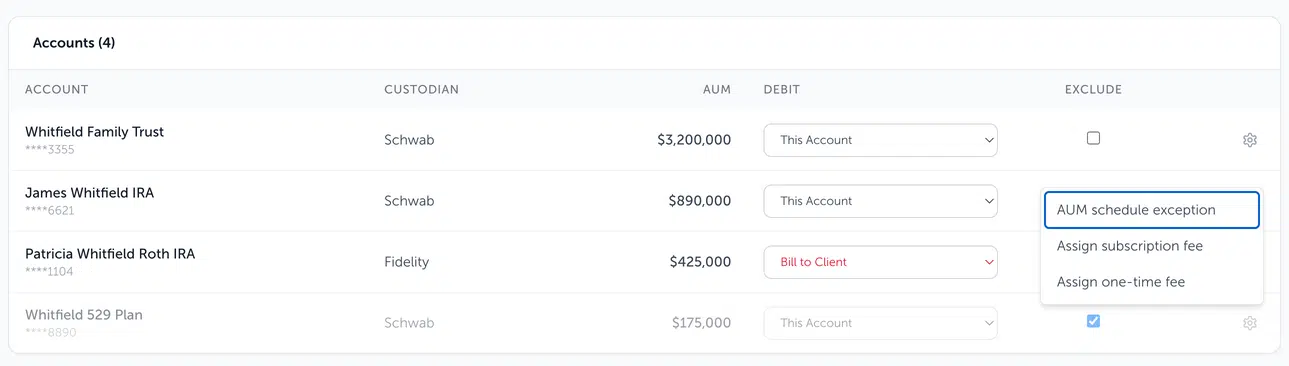
Per-account decisions that survive the run.
None of these is exotic. Every firm has some of them. They’re only remarkable because most systems make you carry them in a spreadsheet, on a checklist, or in your head.
Set it once and it holds. The file comes out the way you’d have fixed it anyway.
So Who Runs It Now
Back to those two days, because that’s what all of this was supposed to fix.
Billing belonged to one person for two reasons, and neither was a policy. There was too much to know. And the person who knew it was the only one you could safely let near it.
The first is what the four steps and the plain labels are for. We spent the time on what things are called and where they sit, not on adding features. There’s less to know now, not because the documentation got better, but because there’s less that has to be learned. If you know what you want to do, you can find where to do it. Ninety days from now it’ll be in the same place, in the same order.
The second is what roles are for. Access comes in three built-in shapes. An administrator can change everything, including the firm-wide settings and the roles themselves. A billing manager can run the whole billing process, but your configuration stays read-only. A viewer sees every page and changes nothing. If none of those is the shape you want, build one, switching on only the areas that role should be able to edit.
Here’s the part that makes it usable. Turning an area off restricts editing, not viewing. Someone with every toggle off still opens every page and reads what’s there. So bringing a second person into billing isn’t a choice between handing over the keys and keeping them in the dark. They can learn it by watching before they touch it, and you widen what they’re allowed to change as they get comfortable.
Which means the two days at the end of the quarter stop being one person’s two days.
And then they stop for two days.
Billing day should be boring. It should also be something more than one person at your firm can do.
See the billing platform running on your own book in a 30-minute walkthrough.