Winning Advisor Talent: Why Your Technology Package Can Win What Your Payout Grid Can’t
8 min Read
Enterprise RIAs rarely win the payout comparison outright. The advisors worth recruiting are weighing a different question: what happens to their clients after they move.
Every enterprise RIA that recruits experienced advisors eventually meets the same spreadsheet.
The recruit lays your payout grid next to two or three others. One of them is usually an independent option. Independent broker-dealers and RIAs often pay about twice the revenue share that wirehouses do. InvestmentNews made that point in October 2026, covering Diamond Consultants’ wirehouse data.
An enterprise firm built on shared infrastructure will not always win that line. It does not need to.
The advisors with the strongest books are asking a second question. The payout grid cannot answer it.
The Competition for Advisors Is Getting Harder
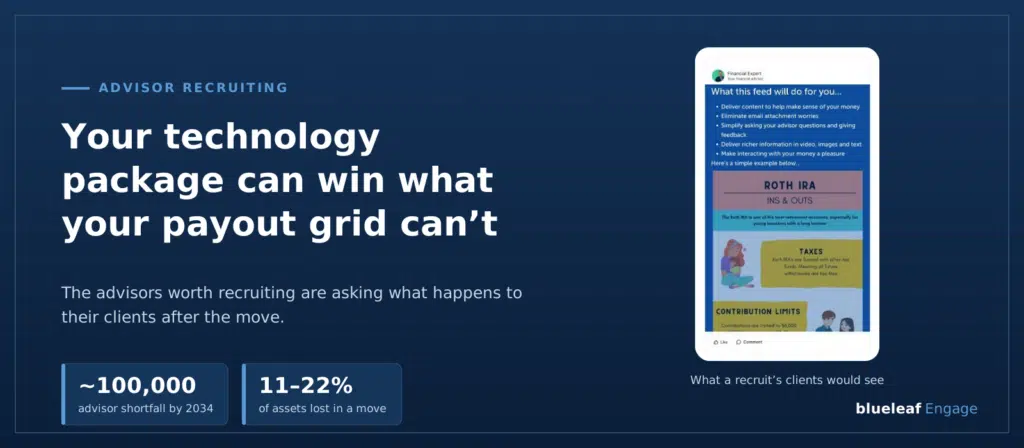
The supply problem is well documented. In February 2025, McKinsey projected a shortage of about 100,000 U.S. advisors by 2034. It expects roughly 38% of today’s advisors to retire within a decade. Those advisors oversee about 42% of industry assets.
~100,000 projected shortfall of U.S. financial advisors by 2034 (McKinsey, February 2025)
Movement is also accelerating. Diamond Consultants counted nearly 11,200 experienced advisors who switched firms in 2025. That was up more than 16% from the year before.
The pace has not slowed in 2026. In the first half of the year, the four wirehouses lost 1,449 experienced advisors and recruited 932, according to Diamond. About 200 firms recruited from them.
RIAs are leaning in. Charles Schwab’s 2026 RIA Benchmarking Study surveyed 1,236 firms from January to March 2026. Recruiting staff to expand capacity ranked as the second-highest strategic priority, behind referral growth. Three in four firms with at least $250 million in assets hired in 2025.
For a PE-backed platform, this is a growth problem, not just an HR problem. Organic growth targets assume advisors. Acquisition models assume the acquired advisors stay.
What Advisors Say They Are Weighing
Compensation still matters. No serious recruiter pretends otherwise. But the research on why advisors move keeps pointing at technology.
Cerulli Associates published new data in October 2026, as reported by InvestmentNews. Among advisors who joined a new broker-dealer in the past three years, 57% said technology played a part.
The same research ranked technology above pay. Fifty-four percent of advisors cited the amount and structure of payouts. Only 40% cited recruiting packages and transition money. Cerulli’s director of wealth management, Michael Rose, said technology consistently ranks as the top factor in an affiliation change, ahead of compensation.
“Technology” covers a lot of ground, though. A recruit is not evaluating your general ledger. They are evaluating what they will use with clients every week.
The Question Behind the Question
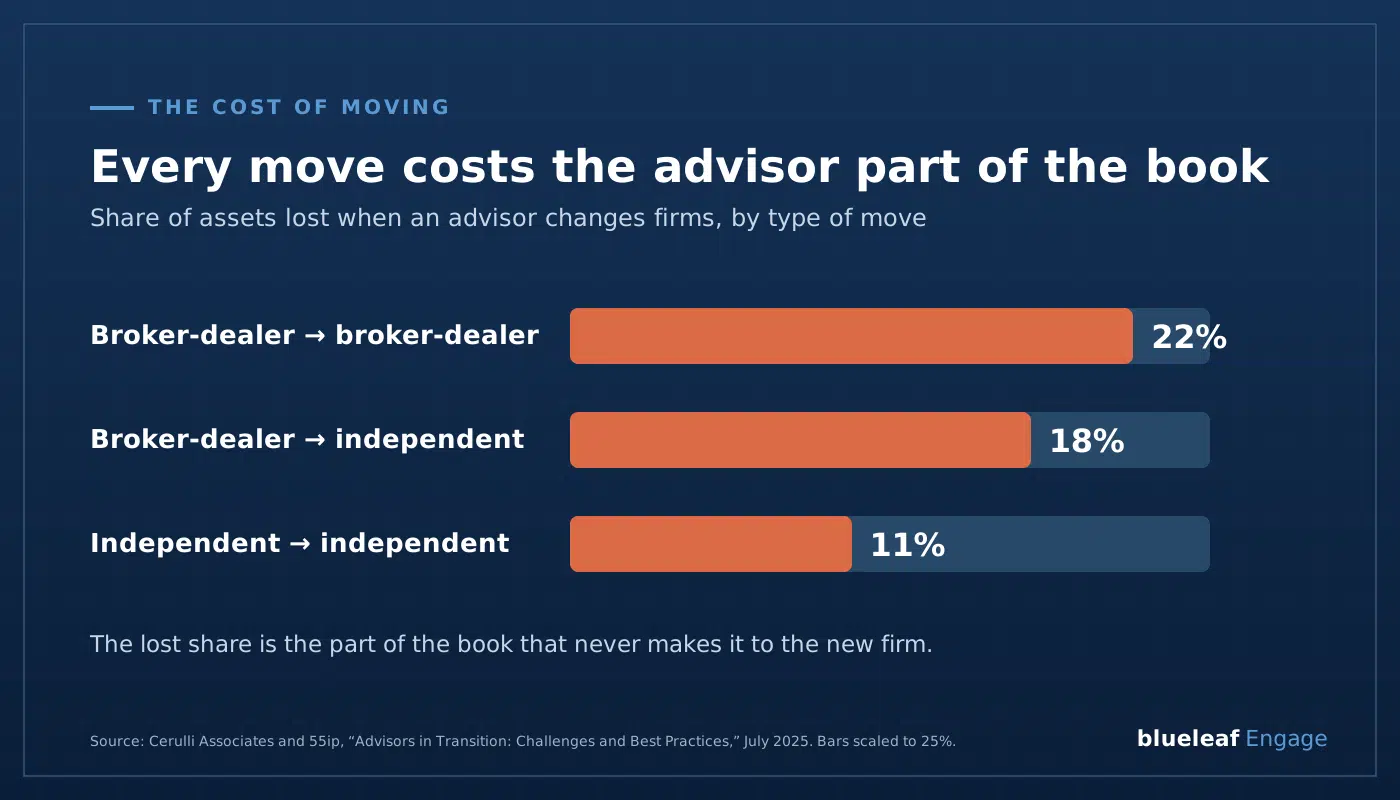
Moving is expensive for the advisor, and the cost is measured in clients. Cerulli and 55ip studied the problem in a July 2025 report, “Advisors in Transition.” It found that advisors moving between broker-dealers lose about 22% of their assets. Moves from a broker-dealer to an independent firm lose about 18%. Moves between independent firms lose about 11%.
The same report lists client communication among the main challenges of a transition. Cerulli calls the potential loss of clients an enormous risk.
So when a recruit asks about technology, the real question is about clients. How will I reach them? What will they see? Will I know which ones are drifting?
A payout grid tells the advisor what they will earn on the assets that arrive. The technology package shapes how many arrive, and how many stay.
The payout grid prices the book. The technology package protects it.
| The recruit’s question | What answers it |
|---|---|
| What share of revenue do I keep? | The payout grid |
| How will I stay in front of clients after the move? | A client communication platform the firm supports |
| What will my clients actually see? | A branded, preview-able client experience |
| Can I send timely content without waiting weeks on review? | A pre-approved content library |
| Will I know which clients are drifting? | Engagement analytics on every message |
Only the first question is about compensation.
Why the Portfolio Platform Doesn’t Close the Gap
Most enterprise RIAs already show recruits a strong portfolio management stack. Performance reporting, billing, and a client portal are table stakes.
That platform is the system of record, and it does that job well. It stops at the moment the advisor needs to start a conversation.
A portal waits for the client to log in. It does not send the market note after a volatile week. It does not invite the client to an event or explain a new tax rule. It does not tell the advisor who read any of it.
Some portfolio platforms now send an automated client email. Ask what it can do. Can the advisor choose what goes in it and who receives it? Does it combine account updates with the firm’s content? Does it reach the client as a mobile notification, or only as one more email? A fixed digest is still a report. It does not start a conversation.
That is the gap a recruit feels most. At their old firm, they either filled it by hand or left it empty.
What a Client Engagement Layer Adds to the Pitch
Blueleaf Engage sits on top of the firm’s existing portfolio management platform. It does not replace that system. It adds a client marketing engine the advisor can use from the first week.
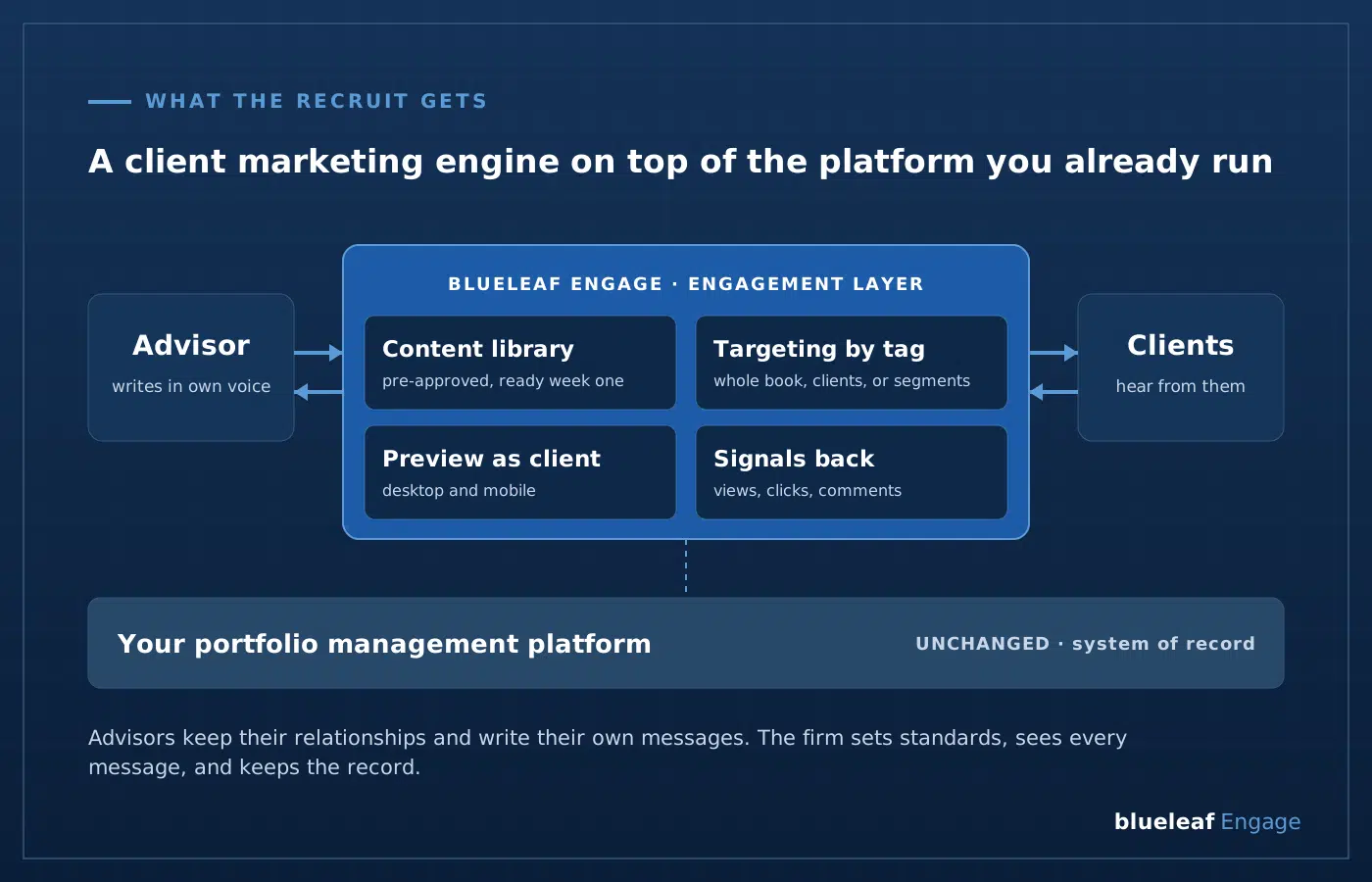
- A content library on day one. The firm’s central team publishes commentary, explainers, and infographics. Content from pre-approved sources can clear compliance automatically. A new advisor can share it before learning every rule of the review process.
- Messages in the advisor’s own voice. Advisors write their own posts and choose who receives them. That can be the whole book, specific clients, or segments by tag, such as retirees or plan participants.
- A preview of what clients see. Advisors can preview any post as a specific client, on desktop or mobile, before it goes out.
- Signals back from clients. Views, clicks, reactions, and comments flow back to the advisor. Notifications flag client responses. Analytics show which content gets traction.
Each of these is something a recruit can see in a demo. None of them is a line in a benefits summary.
Answering the Fear Every Recruit Brings
Experienced advisors are wary of firm-controlled channels. Many are moving precisely because their old firm seemed to stand between them and their clients.
So the pitch has to be direct. Advisors write their own messages and keep their own relationships. The firm sets brand and compliance standards, sees every message, and keeps the record, as its regulatory obligations require.
The platform does not change who owns the client relationship. Employment and transition agreements govern that, as they always have. What changes is that the advisor has a channel the firm supports, instead of one they have to build alone.
The First 90 Days Decide the Hire
A recruited advisor’s hardest stretch comes right after the move. Clients are deciding whether to follow, and then whether to stay.
It is also when the advisor is learning a new review process. Unfamiliar rules make new advisors cautious. Cautious advisors go quiet. Silence is the wrong signal at exactly the wrong time.
A pre-approved content library lets a new advisor communicate from the first week, inside the firm’s standards. Once transferred clients are on the books, engagement data shows who is reading and who is not. The advisor knows where to call first.
The same logic applies to acquisitions. Acquired advisors did not choose your firm. Their seller did. Keeping them is a recruiting job in reverse.
Acquired advisors didn’t choose your firm. Their seller did. The technology package is part of how you win them a second time.
A better way to reach clients than they had before is a concrete answer to the question every acquired advisor asks: why stay?
Five Questions for Your Recruiting Team
Heads of Recruiting and M&A should be able to answer these before the next recruiting meeting.
- Can a recruit see, in a live demo, what their clients would receive in the first month?
- How much pre-approved content could a new advisor send in week one?
- How long does a new advisor’s first original post take to clear review?
- Will the advisor see which transferred clients are engaging, and which are not?
- Does the pitch explain plainly who owns the client relationship and who keeps the record?
Changing the Conversation
Payout comparisons are a race to the margin. Enterprise firms with shared infrastructure rarely win them on price alone.
The advisors with the best books want something else. They want confidence that their clients will follow, hear from them, and stay.
A firm that can demonstrate that confidence has a recruiting story no payout grid can match.
See what your advisors’ clients would receive through Blueleaf Engage. [Request a Demo]