The Post-Acquisition Client Retention Problem (and How to Solve It Before Day 90)
8 min Read
The deal closes. The press release goes out. Integration planning kicks into gear. And somewhere in the chaos of onboarding advisors, migrating data, and aligning systems, the firm’s most valuable asset gets left on autopilot: the acquired client relationships themselves.
It is the hidden risk in every RIA acquisition. Clients don’t leave because something went wrong. They leave because nothing went right. No communication, no reassurance, no demonstration that the acquiring firm understands who they are and values the relationship. For the three to six months when clients are watching most closely for signals, silence is itself a signal.
97%
Client retention across the RIA industry in 2025, a rate the industry has sustained for a decade. At firms that sold equity, client turnover ran 8.4% in 2023. Sources: Charles Schwab 2026 RIA Benchmarking Study (1,236 firms, $2.5T AUM); The Ensemble Practice survey of 2023 operating results, reported in Financial Advisor magazine, April 2024.
Retention Is the Industry’s Best Number. Acquisitions Are Where It Fails.
Client retention is the strongest fundamental the RIA industry has. Schwab’s 2026 RIA Benchmarking Study puts industry retention at 97%. That study draws on 1,236 firms holding more than $2.5 trillion in assets, and the figure has held for a decade. Schwab’s own leadership calls it the industry’s superpower. The description is fair. Almost no other business in financial services keeps 97 of every 100 customers year after year.
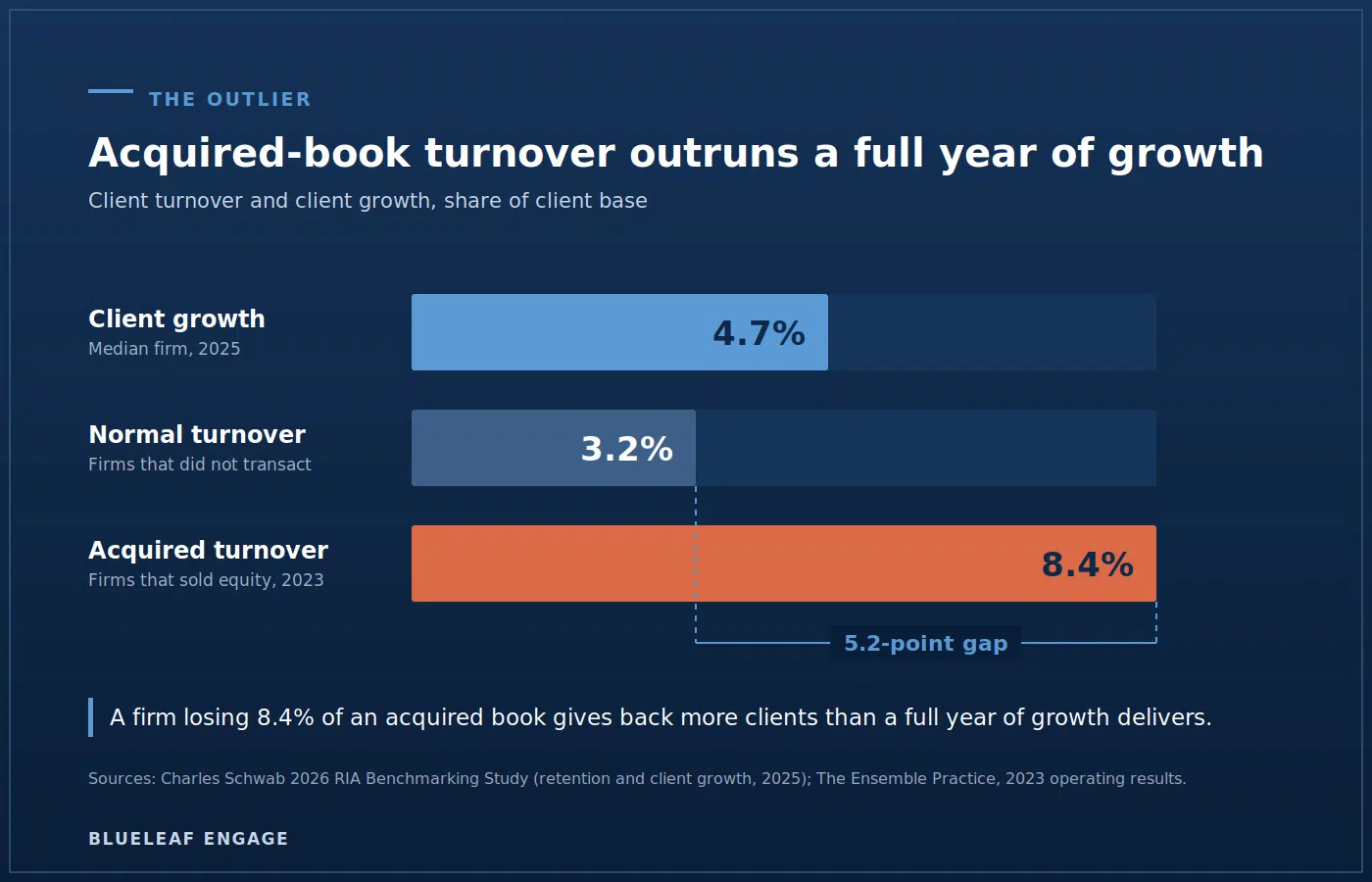
Acquisitions are the visible exception. The Ensemble Practice tracked client turnover at firms that sold equity, in both minority and majority deals. Those firms lost 8.4% of their clients in 2023. Firms that did not transact lost 3.2%. That baseline lines up closely with what Schwab reports for the industry overall. Two unrelated studies agree on the normal rate, which makes the acquisition figure the outlier. One caveat: the Ensemble split covers 2023 and has not been republished. Treat the exact number as directional rather than current.
Set the outlier against the growth side, and the cost becomes concrete. Schwab found that client headcount at the median firm grew 4.7% in 2025. A firm losing eight points of an acquired book gives back more clients than a full year of organic growth delivers. It happens in the worst possible window when the acquirer has the most capital at risk and the least influence over the relationships.
The staffing side compounds it. Every acquired firm Ensemble tracked in 2023 lost at least one employee it did not want to lose. And employee turnover is the single largest driver of client turnover. When the person who knew the household leaves, the household’s main reason to stay leaves with them.
None of this is news to deal teams. But the volume makes it urgent. DeVoe & Company counted 167 RIA transactions in the first half of 2026. That is a record and 13% above the same period a year earlier. Attrition assumptions get built into the model, discounted into the price, and accepted as a cost of consolidation. What is striking is how few firms operate any mechanism designed to move the number.
Why Acquired Clients Actually Leave
The instinct is to assume departing clients were unhappy with the acquirer. Most of them were not, because most of them had no basis for an opinion yet. What they had was uncertainty. Was their advisor staying? Were their fees changing? Did the firm they originally chose still exist in any meaningful way?
Uncertainty gets resolved by information. In the absence of information, clients supply their own, and the version they supply is rarely generous to the acquirer.
What clients need to hear during the integration window is not complicated:
- Confirmation that their advisor relationship is continuing
- Context on what the acquisition means for them specifically
- Evidence that the acquiring firm is proactive rather than reactive
- Regular, branded communication that reinforces the value of the relationship
Clients don’t leave because something went wrong. They leave because nothing went right during the window when they were most likely to be watching.
The Structural Problem with Manual Outreach
Most enterprise RIAs understand this dynamic intellectually. The integration playbook includes client communication milestones. Advisors are coached to reach out proactively. Leadership sends a welcome letter.
Execution is where it breaks down. Advisors are absorbing new systems, new compliance procedures, and a new reporting line. They have no spare capacity for systematic outreach. They are also the people the firm is working hardest to retain. The letter from the CEO goes out once. Follow-up depends on individual initiative. Quality varies by advisor, and so does compliance exposure.
At scale the model simply cannot hold. Consider a mid-market PE-backed platform completing three to five acquisitions a year. Each deal carries hundreds or thousands of client households. The firm is asking its least available people to run its most time-sensitive communication program. It is asking them during the months when those same people are most likely to leave.
The result is the predictable attrition pattern that surfaces in AUM data six to twelve months after every close. Deal teams model for it. Operators accept it. Very few firms have built anything that changes it.
What a Client Marketing Engine Changes
The firms closing the post-acquisition retention gap are not doing it with better onboarding checklists. They are doing it with systematic, automated delivery of branded client communications. Those communications begin the moment an acquisition closes and continue well past the integration window. They run regardless of how busy any individual advisor happens to be that month.
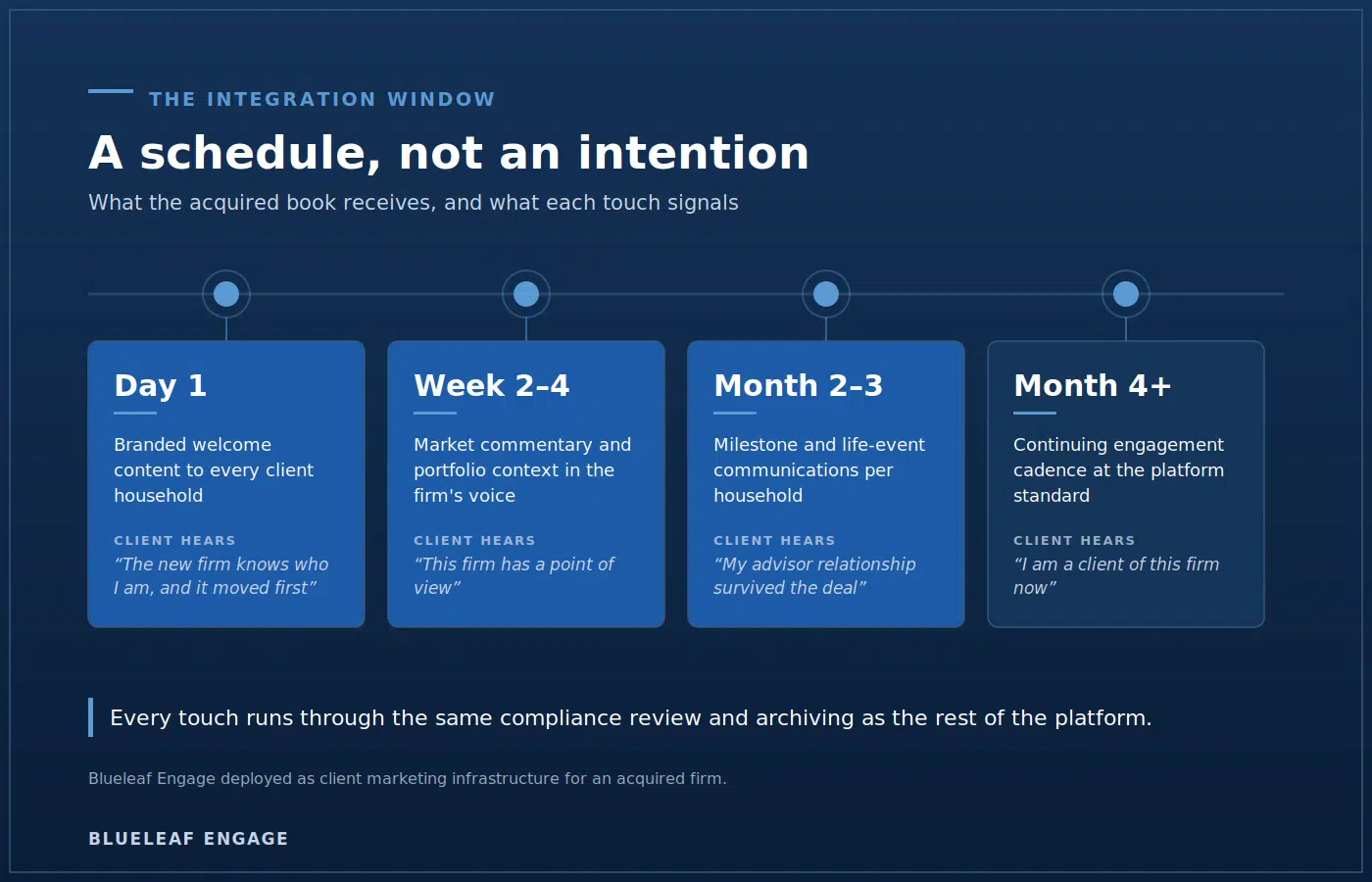
With Blueleaf Engage deployed as the client marketing infrastructure for an acquired firm, the integration communication plan becomes a schedule rather than an intention:
| Window | What the client receives | What it signals |
|---|---|---|
| Day 1 | Branded welcome content delivered to every client household in the acquired book | The new firm knows who I am, and it moved first |
| Week 2–4 | Market commentary and portfolio context in the acquiring firm’s voice | This firm has a point of view and is willing to share it |
| Month 2–3 | Milestone and life-event communications tied to the individual household | My advisor relationship survived the transaction |
| Month 4+ | Continuing engagement cadence at the platform standard | I am a client of this firm now, not a holdover from the last one |
Every one of those touches runs through the same compliance review and archiving as the rest of the platform. That matters when an acquired firm arrives with its own communication habits and none of its own supervision history.
The firms winning at post-acquisition retention aren’t asking advisors to do more. They’re deploying infrastructure that makes consistent client engagement automatic.
The ROI Case for Day-One Deployment
The arithmetic is simple enough to run on the back of a deal memo. Start with a $500M AUM acquisition. Ensemble observed 8.4% turnover at firms that sold equity, against the 3% the industry loses in a normal year. Call the gap five points. If the departing households resemble the rest of the book, five points is $25M in assets. At a 1% advisory fee, that is $250,000 of recurring annual revenue from a single deal.
Both inputs are worth testing against your own post-close history. Acquirers frequently shed small relationships on purpose, so the households that leave are not always representative. The turnover gap itself is drawn from 2023 data. But the direction holds at any reasonable weighting, and it compounds. Run three to five deals a year, and the revenue at stake exceeds what most firms spend on their entire client communication stack. Closing the whole gap is not required for the math to work. Closing a third of it changes the return profile of every acquisition in the pipeline.
PE operating partners running acquisition-driven growth strategies increasingly treat post-acquisition retention infrastructure as a deal value driver rather than an operational nice-to-have. The firms that deploy it before Day 90 capture that value. The ones that don’t fund it out of attrition.
Five Questions to Ask Before the Next Deal Closes
- Who owns client communication for the acquired book in the first 90 days, and what happens to that plan if that person leaves?
- How many client households does the deal add, and what is the per-household cost of the current outreach model at that volume?
- What does the target’s client communication look like today, and who has been supervising it?
- Is the retention assumption in the deal model based on the firm’s own post-close history or on a market average?
- Can client communication go live in the acquired book on Day 1, or does it queue behind the technology integration roadmap?
Answer these before the LOI is signed and you are pricing the deal accurately. Find out at month nine, and you are not.
Blueleaf Engage deploys as the client marketing engine for every acquired firm, delivering branded, compliant, advisor-voice communications to every client household from Day 1 of integration.
The retention window is short, and the cost of missing it is permanent. If you want to see what a systematic Day 1 communication plan looks like in practice, we can walk you through it in 30 minutes. [Request a Demo]